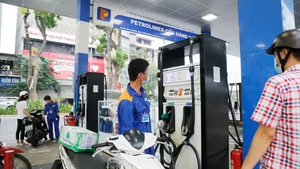
According to Viet Nam News Agency reporters’ observations on the morning of March 7, operations at several petrol stations across the city were running normally. Along major routes such as Giai Phong, Pham Van Dong, Nguyen Trai, Tran Khat Chan and the Ring Road 3 area, petrol stations remained open and continued to serve customers as usual. The number of vehicles refueling showed no major changes compared to the days before the price adjustment. Sales activities continued without interruption, and there were no long queues or supply disruptions.
Nguyen Thu Nga, an employee at a petrol station in Tu Liem ward, said: “After fuel prices were adjusted upward from March 5, the number of customers purchasing fuel has remained stable, mainly for private vehicles and transport trucks.”
A representative of a petrol station in the southern part of the capital said that supplies from wholesale distributors are still being delivered in full according to plans, ensuring sufficient fuel for residents and transport businesses.
Retailers said the recent price increase has not caused significant disruptions to business operations, as consumers have become accustomed to periodic fuel price adjustments. Although the market is currently stable, some fuel businesses noted they are closely monitoring global oil price movements to plan imports and reserves accordingly.
Several transport and service drivers said fuel costs are a major component of operating expenses. Therefore, when fuel prices rise, businesses and workers have to adjust vehicle usage plans to save costs. However, most believe the latest increase has not significantly affected daily life or production and business activities in the short term.
According to the Ministry of Industry and Trade, domestic fuel supply is currently largely ensured through a combination of domestic production and imports. The ministry has also requested enterprises to maintain the operation of their distribution systems and avoid hoarding, limited sales or unjustified closures.
Market surveillance forces in localities have been tasked with strengthening the inspection and monitoring of fuel trading activities in order to promptly detect and handle any violations.
In Ha Noi, the municipal Department of Industry and Trade said it will continue closely monitoring fuel supply and demand in the city while coordinating with market management forces to inspect retail outlets to ensure the market operates smoothly.
Economist Dinh Trong Thinh noted that the fuel market may continue to be affected by various international factors, including geopolitical tensions, fluctuations in crude oil supply, production policies of major oil-exporting countries and developments in the global economy.
According to Thinh, managing domestic fuel prices under a market mechanism with state regulation is necessary to balance the interests of the State, businesses and consumers while helping to maintain macroeconomic stability.
According to the joint announcement of the ministries, from 3 p.m. on March 5, domestic retail fuel prices were increased compared with the previous adjustment. Specifically, the price of E5 RON92 rose to more than 21,400 VND per litre (0.82 USD), while RON95-III increased to more than 22,300 VND per litre. Oil products also saw sharp increases, with diesel exceeding 23,000 VND per litre and kerosene above 26,000 VND per litre.
The authorities said the price adjustment was made in line with recent developments in the global fuel market. During the latest adjustment cycle, crude oil and refined fuel prices in the international market showed an upward trend due to factors such as supply fluctuations, geopolitical tensions in some regions and changes in production policies of oil-producing countries.
These factors directly affected the base price of domestic petroleum products, prompting regulators to adjust prices to ensure adherence to the market-based mechanism under state management.




![[Infographic] Viet Nam's 16 Comprehensive Strategic Partners](https://en-cdn.nhandan.vn/images/nyM650OGFWrOVWc-xajqN-rTZ68Rlmc1fiGJOhBRYHHdkBILL2hAdMw_FHcqH-128bTaQBSOAMd0_NcTypwz7H-j_NBZzuSdgF8ETMmVl1xLtdcCjym8rCUyKZqQgOZtC4ouMEzxlJoQ-MllehtjehDxIkn58uqaoaCRy4fSY54/1792513260540-1528117236743671738-1528117236743671738-9e797c256fe32c7c7b9c1cc03b0ca64e.jpg.avif)