Amid the rapid transformation of the Day River delta, the co-operative credit network in the former Ha Nam area (now within Ninh Binh Province) has become a standout example of a grassroots financial linkage model that is stable, transparent, and socially far-reaching. The tight connection between Co-opBank’s Ha Nam Branch and the People’s Credit Funds — across capital balancing, staff training and digitalisation — is strengthening system security and supporting local economic growth.
A bridge to modernising rural finance
To date, Co-opBank’s Ha Nam Branch has affirmed its role as the “bank of the People’s Credit Funds”, effectively performing capital-balancing functions and acting as a “safety valve” for the entire system.
According to Bui Dinh Thanh, Director of Co-opBank’s Ha Nam Branch, by the end of the third quarter of 2025, total liquidity-balancing deposits reached 839 billion VND, up 6.8% from the start of the year. This funding enables the funds to flexibly manage liquidity, proactively expand credit, and still maintain capital safety ratios.
Interest-rate policy has been adjusted in a flexible, transparent, and preferential manner — especially for well-performing funds such as Yen Bac, Chuyen Ngoai and Tan Son — helping to regulate cash flows across the system effectively.
Beyond capital balancing, Co-opBank has also expanded syndicated lending — an advanced form of co-operative credit that both disperses risk and broadens the capacity to serve customers with large borrowing needs.
As of September 30, outstanding syndicated loans between Co-opBank and the People’s Credit Funds stood at 143 billion VND, up 146% compared with the end of 2024. Of this figure, Chuyen Ngoai Fund recorded syndicated loan outstanding of 42 billion VND, while Yen Bac Fund reached 27 billion VND. These syndicated loans not only strengthen the funds’ competitiveness against commercial credit institutions but also generate income from cooperation fees.
Co-opBank’s support goes beyond capital, opening the door to digital transformation for the funds — often regarded as the “weakest link” in the co-operative finance chain. Since early 2025, 100% of People’s Credit Funds in the area have joined the CF-eBank e-banking system and the Cfe-PCF application to process operations online. New services such as CfeBiz, account-based payroll disbursement, collection services on behalf of customers, and digital-banking revenue sharing have been rolled out in a co-ordinated manner, helping the funds enter a phase of comprehensive digitisation.

In the co-operative credit system, workforce quality and supervision are two factors that are vital to survival. Co-opBank’s Ha Nam Branch regularly organises training courses in electronic transfers, digital banking and internal control, and works with the People’s Credit Fund Association to provide specialised training in credit, accounting and auditing. In 2025 alone, 104 managerial and operational staff from the 12 People’s Credit Funds were awarded payment-agent certificates — an important step in standardising operations.
Spreading community value through co-operative capital
Figures on outstanding loans, mobilisation and bad-debt ratios may seem dry, but they reflect something deeper: the vitality of the community economy. Capital from the People’s Credit Funds has been, and continues to be, directly nurturing thousands of small-scale production models, creating jobs and improving livelihoods for local residents.
Bui Duc Cuong (Lanh Tri Residential Group, Duy Tan Ward, Ninh Binh) has run a home-based weaving workshop for nearly a decade. Over the past two years, he has shifted from old shuttle looms to modern industrial machines to improve productivity and product quality, especially for silk items.
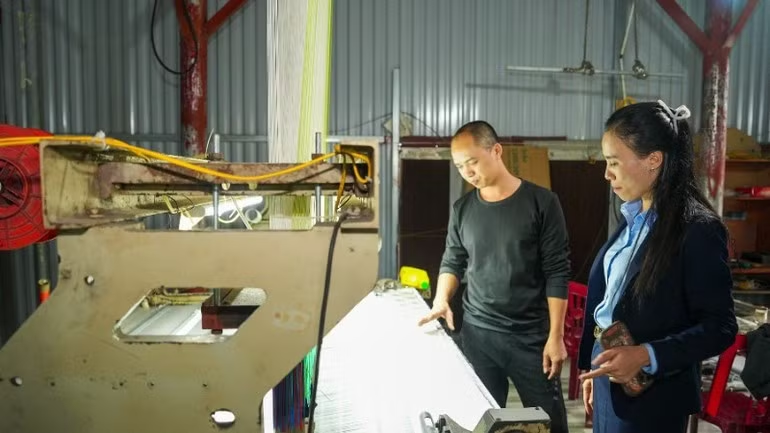
“Using industrial machines brings higher productivity and better production efficiency. The products are of higher quality than those made with the older machines. But this technology shift also means the family now requires more capital for purchases — from input materials to machinery,” Cuong said.
To address this capital challenge, Cuong approached Chuyen Ngoai People’s Credit Fund and received loan support.
To date, his outstanding loan at the fund has reached 600 million VND, used mainly to purchase machinery and as working capital to buy materials — especially at a time when silk prices are relatively high.
Similarly, the family of Luong Hong Thai (Duy Tan Ward, Ninh Binh) has also accessed a loan of 1.5 billion VND from Chuyen Ngoai Fund to run a grocery business and open a weaving workshop to develop textile and garment products. Thai said he had to borrow a large amount to invest in machinery and maintain working capital. As a result, he has not only been able to support his family’s life and earn additional income but also create more jobs for local workers.

These stories demonstrate the social role of cooperative capital flow — small but enduring — in boosting household economies and strengthening community trust. The People’s Credit Funds are also active in social movements such as contributing to the Fund for the Poor, the Education Promotion Fund, supporting disadvantaged households, and building new-style rural areas. As a result, the image of a “bank of the people, by the people and for the people” is being firmly reinforced.
The co-operative banking model is proving its lasting vitality amid the fierce competition of the financial market. The core lies not in asset size, but in system linkage — whereby each People’s Credit Fund does not operate in isolation but as a cell within a “shared body”, supported, shared with, and mutually supervised through Co-opBank.
With a solid foundation already in place, the People’s Credit Fund system is moving into a new stage of development: comprehensive digitisation, professional governance and stronger community linkage. The connection between Co-opBank and the People’s Credit Funds not only safeguards operational safety but also serves as a driving force for the co-operative economy, creating a platform for financial inclusion, where every citizen, whether in rural or urban areas, can access capital in a fair and sustainable way.