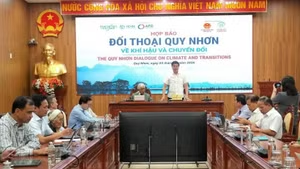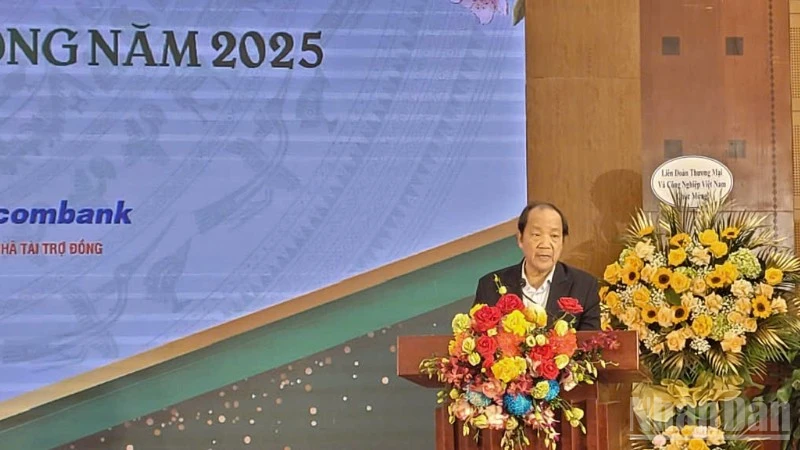
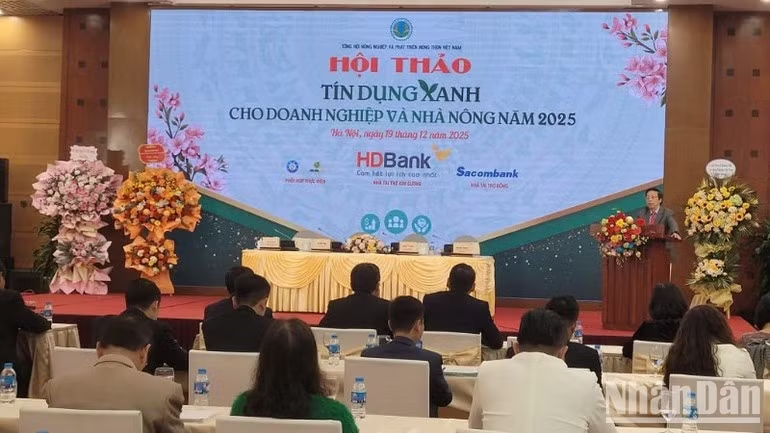
Within the framework of the programme, the Association coordinated with a number of ministries, agencies and sectors to organise the workshop “Green Credit for Enterprises and Farmers”, with the aim of promoting green production, circular agriculture, emission reduction and improving access to preferential capital sources for enterprises and farmers.
Speaking at the event, Ho Xuan Hung, Chairman of the Viet Nam Association of Agriculture and Rural Development, emphasised that in the context of Viet Nam implementing the Green Growth Strategy, committing to achieve net-zero emissions by 2050, and transforming the agricultural model towards sustainability, green credit plays a particularly important role in mobilising resources for development.
The communication programme “Green Credit for Enterprises and Farmers 2025” was implemented with the support of ministries, agencies, media organisations, experts and the business community. Through communication activities, surveys, training courses, capacity-building sessions and experience sharing, the programme reached hundreds of enterprises, contributing to raising awareness among enterprises and farmers about innovation, digital transformation, green, clean, circular and organic production, climate change adaptation and sustainable development. At the same time, State green credit policies and those of the banking system have been disseminated more widely to producers and agricultural enterprises.
However, in reality, demand for capital for environmentally friendly, energy-saving and low-emission agricultural production models is increasing, while access to green credit remains limited. Information on policies has not been disseminated widely enough; the ESG capacity (ESG: Environmental, Social and Governance – a set of criteria used to measure the level of sustainability and the impact of enterprises on the community) of many enterprises remains weak; and the legal framework and data systems serving the evaluation of green projects are not yet synchronised.
At the workshop, experts noted that as of November 30, 2025, outstanding green credit across the entire banking system was estimated at around 750 trillion VND, accounting for approximately 4.5% of total outstanding credit in the economy, with an average growth rate of over 21% per year from 2017 to the present. However, this scale remains disproportionate to the objectives of the National Green Growth Strategy for the 2021–2030 period, with a vision to 2050.
Representatives of several commercial banks shared experiences in implementing green credit. Tran Hoai Phuong, Director of the Corporate Banking Division of Ho Chi Minh City Development Joint Stock Commercial Bank (HDBank), said that in recent years HDBank has continuously rolled out green credit packages with preferential interest rates for many sectors such as infrastructure, digital technology, agriculture, and import–export. Sacombank has also launched its Green Finance product package (Sacombank Eco), aimed at supporting customers in sustainable development associated with environmental protection.
At the workshop, Ho Xuan Hung pointed out that although Decision No. 21/2025/QD-TTg has initially issued criteria for classifying green projects, the green credit market still faces many “bottlenecks”. These include banks’ lack of standardised databases on emissions and energy; interest rate incentives that do not yet create clear differentiation; and domestic standards that still differ from international practices. For enterprises, especially small and medium-sized enterprises, capacity to apply and report in accordance with ESG standards remains limited.
The workshop agreed to recommend that the State soon establish a national database on emissions and energy; improve incentive mechanisms and risk-sharing arrangements for green credit; enhance ESG capacity for enterprises; and complete the legal framework for green bonds in line with international standards. These are considered important conditions for green credit to truly become a driving force for sustainable development, especially in agriculture, a pillar of the economy.


![[In Pictures] Bridge columns and underpasses in Ha Noi begin to turn green](https://en-cdn.nhandan.vn/images/nyM650OGFWrOVWc-xajqN-rTZ68Rlmc1fiGJOhBRYHH_N-Xs0TE8Psnfce7ORTs-KVfoJaEblqjNufFrgeF3e2xFkGtLQVaXm04VcmMKBEkANUyiOkpz4zAuIKgydVrrfBxmGez0E_YJIag0u_Uil0E7jpuJXsIxeMmGjoY1-W4/1791863309074-2994714492692222878-2994714492692222878-adb9ff3f4175c70066ed8bb80cfbead9.jpg.avif)