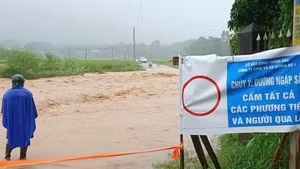
According to Pham Duc Luan, Director of the Viet Nam Disaster and Dyke Management Authority (VDDMA), natural disasters in Viet Nam in 2025 resulted in substantial losses, with 468 people killed or missing, 741 injured, and economic damage estimated at nearly 98.7 trillion VND (3.8 billion USD).
These losses were not only material in nature but also had long-term repercussions for the lives and livelihoods of millions of people. During the year, the country witnessed successive storms, record-breaking rainfall, and devastating landslides across many regions.
Against this backdrop, alongside emergency response efforts, disaster risk prevention and control were given particular emphasis.
The VDDMA advised on improving disaster response command mechanisms, ensuring no disruption as the country was reorganising its governance structure under the two-tier local government model.
In 2026, the VDDMA will continue to build on its experience, strengthen coordination, take proactive action, safeguard dyke systems, minimise loss of life and property, and stand ready to meet the increasingly demanding requirements.
Sharing his views on the issue, Senior Colonel Tran Tuan Anh, Deputy Chief of Staff of the Border Guard Command, noted that the application of technology and disaster monitoring software has enabled border guard forces to proactively deploy measures to issue warnings to vessels at sea and call them back to home, thereby minimising risks to fishermen.
However, he also recommended that the Ministry of Agriculture and Environment continue to study and invest in mooring facilities and storm shelters for fishing vessels, while intensifying reviews and assessments and implementing solutions to relocate residents from areas at high risk of flash floods and landslides.
To gradually reduce disaster-related losses and move towards zero fatalities, Senior Colonel Doan Van Than of the Department of Search and Rescue under the Ministry of National Defence stressed the need to innovate training programmes and drills in line with the “four on-the-spot” principle, closely linked to specific disaster scenarios for each locality, particularly high-risk areas.
This is especially important as the two-tier local government model comes into operation, requiring greater proactivity, flexibility and clearly defined responsibilities at the grassroots level.
Looking back at the developments of natural disasters in 2025, Deputy Minister of Agriculture and Environment Nguyen Hoang Hiep stated that while the year marked the country’s highest economic growth in the past 15 years, it was also the most severe year for natural disasters in history, with extremely abnormal developments that defied established patterns and shattered almost all historical records.
Nevertheless, under these exceptional circumstances, the entire system made concerted efforts to overcome difficulties with unity and determination, achieving the important result of reducing losses. Notably, in advising and directing disaster response, specialised agencies dared to act and take responsibility, confront new issues and even accepted risks, as reality demanded rapid change.
Alongside emergency response, post-disaster recovery was carried out swiftly, professionally and methodically. In particular, through the Quang Trung Campaign, housing support for people in disaster-affected areas was implemented decisively and effectively. By the upcoming Lunar New Year 2026, no one will have to celebrate Tet without a home.
In the years ahead, disaster prevention and control must be approached with new perspectives, underpinned by a long-term strategy, a clear guiding doctrine and well-structured plans.
In this process, science and technology, digital transformation and artificial intelligence will be key factors in enhancing proactivity, ensuring preparedness and avoiding being caught off guard.