Low-emission rice “goes North”
Le Thanh Tung, Standing Vice Chairman and Secretary General of the Viet Nam Rice Industry Association (VIETRISA), said: In 2025, VIETRISA developed 148 members (including organisations, enterprises, cooperatives and individuals). The Association also granted the trademark “Vietnamese Green Low-Emission Rice” to eight enterprises, covering an area of more than 18,000 hectares, with a corresponding certified rice output of 71,420 tonnes in the same year. In particular, Trung An High-Tech Agriculture Joint Stock Company was the first unit to successfully export 500 tonnes of rice bearing this trademark to the Japanese market in June 2025. In 2026, the Association expects to expand the application of technical processes, build more linkage models and complete the system of services supporting low-emission rice production.
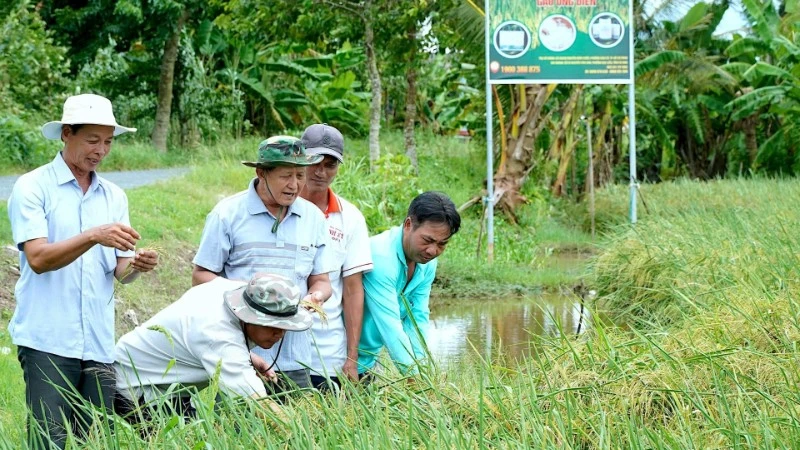
It is known that starting from pioneering models in An Giang, Dong Thap, Can Tho and other localities, farmers in the western region have recently boldly reduced seed rates, fertiliser use and irrigation water in rice cultivation. As a result, farmers have reduced costs, the soil has become healthier, and rice plants more resilient.
Accordingly, a summary of the implementation of the above project shows that in 2024 and 2025, through three cropping seasons, seven pilot models in Can Tho, Vinh Long, Dong Thap and An Giang helped reduce production costs by 8.2–24.2% compared to the control models. These results were achieved by reducing seed sowing rates by 30–50%, reducing fertiliser by 30–70 kg/ha, reducing irrigation water by 30–40%, and reducing 1–4 pesticide sprayings per crop compared to the control models. The above production process also contributed to increasing rice yields by 2.4–7%, with farmers’ income increasing by 4–7.6 million dong/ha compared to the control models. More importantly, this production process contributed to reducing greenhouse gas emissions by 2–12 tonnes of CO₂ equivalent/ha (depending on the application method).
After the positive results in the Mekong Delta, Bui Ba Bong, Chairman of the Viet Nam Rice Industry Association (Vietrisa), said that the agricultural sector plans to spread the model of high-quality, low-emission rice associated with green growth to the Red River Delta, on a scale of 500,000 hectares.
This step aims to replicate the effectiveness of reducing costs, increasing farmers’ income and cutting greenhouse gas emissions in rice production. In particular, localities in the Mekong Delta will continue to accompany VIETRISA to bring the Project on one million hectares of high-quality rice to completion on schedule by 2030.
More breakthroughs are needed
Talking about the Project on one million hectares of high-quality rice, Cao Duc Phat, former Minister of Agriculture and Rural Development (now the Ministry of Agriculture and Environment) and former Chairman of the Board of Trustees of the International Rice Research Institute (IRRI), emphasised: The Project helps maintain the effective development of the rice sector, improve farmers’ income and livelihoods, and at the same time address environmental issues and adapt to climate change.
Specifically, in economic terms, Phat analysed: The world produces about 800 million tonnes of rice each year, of which about 90% of output is concentrated in Asian countries. This 90% is found in eight countries, including India, China, Bangladesh, Indonesia, Viet Nam, Thailand, the Philippines and Myanmar. In Viet Nam, if production follows the process of the Project on one million hectares, as in the pilot models already implemented, Viet Nam will have the lowest production cost per 1 kg of rice among these eight countries, while farmers earn high profits.
Phat said at present, the Project has many favourable conditions in terms of direction, implementation methods, and the attention and response from farmers, enterprises and authorities at all levels. However, in the coming time, the relevant units need to achieve more breakthroughs, of which the most important is focusing on market expansion, so that the green and clean rice produced by farmers is sought after by enterprises and exported to the world at more deserving prices.
From local practice, Tran Chi Hung, Vice Chairman of the Can Tho City People’s Committee, pointed out: “Can Tho has the second largest rice-growing area in the region, only after An Giang Province. After two years of implementing the Project, the city has conditions to expand with the target of reaching about 170,000 hectares by 2030. However, the major difficulty at present is still small-scale production, and the linkage between cooperatives and enterprises is not yet tight. The measurement of greenhouse gas emissions, although processes and equipment are available, still has high costs and depends heavily on technical staff and experts.”
With An Giang – the largest rice granary of the Mekong Delta, Tran Thanh Hiep, Deputy Director of the provincial Department of Agriculture and Environment, said: In 2025, the area of high-quality rice accounted for 59% of the total production area of the province, and the locality aims to approach 70% in 2026. An Giang has established 375 high-quality rice zones with a system of nearly 700 cooperatives, about 46,000 members, and these are continuing to be upgraded. According to Hiep, in the coming time the Project will have many advantages when enterprises play a leading role, together with a community-based agricultural extension force that is being strongly reorganised at the commune level. This will be an important foundation to expand the recognition of the trademark “Vietnamese Green Low-Emission Rice” and promote deeper enterprise participation in the linkage chain.
From the business perspective, for the objectives of this Project to succeed, Huynh Van Thon, Chairman of the Board of Directors of Loc Troi Group Joint Stock Company, said that the important issue to be solved is to have a “breakthrough” in product output markets. Because without output markets, it is impossible to organise large raw material areas and fully implement all the ideas, aspirations and even the benefits of farmers. It is hoped that the Project on one million hectares of high-quality rice will resolve this bottleneck.
Can Tho City proposed that it is necessary to strengthen training, soon issue basic standards for emission measurement, and at the same time build a carbon market so that people can have real income from carbon certificates.
Tran Chi Hung, Vice Chairman of the Can Tho City People’s Committee
![[In Pictures] Bridge columns and underpasses in Ha Noi begin to turn green](https://en-cdn.nhandan.vn/images/nyM650OGFWrOVWc-xajqN-rTZ68Rlmc1fiGJOhBRYHH_N-Xs0TE8Psnfce7ORTs-KVfoJaEblqjNufFrgeF3e2xFkGtLQVaXm04VcmMKBEkANUyiOkpz4zAuIKgydVrrfBxmGez0E_YJIag0u_Uil0E7jpuJXsIxeMmGjoY1-W4/1791863309074-2994714492692222878-2994714492692222878-adb9ff3f4175c70066ed8bb80cfbead9.jpg.avif)