The province is gradually forming and developing concentrated, large-scale rice production areas that meet quality and safety standards.
To achieve this, the locality plans to establish a closed, sustainable and efficient ecological rice value chain from inputs–production–processing–trade–by-product recycling, bearing the distinctive Dong Thap brand, thereby contributing to enhancing the position and branding of Viet Nam’s rice in the international market.
From local realities
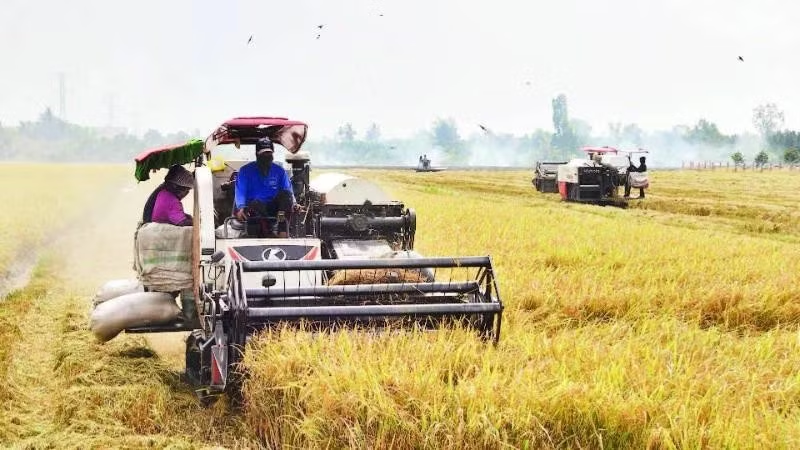
Dong Thap province has a total annual rice cultivation area of more than 603,000 hectares, with an output of about 4 million tonnes. Nguyen Van Hue, residing in Hamlet 5, My Thanh commune, has just harvested 0.9 hectares of the 2025–2026 winter-spring rice crop with a yield of 9 tonnes per hectare, sold at 6,100 VND/kg. After deducting all costs, the profit is less than 10 million VND. Hue said: “In recent years, many people in the area have converted rice land to fruit orchards. As a result, pests and rats have directly affected the remaining rice-growing areas, so the yield of each crop is not high. If rice prices do not increase and there is no profit, people here will gradually switch to growing fruit trees with higher quality and better profits.”
In localities in the eastern part of Dong Thap province, farmers mainly grow high-quality and specialty rice. However, profits for the whole crop are not high, even leading to losses, causing concern among many people. Tran Van Man, residing in Thanh Loi hamlet, Long Binh commune, has just harvested 0.5 hectares of Dai Thom rice with a yield of 8 tonnes per hectare, sold at 6,500 VND/kg. Man said: “This year, the weather is favourable so the harvest is good, but with the current rice price, farmers do not earn much profit. After more than three months of cultivation, we only earn a few million VND for 0.5 hectares of land, which is too low.” Huynh Van Danh, Director of Vinh Hien Company Limited, Phu Thanh commune, Dong Thap province, said: “We always purchase rice from farmers at a price 200 VND/kg higher than the market. However, if rice prices remain low for a long time, many people will continue to switch to growing fruit trees and vegetables with higher efficiency. Therefore, the State needs a long-term plan to maintain the rice-growing area of the locality.”
Need for a long-term plan
In order for rice farmers to have stable profits and maintain rice-growing land areas, Dong Thap province is developing a plan to become a rice economic hub not only serving the province but also acting as a regional nucleus in the ecological rice value chain of the entire Mekong Delta; performing functions of coordination, connection, technology sharing, market linkage and standardisation of production, processing and consumption processes.
According to the provincial Department of Agriculture and Environment, from now until 2030, Dong Thap strives for all households and cooperatives to participate in the project of one million hectares of high-quality, low-emission rice. 100% of cultivated areas will be synchronously mechanised; 80 % of production establishments and households will have electronic logs and digital traceability. 100% of straw, husk and major by-products will be collected, recycled and used effectively. By 2030, the province’s area of high-quality, low-emission rice cultivation will reach about 128,000 hectares, ensuring synchronisation in irrigation, infrastructure and farming conditions, contributing to improving farmers’ incomes, ensuring Dong Thap’s role as a core production area of the Mekong Delta region, and making a positive contribution to national food security and export turnover.
In addition, the rice economic hub of Dong Thap province is developed on the foundation of wet-rice cultural values and the tradition of diligence and creativity of local people, taking people as the centre, subject and driving force of development. All policies, models and activities of the hub aim to improve income, knowledge and spiritual life of people in rice-growing areas, ensuring social progress and equity; developing the hub in association with preserving and promoting traditional cultural values, indigenous knowledge and distinctive farming occupations, combined with science-technology and innovation to form models of ecological farmers, digital farmers and civilised farmers. This is the foundation for building a dynamic, cohesive and self-reliant new rural community capable of adapting to climate change and international economic integration.
According to the provincial Department of Agriculture and Environment of Dong Thap, the locality will focus on developing the hub towards integrating specialised functional networks such as: concentrated raw material production areas, logistics and processing–preservation zones; research, testing, training and technology transfer areas; commercial-service systems and by-product recycling infrastructure. The formation of these functional components will be implemented according to a multi-layered linked value chain model, ensuring synchronisation, consistency and efficiency across the region. The value chain linkage is developed on the principle of public–private partnership; in which the State plays a facilitating role, enterprises are the driving force for investment, cooperatives and farmers are the production subjects; at the same time, there is close coordination among localities in the region to optimise infrastructure, logistics costs and the competitiveness of the entire ecological rice value chain in the Mekong Delta region.