This trend is posing major challenges for Viet Nam’s agricultural sector in shaping a new management approach that is transparent and consistent throughout the entire production chain.
Changes in compliance assessment procedures
According to the Viet Nam SPS Office, from June 1, Decree 280 on the registration and management of overseas imported food producers issued by the General Administration of Customs of China (GACC), replacing Decree 248 (Order 248), will officially take effect. This represents not merely a procedural administrative change but a major shift in the way China manages imported food safety — moving from document inspection towards risk- and supply chain data-based management.
According to Nguyen Quy Duong, Deputy Director General of the Plant Production and Protection Department under the Ministry of Agriculture and Environment, the GACC will apply a comprehensive assessment mechanism for overseas food production, processing, and storage enterprises through a “multi-layered risk” approach.
Specifically, authorities will simultaneously examine multiple factors, ranging from the origin of raw materials and production-processing procedures to historical food safety data and methods of consumption.
In addition, post-registration supervision mechanisms will be tightened. Under the new regulations, the GACC may directly conduct or authorise relevant agencies to assess enterprises through various methods, including written inspections, video inspections, and on-site inspections. As a result, exporters to China will have to maintain continuous compliance, as inspections will no longer focus solely on the final stage but on the entire production chain.
Meanwhile, in the Korean market, the amended Food Sanitation Act (Act No. 21299) issued by the Ministry of Food and Drug Safety (MFDS) will officially take effect from December 31, 2026. A key change is the transition of the Hazard Analysis and Critical Control Points (HACCP) certification management system from paper-based documentation to a digital platform.
Under the new system, the MFDS will establish an “Integrated Management System for Food Safety Certification Standards,” allowing all information related to enterprises’ HACCP certification to be collected, analysed, stored, and provided digitally. At the same time, the authority will have the right to request HACCP-certified facilities to provide data for integration into the system, enabling more synchronised and comprehensive inspections and assessments.
In the US market, Le Hang, Deputy Secretary General of the Viet Nam Association of Seafood Exporters and Producers (VASEP), said that since early March 2026, regulatory agencies have continued tightening controls over the origin of imported seafood through the Seafood Import Monitoring Programme (SIMP). Importers are required to provide complete information on harvesting and farming origins, fishing vessels, fishing areas, and transportation routes throughout the supply chain. These data are stored within the electronic system of the US Customs and Border Protection (CBP) for monitoring and verification when necessary, thereby imposing increasingly stringent compliance requirements on exporting enterprises.
Standardising data across the entire supply chain
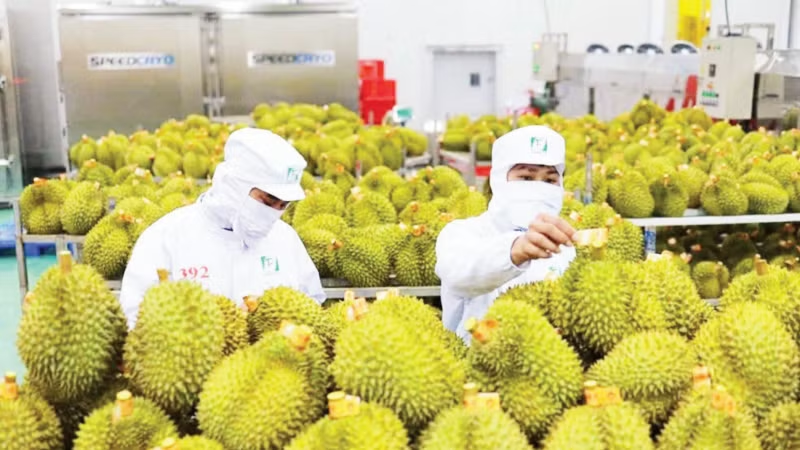
In response to increasingly stringent controls over the entire production, circulation, and export process for agricultural products, the Ministry of Agriculture and Environment launched the Viet Nam Agricultural Product Traceability System at the end of 2025, initially piloting it for durian from January 1, 2026. By early April this year, at Huu Nghi International Border Gate in Lang Son Province, the first durian shipment applying the “green lane” procedure based on a full-chain traceability system had been cleared through customs.
According to Le Minh Tam, Director of Thien Tam Agricultural Trading Co., Ltd — the enterprise whose shipment was the first to be cleared under the “green lane” process — the fundamental change lies in extending traceability to the very beginning of the production chain. Traceability labels are attached directly to the fruit stem during harvesting. The products are then transported to packing facilities for sorting, QR code labelling for each carton, container identification coding, and completion of electronic documentation.
However, several businesses believe that for wider implementation across multiple product sectors, the process still requires further refinement. In practice, attaching labels directly in orchards may generate considerable costs, as not all harvested products ultimately meet export standards after sorting. This requires more careful calculations regarding data standardisation procedures to ensure both economic efficiency and information transparency requirements.
As one of Viet Nam’s major export sectors to markets such as the US, the RoK, and China, the seafood industry is also facing growing demands for innovation in supply chain data governance.
To avoid export disruptions, VASEP expert Tran Hoang Yen said enterprises need to review and standardise their entire documentation systems through digitalisation, ensuring rapid traceability for each shipment, production stage, and control point. Businesses should also proactively work with import partners to unify document structures, templates, and methods of data provision when requested, while rechecking consistency among HACCP records, quality dossiers, traceability records, and export documentation.
From the perspective of state management, in January 2026 the Government issued Decree No. 37/2026/ND-CP detailing several articles and measures for implementing the Law on Product and Goods Quality. The decree includes provisions on digital product passports and electronic product labels, including for agricultural, forestry, and fishery products, aimed at establishing a traceability mechanism based on electronic data and unique identification codes for each product.