The Office of the US Trade Representative (USTR) announced the findings of its Section 301 investigation into unfair trade practices. The USTR concluded that 60 economies failed to take reasonable measures to prevent the circulation of products made with forced labour, placing the US at a disadvantage in trade competition.
US proposes additional 12.5% tariff
Based on these findings, the agency proposed an additional 10% tariff on goods from Canada, Ecuador, the EU, Indonesia, Mexico, Pakistan, Argentina, Bangladesh, Cambodia, El Salvador, Guatemala, Malaysia, Taiwan (China), and the UK. For the remaining 45 economies covered by the investigation, including Viet Nam, the proposed additional tariff is 12.5%.
Assessing the impact of the proposed measure, the research division of KB Securities Viet Nam (KBSV) believes the new tariff policy is unlikely to have a major adverse effect on Viet Nam’s export outlook or foreign direct investment (FDI) inflows. Most of Viet Nam’s key exports to the US that account for a large share of export value are excluded from the tariff list, primarily high-tech electrical and electronic products.
The tariff proposed for Viet Nam is also not significantly different from those imposed on competing economies. Indeed, the 12.5% rate is lower than the previous 19% rate under the International Emergency Economic Powers Act (IEEPA).
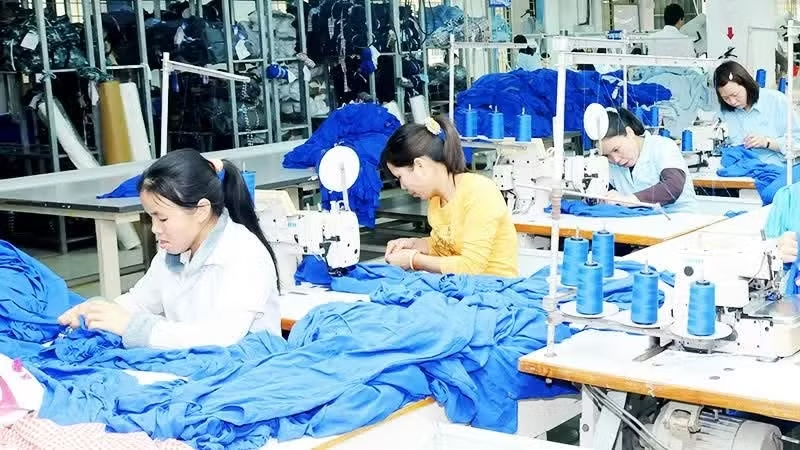
For the textile and garment sector, Viet Nam is currently the largest importer of US cotton in the 2024–2025 marketing year, accounting for around 45–50% of the industry's total cotton imports. Viet Nam’s position as a major customer for US cotton could be an advantage when the USTR considers preferential tariff mechanisms for textile and garment products.
This provides a basis for Viet Nam to be allocated a certain quota eligible for more favourable tariff treatment if the tariff mechanism is formally adopted. Textile and garment companies with a high proportion of cotton imports from the US, such as TCM, ADS, and Vinatex, are expected to benefit.
As a result, the proposed tariff for Viet Nam is on par with those applied to major exporting powers such as China, India, Japan and the Republic of Korea (RoK). Viet Nam is therefore unlikely to be placed in an isolated position and may be able to reduce the risk of losing market share to larger export competitors.
Meanwhile, the Viet Nam Chamber of Commerce and Industry (VCCI) warned that the new policy developments from the US could significantly increase risks for the export business community. As Viet Nam’s largest export market, the US directly affects the competitiveness and profit margins of key industries including textiles and garments, footwear, furniture, electronics, and seafood if the additional 12.5% tariff is implemented.
According to the VCCI, the risks are even greater because the USTR investigation report specifically mentions two sensitive supply chains: raw cotton and polysilicon, a key input for solar panel manufacturing. Both sectors may face closer scrutiny in the period ahead.
Opportunities remain
However, the door remains open. The tariff proposal is still in the consultation stage and has not yet taken effect. According to the USTR’s timetable, stakeholders have nearly one month to submit comments before public hearings begin on July 7, 2026.
The VCCI considers this a pivotal period for government agencies, industry associations, and exporters to participate in the consultation process. Businesses should urgently review their supply chains, assess their dependence on the US market, and quantify potential impacts should the tariff proposal be approved. Such data will form an important basis for submissions to the USTR.
For industry associations, the VCCI called for closer coordination with member companies to develop common arguments, propose expanding the list of excluded products under Appendix A for Viet Nam’s major export items, and clarify practical efforts to combat forced labour.
As the representative body of the business community, the VCCI will continue serving as a focal point for collecting and consolidating feedback from enterprises and industry associations before conveying it promptly to relevant US authorities. It also recommends that businesses not wait until the tariff measure is officially enacted before responding. Instead, they should make full use of the current consultation period to protect their legitimate interests while contributing to a stable, transparent, and sustainable trade environment between Viet Nam and the US.
Section 122 of the Trade Act of 1974 authorises the US President to impose temporary import restrictions, including additional tariffs or quotas, for up to 150 days to address balance-of-payments issues. Section 232 of the Trade Expansion Act of 1962 allows the US to impose tariffs or import restrictions on national security grounds. In addition, traditional trade defense tools such as anti-dumping, anti-subsidy, and anti-circumvention investigations may continue to be used.
Building legal and financial support mechanisms for businesses
From the business perspective, Ngo Sy Hoai, Secretary General of the Viet Nam Timber and Forest Products Association, said that a Section 301 investigation is not the only instrument that can exert pressure on exports. The US administration still has a range of legal mechanisms available to adjust import policies and could even adopt measures with a greater impact if deemed necessary for economic or trade objectives.
If such measures are introduced, Vietnamese exporters will face considerable pressure on costs and profitability. When import tariffs rise, US importers often seek to negotiate burden-sharing arrangements with suppliers, forcing exporters to adjust prices, accept lower profit margins, or even maintain orders at minimal profitability.
Furthermore, tariff measures may prompt importers to delay contract signings, split orders into smaller batches, or wait for further policy signals, making it more difficult for businesses to plan production, manage inventories, and maintain cash flow.
Regarding solutions, Hoai argued that businesses need to move beyond a reactive mindset and focus on building long-term resilience. The first priority is to diversify export markets and reduce dependence on the US, which currently accounts for more than 50% of Viet Nam’s timber export turnover. At the same time, companies should expand into markets such as the EU, China, Japan, RoK, Canada, Mexico, the Middle East, South America, and Southeast Asia by leveraging existing free trade agreements.
Alongside market diversification, businesses must strengthen compliance capabilities, closely monitor raw material sources, improve supply chain transparency, and complete traceability systems to reduce the risk of investigations or allegations of tariff circumvention. Digital transformation, data standardisation in corporate governance, stronger trade defence capabilities, and close cooperation with industry associations are also becoming increasingly important requirements.
From a policy perspective, the State should strengthen its trade remedy early-warning system, establish legal and financial support mechanisms for businesses facing investigations in the US market, and promote bilateral dialogue aimed at achieving a more stable tariff framework.
“Support policies for credit access, green transition, and competitiveness enhancement will provide the foundation for businesses to maintain sustainable growth amid increasing volatility in global trade,” Hoai stressed.