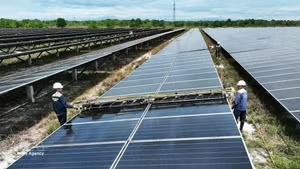
Alongside their strengths in innovative thinking and technological aptitude, young people in Viet Nam are benefiting from favourable national development conditions.
Research by Dr Tran Nguyen Thi Tam Dan of the Ha Noi University of Natural Resources and Environment reveals that today’s young generation adapts rapidly to new technologies, enabling them to access and apply digital tools effortlessly in developing entrepreneurial ideas.
“Young people tend to be more open to emerging values, including environmental protection and sustainable development. They also have a strong ability to spread ideas through social media and communities. Their initiatives often extend beyond the individual level, creating a broad ripple effect that facilitates the development of green business models,” Dr Tam Dan noted.
According to the 2025 Global Innovation Index, Viet Nam ranks 34th out of 132 economies worldwide. The country is currently in the golden population period, with a young population well positioned to embrace science and technology under highly favourable conditions. This yields immense potential for digital content creation and other industries requiring creativity and technology.
A series of key policies issued by the Party and the State have established a legal framework and injected potent momentum for the development of the creative economy. Notably, Politburo Resolution 57, issued in December 2024, places innovation at the centre of national development.
Government Decree 17, issued in April 2023, which sets out regulations on copyright and digital copyright management, has created a legal foundation for young people to pursue creative economy start-ups in the digital era. The emergence of thousands of technology-based enterprises provides clear evidence of expanding entrepreneurial opportunities in digital content creation and related technologies.
Dr Ngo Dac Thuan of Becamex R&D Institute emphasised that Resolution 57, together with decisions issued by the government and ministries and implemented consistently from central to local levels, has established a policy framework to support the development of the innovation start-up ecosystem.
This framework covers the entire innovation process, from research, testing, and product development to workforce training, digital infrastructure investment, blockchain applications, intellectual property registration and protection, access to digital markets, and product commercialisation.
At the same time, Viet Nam’s young, dynamic population and widespread habit of consuming content across multiple social media platforms engender highly favourable conditions for developing digital content products.
However, these opportunities are coupled with significant challenges, particularly as technological advances are outpacing both institutional reform and the development capacity of the start-up ecosystem.
According to Dr Tam Dan, young entrepreneurs in the creative economy will face challenges related to copyright, content regulation, and existing governance mechanisms. Although the legal framework has improved considerably, it has yet to keep pace with the rapid development of technology.
The rapid rise of artificial intelligence (AI) has spawned unprecedented issues surrounding authors’ rights, reproduction rights, the use of data to train AI models, and the handling of copyright infringement in the digital environment. These developments have made the enforcement of sanctions and the protection of copyright increasingly complex.

A shortage of human resources, particularly highly qualified professionals in science and technology, together with limited financial capacity and implementation capability, remains one of the main barriers facing most start-ups. As a result, many struggle with creative skills, content development, access to finance, copyright insurance, and investment in sustainable business models.
In addition, copyright issues, the regulation of AI-generated content, and digital infrastructure that has yet to meet growing demands persistently expose start-ups to considerable difficulties and risks.
According to the State Agency for Technology and Innovation under the Ministry of Science and Technology, in addition to improving policies and the legal framework, Viet Nam has introduced numerous incentives for innovative enterprises and technology start-ups. These include tax incentives, financial assistance, preferential loans, innovation vouchers, specialised stock markets, and venture capital funds to support the start-up ecosystem.
Nevertheless, the challenges posed by AI highlight the urgent need to strengthen the legal framework governing AI-generated works, related rights, digital evidence, and principles for handling cross-border infringements.
The capacity of the innovation ecosystem must also be augmented to enable businesses to achieve sustainable growth.
Regulatory authorities should further simplify and digitise administrative procedures, establish innovation development funds, invest heavily in training highly skilled technology professionals, expand digital infrastructure coverage, and develop effective monitoring and management platforms.
Expedited enforcement against violations and stronger international cooperation to address cross-border infringements should also be prioritised.
In the longer term, the emergence of large-scale technology enterprises and a fair, competitive business environment will provide the foundation for the sustainable development of the creative economy.
Alongside policies encouraging innovation-driven entrepreneurship, Viet Nam should foster the growth of major technology corporations and leading research centres.
At the same time, appropriate regulatory mechanisms and enforcement measures are needed to ensure a level playing field for technology firms, preventing market dominance by larger companies, reducing the exodus of highly skilled talent overseas, and effectively controlling unlawful activities.