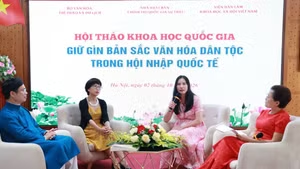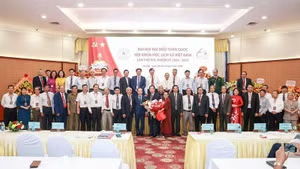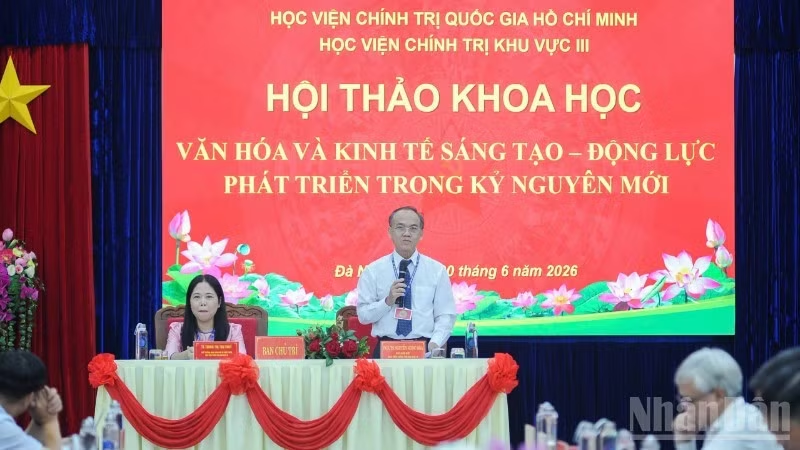
The scientific conference entiteld “Culture and the creative economy – Drivers of development in the new era,” organised by the Academy of Politics Region III on June 30, attracted numerous papers and contributions from scholars, policymakers and business representatives. The event provided valuable theoretical and practical insights to support the formulation of policies for the development of culture and the creative economy in Viet Nam.
Alongside the rapid expansion of the knowledge economy, digital technologies, artificial intelligence (AI) and deepening globalisation, creativity has become one of the most important productive forces. Within the creative economy, cultural values are increasingly being transformed into high value-added products, services and economic assets.
According to Associate Professor Dr Nguyen Ngoc Hoa, Deputy Director of the Regional Academy of Politics III, when unlocked through creative thinking, cultural capital becomes an inexhaustible renewable resource that grows richer the more it is utilised, overcoming the limitations of finite natural resources.

At the conference, Dr Vo Van Loi, Dean of the Faculty of Political Economy at the Academy of Politics Region III, noted that in the digital economy, the relationship among culture, the creative economy and digital technology is multidimensional and interactive, with each element serving both as an input and as an outcome of the broader development process.
According to Dr Loi, within this framework, culture serves as the primary resource, the creative economy acts as the transformative driving force, while the digital era, underpinned by technology and data, functions as the catalyst for breakthrough development.
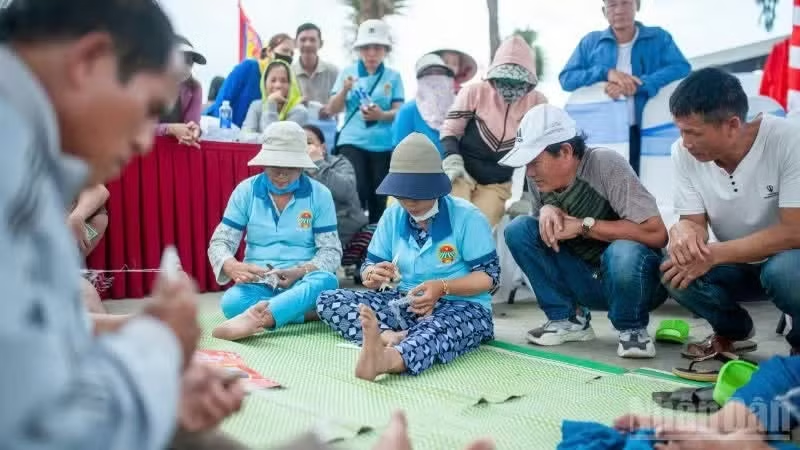
Experience from recent years shows that provinces and cities in Viet Nam's Central and Central Highlands regions, home to rich layers of cultural heritage ranging from architecture and maritime culture to extensive intangible cultural assets, have begun proactively harnessing these resources.
Against this backdrop, many participants at the conference emphasised that cultural enterprises are the key actors in transforming cultural values into economic value.
At the conference, Associate Professor Dr Nguyen Ngoc Hoa, Deputy Director of the Academy of Politics Region III, stated that experience has shown that wherever local authorities proactively work alongside businesses and embrace digital technologies, traditional cultural values become a sustainable source of livelihood for local communities.