Partnership to enhance value
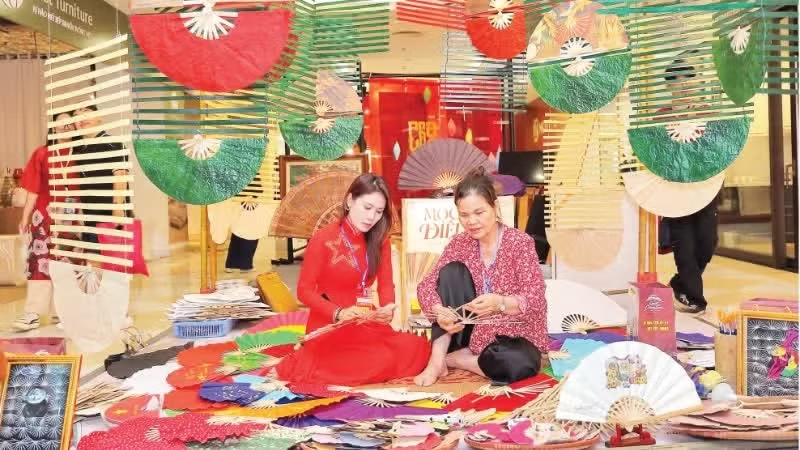
A shopping centre on Nguyen Trai Street in Ha Noi was transformed into a showcase for handicrafts and products inspired by traditional crafts in mid-June 2026.
Among the highlights featured a chair design named Vong Ha, whose structure evokes the ceremonial hammocks once used in traditional processions. Its traditional character is reflected in dragon-head carvings on the carrying poles, while the backrest incorporates bamboo and rattan weaving.
Another seemingly ordinary yet striking exhibit was a shoe cabinet created by combing woodworking and bamboo-and-rattan weaving techniques. The unique fusion of the two crafts yielded a product that felt both elegant and distinctly Vietnamese.
These were just two of many products developed under the Craft Development Programme Based on Craft Village Heritage, an initiative launched by the Ha Noi Department of Culture and Sports. The programme brings together village artisans and a creative community comprising designers, artists, and students from art and architecture institutions.
Editor-in-Chief of Architecture Magazine and Architect Bui Thi Thanh Huong said: “We were truly impressed by products inspired by traditional crafts. Designers, particularly younger ones, have successfully brought the beauty of traditional craftsmanship into contemporary life. Many of these creations have made traditional crafts appear more refined and sophisticated.”
Meanwhile, Pham Thi Lan Anh, Head of the Heritage Management Division under the Ha Noi Department of Culture and Sports, noted: “The creators retain the intellectual property rights to their products. However, through their interactions with artisans, especially in the case of students, they have also introduced new perspectives that inspire artisans to experiment with different materials, combine various crafts, and develop fresh design ideas.”
Ha Noi is home to 1,350 craft villages and thousands of designers and artists. According to Director of the Ha Noi Department of Culture and Sports Pham Tuan Long, many craft villages struggle to innovate designs and expand market access, while designers and artists often lack opportunities to engage directly with traditional craft knowledge.
“In response, Ha Noi launched the Craft Development Programme Based on Craft Village Heritage, creating conditions for artisans and designers to work together on research and product development. Artisans not only provide knowledge but also become creative partners from the earliest stages of idea formation, while designers gain direct access to traditional craft expertise to create products that meet market demand,” he said.
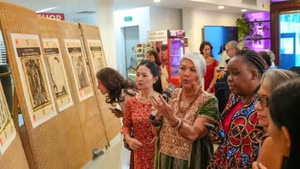
To foster a sustainable partnership between creative professionals and craft village artisans, designers, artists, and students of art and architecture have been encouraged to engage in dialogue and collaborative activities. These interactions serve as a platform for generating ideas and exploring opportunities for joint product development.
One notable activity involved 400 students from the University of Industrial Fine Arts visiting craft villages to learn directly from artisans.
Nguyen Van Tinh, an artisan from Phu Vinh bamboo-and-rattan craft Village in Phu Nghia Commune, said: “I have won a number of awards for my bamboo-and-rattan designs, but collaboration with designers and creative professionals still offers significant benefits. We gain access to new perspectives from young designers. For example, I plan to work with fashion designers to create handbags made from bamboo and rattan. During the process, we also provide feedback to designers, especially students, helping them develop designs that are more practical and applicable.”
Designer Luu Quoc Thang highly praised the initiative, describing it as a model that links education, creativity, and heritage. He said it enables young designers and students to develop professional skills while fostering a sense of responsibility for preserving and promoting traditional cultural values.
Potential for craft villages to reach global markets
Ha Noi currently has four craft villages that have joined the World Crafts Cities Network: Bat Trang ceramics, Van Phuc silk, Chuyen My mother-of-pearl inlay, and Son Dong woodcrafts.
To gain admission to the network, craft villages must meet stringent criteria relating to heritage value, innovation, government support, community participation, and development potential.
Nguyen Viet Huan of the Son Dong Craft Village Artisans Association said: “Membership in the World Crafts Cities Network opens unprecedented opportunities for our products to become part of the world's finest craft traditions and enhances their competitiveness in international markets.”
The potential for tapping into and promoting the value of craft villages, as well as the opportunities for these villages to reach the global stage, remains enormous. The city is home to many renowned traditional craft villages, including Phu Vinh bamboo-and-rattan weaving, Ha Thai lacquerware, Chuong conical hats, Chang Son fans, and Quat Dong embroidery.
However, many villages still face limitations in meeting the expectations of international consumers. Son Dong Village in Hoai Duc Commune, for example, is one of the city’s most economically successful craft villages. Yet, its main products remain religious and ceremonial items such as statues, altars, and palanquins, while more creative and lifestyle-oriented products account for only a small share of production.
Membership in the World Crafts Cities Network opens unprecedented opportunities for our products to become part of the world's finest craft traditions and enhances their competitiveness in international markets.
Nguyen Viet Huan from the Son Dong Craft Village Artisans Association
Ha Noi’s Craft Development Programme Based on Craft Village Heritage needs to go beyond providing forums for dialogue and interaction. Future efforts could include organising immersive learning programmes that allow designers and students to study directly with artisans, launching design competitions inspired by cultural heritage, and selecting and funding 10 collaborative projects between artisans and creative professionals.
Such initiatives would serve as a robust bridge connecting artisans with the design and creative community to generate new products.
Among handicraft products, gifts and souvenirs exert a particularly strong cultural influence. This category has attracted growing attention from experts and researchers because many handicrafts, while aesthetically appealing, do not always meet consumer needs. Reimagining craft heritage to better align products with market demand is therefore increasingly important.
Dr Lu Thi Thanh Le of the School of Interdisciplinary Sciences and Arts under Viet Nam National University, Ha Noi, said: “When purchasing handicraft products, particularly gifts and souvenirs, consumers often have specific criteria. Authentic identity is one of the most important considerations for many people. Personally, in addition to cultural identity, I value reasonable pricing and ease of transportation. Others may place greater emphasis on practical usefulness or the cultural story behind a product. These are all factors that artisans and creative professionals should take into account when developing handicraft gifts and souvenirs.”