In reality, Viet Nam has no shortage of unique heritage that embodies the nation's cultural, historical, and intellectual depth. However, if efforts remain focused solely on preservation or conventional forms of exploitation, the value of this heritage will struggle to become a source of competitive strength in the creative economy.
Although Viet Nam is home to more than 40,000 historical and cultural sites and scenic attractions as well as nearly 70,000 items of intangible cultural heritage, including 38 elements inscribed by UNESCO, much of the country's heritage remains neither digitised, standardised nor integrated into shared databases. It has yet to be effectively protected and exploited as intellectual property, or transformed into digital knowledge, creative products, and resources for education, cultural industries, and artificial intelligence.
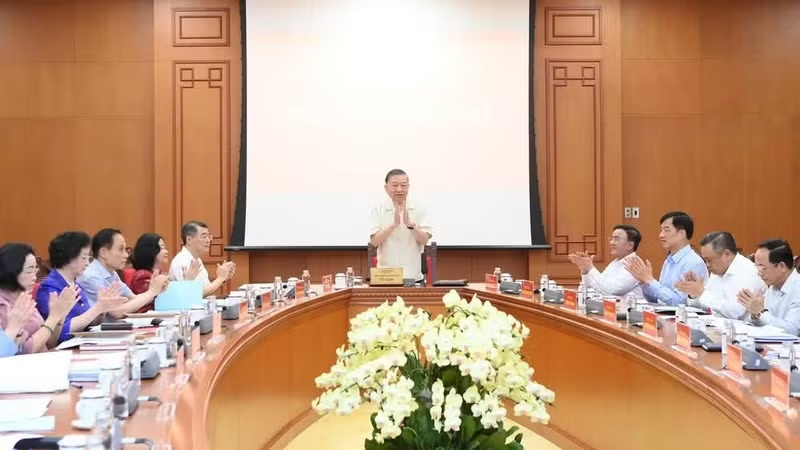
The assessment by Party General Secretary and State President To Lam highlights one of the key shortcomings facing the cultural sector today and underlines the urgent need to turn Viet Nam's vast heritage into an endogenous resource for development in the digital era.
According to Dr Nguyen Thu Hanh, Director of the Centre for Research and Development of Viet Nam Cultural Industry (S-DCI), efforts have for many years been focused mainly on preserving heritage rather than transforming it into new forms of value.
The principal bottleneck lies in the lack of capacity to connect heritage with science, technology, education, design, communications, and the market. As a result, while Viet Nam possesses abundant cultural resources, their economic value, educational contribution, and social impact remain modest. In other words, the country has plenty of "raw materials" but lacks an ecosystem strong enough to convert them into drivers of national development.
The "gap" highlighted by Party General Secretary and State President To Lam is therefore not simply a matter of technology or digital transformation. More fundamentally, it reflects shortcomings in the way heritage is understood, utilised, and promoted. Party General Secretary and State President To Lam stressed the need to transform heritage and cultural capital into knowledge; intellectual property; creative products; and resources for education, science, technology, cultural industries, and innovation.
He also stressed that heritage digitisation should not become a box-ticking exercise focused merely on increasing the proportion of digitised assets. Heritage data must have proper identification, provenance, technical standards, and the capacity to be searched, connected, shared, and reused. Every dataset and every digitised heritage asset should be managed as a form of property capable of generating scientific, cultural, and economic value.
Preserving culture in the digital era is not simply about safeguarding heritage, it is about ensuring that heritage continues to thrive in contemporary life. Digitisation should not be carried out merely for storage, but to support education, creativity, and wider dissemination, thereby enabling heritage to become a resource for development, cultural industries, and Viet Nam's artificial intelligence industry.
Party General Secretary and State President To Lam
Party General Secretary and State President To Lam affirmed that preserving culture in the digital era is not simply about safeguarding heritage, it is about ensuring that heritage continues to thrive in contemporary life. Digitisation should not be carried out merely for storage, but to support education, creativity, and wider dissemination, thereby enabling heritage to become a resource for development, cultural industries, and Viet Nam's artificial intelligence industry.
According to Dr Nguyen Thu Hanh, appropriate mechanisms are needed to promote closer links among culture, technology, education, tourism, design, communications, and creative businesses in order to establish a complete value chain, while sustainable mechanisms also need to be introduced towards protecting and commercialising intellectual property.
She also called for greater investment in innovation models based on heritage so that heritage is not only preserved and retold, but also experienced, interpreted through dialogue, and continually reimagined, thereby creating new value for both culture and the economy.
From a legal perspective, lawyer Le Quang Vinh, Director of Bross & Partners Intellectual Property Company, argued that developing the heritage economy requires placing it at the intersection of multiple legal frameworks, including the Law on Cultural Heritage, the Law on Intellectual Property, the Law on Data, and the Law on Management and Use of Public Assets, together with regulations governing digital transformation and artificial intelligence.
In particular, he said it is essential to clearly identify the different layers of value embedded in heritage, ranging from the core heritage itself to intellectual property assets, data assets, digital assets, state-owned assets, and community assets derived from it. Properly identifying these different layers will provide the basis for establishing appropriate mechanisms to manage and exploit each type of asset generated from heritage.