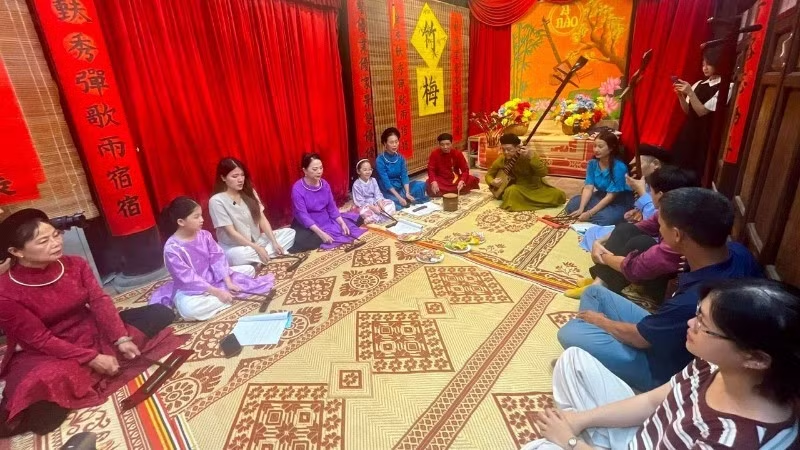
At this special class, what is passed down is not merely the techniques of singing, playing the clappers or the lute, but also a love of, appreciation for and responsibility towards preserving the precious cultural heritage handed down by previous generations.
Persevering in reviving ancient repertoire
Few people know that before becoming a renowned ca tru singer, Meritorious Artist Nguyen Thi Van Mai was involved in cheo singing (Vietnamese traditional opera) and chau van singing (spiritual singing), two other traditional Vietnamese art forms. A turning point came in 1990, when she happened to hear People's Artist Quach Thi Ho perform Ty Ba Hanh (Song of the Pipa) on the radio.
“I was immediately captivated from the very first lines and wondered how such a distinctive style of singing could exist,” Artist Van Mai recalled. From then on, she became determined to pursue ca tru, regarding it as a lifelong passion.
At this special class, what is passed down is not merely the techniques of singing, playing the clappers or the lute, but also a love of, appreciation for and responsibility towards preserving the precious cultural heritage handed down by previous generations.
At the time, very few people studied this art form, while many of its master practitioners were already at an advanced age. She repeatedly sought out teachers but was often turned away. Undeterred, she continued to approach experts and researchers to borrow old recordings, from which she taught herself the singing styles of renowned ca tru singers such as Dinh Thi Hao, Dinh Thi Ban and Chu Thi Nam.
For more than a decade, she gradually deepened her knowledge of ca tru while tirelessly practising techniques such as breath control, diction and vocal ornamentation. As a result, when she sings, audiences can appreciate not only the resonance and depth of her voice but also its subtlety and emotional expressiveness.
In 2007, Meritorious Artist Van Mai won a Gold Medal at the National Ca Tru Festival. This achievement gave her even greater motivation and confidence in the path she had chosen. More importantly, in addition to teaching herself to sing, she gradually revived ca tru repertoires that had seemingly been lost.
One notable example is Non Mai Hong Hanh, a repertoire that had disappeared for more than 70 years before she successfully restored it in 2009. She also revived pieces such as Mua Hat Bai Bong and Mua Hat Don Dai Thach. To date, Artist Van Mai can perform nearly 40 ca tru repertoires — a substantial body of traditional knowledge that few ca tru singers possess.
Spreading the love of heritage
Concerned about the gradual disappearance of ca tru repertoires, in 2008 Artist Van Mai and her husband, Meritorious Artist Tran Van Truc, decided to establish a ca tru class at Bich Cau Dao Quan. There, Artist Van Mai passionately teaches ca tru melodies and singing techniques, while Artist Tran Van Truc provides detailed instruction in playing the ceremonial drum and dan day.
For nearly two decades, the class has charged no tuition fees and has welcomed learners of all ages. The couple's only hope is that more people who love ca tru will come and persevere in learning the art, giving these traditional sounds a chance to be passed on to future generations. To keep the class running in the long term, the couple have quietly used income from their family business to cover its expenses.
Initially, the class had only a few students who were friends or relatives. Over time, however, more and more people learned about it and came to study. Besides students from Ha Noi, there are also learners from Hung Yen and Hai Phong. The class currently has around 25 regular students.
According to Artist Van Mai, learning to sing ca tru requires not only talent but also rigorous practice. As a result, some students attend only a few sessions before giving up, while others become deeply inspired and have remained with the class for more than a decade.
Notably, some students have gone on to become established ca tru singers and instrumentalists, including singers Bach Yen, Minh Hang and Hong Pha, lute player Tran Koong, and ceremonial drum player Thanh Hung. Some of them have returned to support the couple by guiding new students and helping them improve their singing and instrumental techniques.
Alongside maintaining the class, in 2018 the couple founded the Bich Cau Ca Tru Theatre, creating a free performance space on weekend evenings. The venue gives students an opportunity to gain stage experience while also bringing ca tru closer to the public.
Notably, many performances combined with ca tru cultural experiences have been held at Bich Cau Dao Quan for domestic and international visitors. International tourists have shown great enthusiasm, enjoying ca tru performances while listening to artists explain the characteristics, history and cultural value of the heritage. They can also try playing the wooden clappers themselves and sing the opening lines of Hong Hong Tuyet Tuyet.
The free teaching and performance stage at Bich Cau Dao Quan are not intended merely to train ca tru singers and instrumentalists. They also aim to spread a love of the heritage and build a community of audiences who care about, participate in and contribute to preserving and promoting ca tru.
Artist Tran Koong, Deputy Director of the UNESCO Ha Noi Centre for Traditional Arts and co-founder of the Bich Cau Ca Tru Theatre
Artist Tran Koong, Deputy Director of the UNESCO Ha Noi Centre for Traditional Arts and co-founder of the Bich Cau Ca Tru Theatre, said that free ca tru classes and performances at Bich Cau Dao Quan are intended not only to train singers and instrumentalists, but also to spread a love of the heritage and build a community of audiences who share an interest in preserving and promoting ca tru.
At the venue, Artist Tran Koong and the couple also guide groups of university students working on essays, projects and graduation theses on cultural heritage in general and ca tru in particular, giving young people more opportunities to approach and explore the heritage through first-hand experience.
Although UNESCO inscribed ca tru on the List of Intangible Cultural Heritage in Need of Urgent Safeguarding in 2009, the art form continues to face numerous challenges. What particularly concerns Meritorious Artist Van Mai is that a number of ca tru repertoires now exist only on paper, while teaching activities in many places have suffered from distortion and inconsistent transmission.
Therefore, the immediate priority is to record and film the ca tru repertoires that artists still preserve today, so that they can be digitised, standardised and archived. At the same time, strategies for transmission must be developed and more performance spaces created so that artists can make a living from their craft.
This is also the way to ensure that ca tru heritage can develop sustainably and continue to evolve alongside contemporary life.