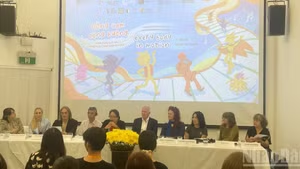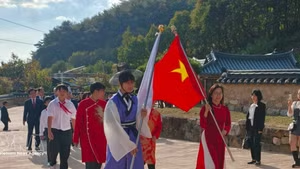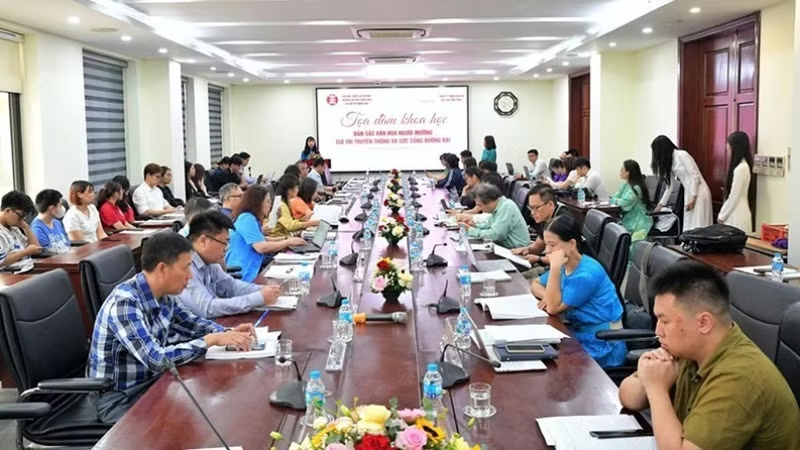
The event was participated in by numerous researchers, experts, managers, lecturers, students, and representatives from localities where Muong communities live.
Participants at the seminar agreed that the culture of the Muong people should not only be preserved as a heritage of the past but also promoted as a valuable resource for sustainable development.
Preservation efforts should be closely linked with education, cultural tourism, cultural industries, creative economy, and digital transformation. At the same time, they should respect the leading role of local communities, strengthen intergenerational knowledge transmission, and enhance cooperation among research institutions, management agencies, localities, and businesses.
According to Assoc. Prof. Dr. Dang Thi Thu Huong, Vice Rector of the University of Social Sciences and Humanities under Viet Nam National University, Ha Noi, the Party and the State are currently giving special attention to cultural development, recognising culture as both the spiritual foundation of society and an internal resource and key driving force for rapid and sustainable development.
In the field of preserving and promoting the traditional cultures of ethnic minority groups, the approach has shifted from "preservation for safeguarding" to "preservation for development", placing local communities at the centre of heritage protection and recognising culture as a resource for sustainable development, development of tourism, cultural industries and the creative economy.
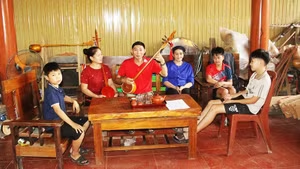
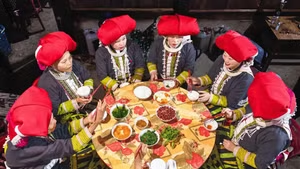
As one of the oldest communities in Viet Nam, the Muong people have preserved a rich cultural heritage, including their language, Muong Mo rituals, gong culture, indigenous knowledge, stilt-house architecture, life-cycle ceremonies, community institutions and many valuable forms of traditional folk culture.
These are not only the elements that shape the cultural identity of the Muong community but also contribute to the richness and diversity of Viet Nam's unified national culture.
Nguyen Xuan Trung, Director of Tam Chuc Tourism Services Company Limited and representative of the organising committee, said: "Beyond helping us better understand the culture of the Muong people, the research results affirm an even greater value: cultural diversity is a source of national strength. Studying and preserving the cultures of Viet Nam's ethnic groups is not only about safeguarding heritage but also about strengthening national unity, sovereignty and the nation's enduring strength for future generations."
Assoc. Prof. Dr. Nguyen Truong Giang from the University of Social Sciences and Humanities under Viet Nam National University, Ha Noi, noted that in Ninh Binh Province, local historical records and heritage management documents show that the Muong population is concentrated mainly in Nho Quan District and parts of Tam Diep City. Heritage practices are centred in Nho Quan, where a large Muong community continues to preserve many traditional cultural features.
Experts affirmed that Muong cultural tourism should be developed based on a community-centred approach. By placing the community at the heart of the process, the Muong people should not merely be the subjects of research, performances or promotion. Instead, they must play the leading role in deciding how their cultural heritage is preserved, passed on to future generations and promoted.