Damage caused by natural disasters
Before 1993, many heritage structures in Hue had deteriorated due to war, the passage of time, and natural disasters. The inscription of the Complex of Hue Monuments on UNESCO’s World Heritage List marked a new phase in conservation efforts. Numerous monuments have since been restored and rehabilitated, but extreme weather continues to take its toll on architecture that has stood for centuries.
Preliminary records indicate that An Hoa Gate in the Hue Citadel was damaged by lightning in 2008, while the Quoc Tu Giam, or Imperial Academy, suffered a fire in the summer of 2022. At Hue Nam Temple, a heritage site situated on sloping ground overlooking the Huong River, heavy rain caused a landslide behind the temple complex in the early 2020s, and the riverbank in front eroded.
Areas at risk of landslides and falling rocks have been monitored, with reinforcement measures planned since 2023. The prolonged flooding in November 2025 also caused erosion and subsidence affecting several stone embankments around canals and lakes within the system of monuments dating from the Nguyen dynasty.
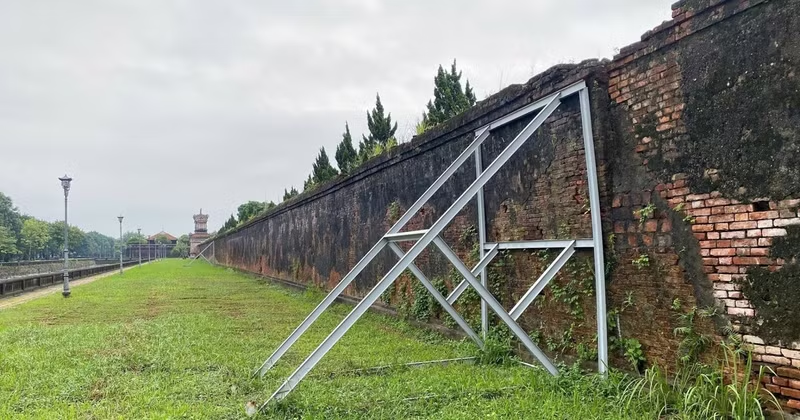
Following the collapse of the section of the citadel wall, Director of the Hue Monuments Conservation Centre Hoang Viet Trung said that an inspection at the time had found that the binding materials at the collapsed site and in sections of the wall that had tilted out of alignment had virtually lost their effectiveness, having deteriorated after centuries of exposure.
In response to the deterioration, the Hue Monuments Conservation Project Management Board formulated plans for restoration and rehabilitation. The proposed works, with a total estimated budget of around 80 billion VND, will cover the walls of Hue Imperial Citadel and the stone embankments surrounding the moat of the Imperial City. The project is expected to restore more than 2,400 metres of the citadel walls and more than 5,700 metres of walls and stone embankments along the moat.
Historical records from the Nguyen dynasty document major floods in 1844, 1864, and 1904, with intervals of approximately 20 and 40 years between the successive events. Since 1999, meanwhile, Hue has experienced severe floods in 1999, 2020, 2023, and 2025. The Nguyen dynasty selected elevated sites in western Hue for royal tombs to reduce their exposure to flooding.
During peak floods, rising water levels submerge access roads to the tombs, erode some areas at the foot of hills, and cause localised flooding in ornamental lakes. In the low-lying areas, however, the duration of inundation across many parts of the city and within heritage sites appears to be increasing. Hue Imperial Citadel provides the clearest example.
According to construction engineers, when water drains away slowly, the ground, wall foundations, brickwork, stonework, and surrounding landscapes remain exposed to moisture for longer. For structural elements already weakened by age, each prolonged period of submersion adds further stress. The duration of inundation should therefore be assessed as a distinct factor in evaluating the risk of heritage deterioration, alongside flood frequency, water levels, and intensity.
Preserving the protective layers around heritage sites
Before the storm and rainy season, the Hue Monuments Conservation Centre carries out reinforcement and anchoring work, inspects roofs, walls, embankments, and vulnerable locations, and prunes trees at risk of falling. However, protecting heritage sites from natural disasters involves more than repairing structures after damage has occurred.
According to Deputy Director of the Hue Monuments Conservation Centre Le Cong Son, these efforts require scientific and technological support and must also take greenery and the surrounding landscape into account. Ancient trees are inspected and assessed to ensure safety while preserving their landscape value.
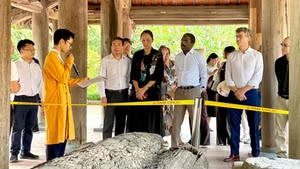
Hue has also organised seminars and round-table discussions with Japanese and Korean experts on adapting heritage conservation to natural disasters. Their contributions have highlighted the need to tailor responses to the characteristics of each site, rather than applying a single formula across the board. According to Son, modern technology can provide valuable support, but solutions must be suited to individual monuments and build on local experience.
Architect Nguyen Thanh Tung, who has conducted extensive research on Hue’s heritage sites, argues that buffer zones around monuments should also be considered a layer of protection. Construction should be restricted in these areas, with priority given to green spaces and natural terrain.
In addition, drainage capacity within and around heritage sites needs to be enhanced, particularly in low-lying areas frequently affected by flooding. Drainage systems should be reviewed, cleared, and adapted to the terrain and landscape to ensure that water can be drained from the sites more quickly after heavy rain and floods.
According to Tung, when structures were built during the Nguyen dynasty, buffer zones may not have been established as a separate requirement for protecting monuments against natural disasters. At the time, many surrounding areas may still have been forested or covered by natural vegetation, providing a buffer without the need for formal planning of the kind required today. Over time, these spaces have changed alongside the development of transport infrastructure, housing, and new construction. This is a factor that must be considered when planning buffer zones and landscapes as part of efforts to safeguard heritage sites from natural disasters.
Reinforcing structures before the storm and rainy season is an essential and ongoing task, but the long-term resilience of heritage sites also depends on how the surrounding areas are managed. Preserving buffer zones, controlling land use, conserving natural terrain, trees, water bodies, and drainage systems can provide additional layers of protection for monuments. As rainfall and flooding become increasingly unpredictable, assessing flood frequency, water levels, the duration of inundation, and retention time within heritage sites will help make conservation efforts more proactive.