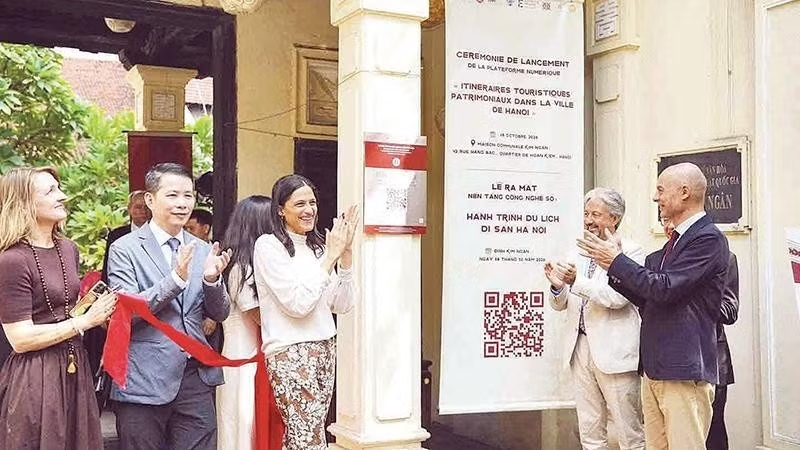
The “Ha Noi Heritage Tourism Itineraries” platform offers a new approach to presenting the capital's monuments and heritage sites. By visiting the website https://heritage-itineraries.com/, users can explore a digital map featuring 28 heritage sites, mainly in the inner-city area, particularly the Old Quarter, connected through four thematic routes distinguished by different colours. These routes comprise the Four Guardian Temples of Thang Long, featuring Bach Ma, Voi Phuc, Quan Thanh and Kim Lien temples; temples dedicated to the Mother Goddess, including Dong Ha Temple, Vu Thach Communal House, Ba Kieu Temple and Tay Ho Palace; communal houses dedicated to craft founders, including Kim Ngan, Dong Lac and Pha Truc Lam communal houses; and a group of pagodas in Ha Noi, including Bao Thien Pagoda, which no longer exists, as well as Lien Tri, Ham Long and Lien Phai pagodas.
Twenty-eight heritage sites represent a small number compared with the thousands of sites in Ha Noi. However, the selection of these four thematic routes enables visitors to explore several major and highly representative aspects of the city's heritage system and the spiritual and religious life of its residents. In particular, each site offers more than the general information commonly provided. Visitors can access a wealth of knowledge, including scholarly descriptions, historical and contemporary photographs, videos, excerpts from stone inscriptions, Sino-Nom documents and architectural drawings.
For example, at Quan Thanh Temple, in addition to photographs, documents and videos, visitors can view the original Chinese-character stone stele, erected in 1893, together with its complete translation of meaning, as well as the system of horizontal lacquered boards and parallel couplets inside the temple. This approach caters to sightseeing needs while also enabling those seeking a deeper understanding of the sites to acquire substantial knowledge.
After exploring https://heritage-itineraries.com/, Nguyen Minh Ngoc, a student at the University of the Capital, said: “I have always enjoyed learning about Ha Noi's heritage sites, and I have learnt a great deal from the ‘Ha Noi Heritage Tourism Itineraries’ platform. It is like a companion when exploring Ha Noi, and it makes me want to visit every heritage site featured on the platform.”
“Ha Noi heritage tourism itineraries” is a digital platform established through cooperation between the University of Social Sciences and Humanities under Viet Nam National University, Ha Noi, the French Embassy in Viet Nam and the French Institute in Viet Nam, with support from the French Ministry for Europe and Foreign Affairs and several other agencies. The platform also provides QR codes that enable tourists to learn about heritage sites when visiting them in person.
Launched in late 2025, the “Ha Noi heritage tourism Itineraries” platform has now officially become operational. Over nearly a year, almost 40 experts and 100 students surveyed more than 100 heritage sites and collected photographs, stone inscriptions, Sino-Nom documents, architectural drawings and videos. Based on this work, the research team selected representative sites, compiled scholarly dossiers and organised the materials along thematic routes. Compared with other heritage digitisation solutions, the platform adopts a more visual approach, enhances interactivity and caters to a wide range of audiences.
As a member of the team responsible for designing the platform's digital map, Dr and architect Nguyen Thai Huyen, Deputy Director of the Institute of International Training at Ha Noi Architectural University, said: “When individual heritage sites are connected into themed itineraries, visitors have more opportunities to recognise the relationships between structures, from their historical origins to their architectural characteristics and religious practices. The value of the platform lies not only in making information available in the digital environment but also in its ability to encourage the public to engage more closely with heritage spaces in the real world.”
The Department of Culture, Sports and Tourism will connect the platform to the city's tourism information portal and promote it through domestic and international tourism promotion programmes. This will make the repository of materials more accessible to residents and visitors while creating an additional channel for showcasing the capital's heritage.