The result of a long-term research process
Since the central area of the Thang Long Imperial Citadel was inscribed on UNESCO's World Heritage List in 2010, Ha Noi authorities and relevant agencies have intensified efforts to research, preserve and promote the site's heritage values. Historical upheavals left Kinh Thien Palace, once the venue for royal court audiences, largely in ruins. At the time of the site's World Heritage inscription, the former palace foundations were occupied by an Artillery Headquarters building constructed by the French in the early 20th century.
The city has conducted numerous archaeological excavations covering more than 10,000 square metres. Four excavation campaigns have been carried out in the area of the Kinh Thien Palace foundations alone.
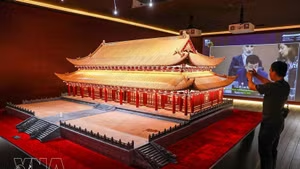
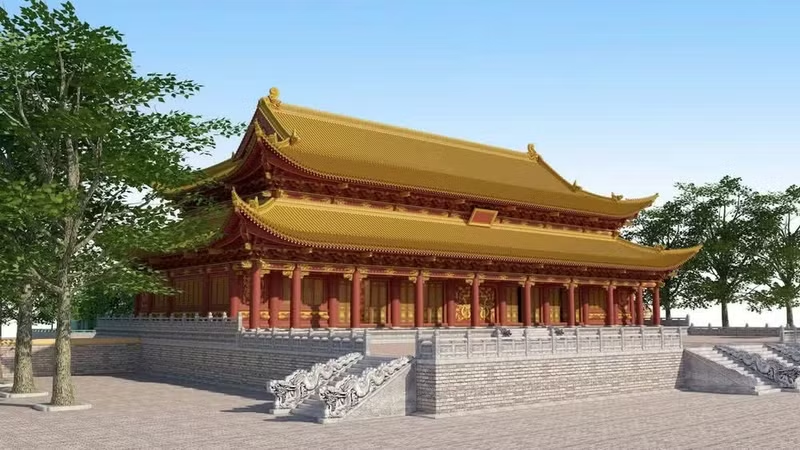
The city has conducted numerous archaeological excavations covering more than 10,000 square metres. Four excavation campaigns have been carried out in the area of the Kinh Thien Palace foundations alone. Kinh Thien Palace was designed according to the cuu ngu chi ton principle, symbolising supreme imperial authority, with nine bays across its width and five bays in depth.
Associate Professor Tong Trung Tin, who has overseen archaeological research at the Imperial Citadel of Thang Long for decades, said: "Kinh Thien Palace was an extraordinarily magnificent structure. Of its nine bays across the width, the central bay alone measured 6.9 metres, with the adjoining bays gradually becoming narrower. The building was also exceptionally deep, with its deepest section measuring 7.2 metres. We can calculate that Kinh Thien Palace covered an area of up to 1,585 square metres. This was an enormous structure, even when compared with palaces in many other countries. Throughout my research career, I never imagined that I would have the opportunity to uncover something of such profound historical and spiritual significance." Beyond the foundation system, evidence of the palace's structural framework and roof has also gradually emerged.
Professor Nguyen Quang Ngoc, Vice President of the Viet Nam Association of Historical Sciences, commented: "Previously, we knew Kinh Thien Palace only through historical records. However, archaeological findings at the Imperial Citadel of Thang Long have demonstrated that ancient accounts of the citadel and Kinh Thien Palace were entirely accurate. I have long maintained that if we fail to restore Kinh Thien Palace and allow the public to see what the royal palace once looked like, we will be failing both our ancestors and future generations."
A great friend of Vietnamese heritage
Throughout the years of research, conservation and promotion of the Thang Long Imperial Citadel, experts from UNESCO and the International Council on Monuments and Sites (ICOMOS), an advisory body to UNESCO, have provided continuous support.
Associate Professor Tong Trung Tin explained: "Whenever we undertake excavations or carry out any intervention affecting the heritage site, UNESCO and ICOMOS experts closely supervise the process because both organisations attach great importance to preserving the integrity of heritage."
Throughout the research process, Viet Nam has consistently and responsibly implemented recommendations from UNESCO and ICOMOS. As a result, many Vietnamese proposals have received UNESCO's endorsement. For decades, UNESCO had not approved the dismantling of structures within World Heritage sites. However, following the discovery of significant archaeological remains of Kinh Thien Palace beneath the former Artillery Headquarters building, together with Viet Nam's systematic and scientifically grounded approach, UNESCO adopted Decision 46 COM 7B.43 in 2024, permitting the controlled dismantling of all six buildings occupying the palace's central area, including the Artillery Headquarters. This decision paved the way for more extensive research into Kinh Thien Palace.
At the 48th session of the World Heritage Committee, held in Busan, the Republic of Korea, in July, UNESCO adopted Decision 48 COM 7B.25 concerning the vision for renovating and restoring the central axis of the Imperial Citadel of Thang Long. UNESCO commended Viet Nam's efforts to safeguard and promote the heritage values of the Imperial Citadel of Thang Long and approved the implementation of the Kinh Thien Palace restoration project.
Translating interdisciplinary scientific findings into the reconstruction of a structure that had almost entirely disappeared presented considerable challenges. However, with support from UNESCO and ICOMOS, these difficulties have gradually been overcome.
Nguyen Thanh Quang, Director of the Thang Long–Ha Noi Heritage Conservation Centre, said: "ICOMOS provided guidance on assessing the reliability of research findings used in the restoration of Kinh Thien Palace through a framework comprising five categories of information: historical documents, archaeological evidence, visual materials, domestic comparisons and international comparisons. Given the large number of valuable artefacts discovered, we added another category covering the intrinsic value of the artefacts themselves.
A total of 50 architectural components and details belonging to the palace's foundations, structural framework and roof were authenticated using this framework. As a result, the proposed architectural restoration of Kinh Thien Palace has not only been clearly substantiated but can also be quantified, verified and made transparent through its incorporation into architectural design drawings. For architectural elements where the level of authenticity remains uncertain, ICOMOS has also provided guidance on the most scientifically appropriate restoration methods."
Notably, the research and restoration of Kinh Thien Palace have also provided a basis for Viet Nam to propose practical recommendations for the Ha Noi Document on Heritage and Authenticity, scheduled to be announced at the closing session of the Asia-Pacific Regional Dialogue on September 30. The document addresses the authenticity of reconstructed architectural heritage that has been destroyed, with the aim of safeguarding the authenticity of heritage attributes and Outstanding Universal Value.
Lazare Eloundou Assomo, Director of the UNESCO World Heritage Centre, highly appreciated the cooperation between Viet Nam and UNESCO in preserving and promoting cultural heritage over the years.
In particular, the collaborative research conducted by Vietnamese scientists and experts from the World Heritage Centre and UNESCO Office in Viet Nam on the Imperial Citadel of Thang Long and Kinh Thien Palace as an exemplary process of dialogue. This cooperation demonstrates Viet Nam's consistent commitment to the standards and credibility of the World Heritage Convention, not only as a State Party but also as an active member currently serving as Vice-Chair of the World Heritage Committee.
The conservation, renovation and restoration of Kinh Thien Palace represent an initial step towards gradually restoring the central space of the Imperial Citadel of Thang Long, thereby bringing the nation's historical and cultural values into sharper focus.
Ha Noi has also researched and revived various royal court rituals, including the Kitchen Gods worship ceremony, the ceremonial erection of the neu bamboo pole and the royal calendar presentation ceremony. By combining research, restoration and the promotion of both tangible and intangible cultural heritage, the Imperial Citadel of Thang Long is expected to realise its heritage potential more fully, particularly through the development of cultural industries in the years ahead.