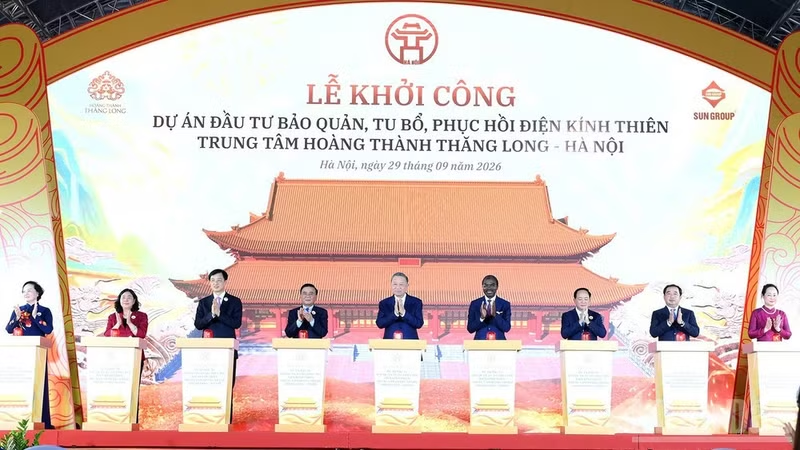
Addressing the ceremony, Chairman of the Ha Noi People’s Committee Vu Dai Thang said the Thang Long Imperial Citadel was inscribed on the UNESCO World Heritage List in 2010. It embodies the outstanding universal value of a site that served as the centre of national power continuously for more than 13 centuries, as evidenced by its overlapping cultural strata and surviving architectural traces.
Within this space, Kinh Thien was the principal palace of the Forbidden City of Thang Long under the Le Dynasty (1428 -1789). According to the Dai Viet Su Ky Toan Thu (The Complete Annals of Dai Viet), construction began in 1428 under King Le Thai To and was completed under King Le Thanh Tong (1442–1497), on the foundations of principal palaces dating back to the Ly and Tran dynasties.
It was the centre of political power and royal ceremonies, where the court held audiences, conducted major ceremonies and received envoys. It was also the highest symbol of the national power of Dai Viet from the 15th to the 18th centuries.
The conservation, restoration and rehabilitation of Kinh Thien Palace must be carried out on a scientific basis, with maximum respect for original elements, archaeological and historical evidence, and interdisciplinary research findings, while preserving the archaeological remains already unearthed.
The Ha Noi People’s Committee Chairman stressed that the capital city views heritage conservation as an integral part of its development strategy.
In his welcoming remarks, Lazare Eloundou Assomo, Director of the UNESCO World Heritage Centre, acknowledged the distinctive feature of the Thang Long Imperial Citadel, namely its unique continuity as a centre of political and cultural power for nearly 13 centuries. He said the site holds profound significance for Viet Nam’s history and identity while also serving as an exceptional testament to the shared history of humanity.
The value of the site lies not only in its archaeological remains and historical structures, but also in the layers of history, memories and traditions they preserve, as well as the strong ties between the heritage site and Ha Noi’s people.
Kinh Thien Palace, which is deeply connected with this history, is an important component of the World Heritage Site. The restoration project marks the beginning of a new phase of stronger cooperation among Viet Nam, UNESCO, the International Council on Monuments and Sites (ICOMOS) and the World Heritage Committee, he said.
General Secretary and President Lam and other delegates visited an exhibition on the authenticity of the Kinh Thien Palace restoration and the Kinh Thien Palace space.
Inscribed by UNESCO as a World Heritage Site in 2010, the Thang Long Imperial Citadel embodies outstanding historical, cultural, archaeological and architectural values, reflecting more than a thousand years of the development of Thang Long-Ha Noi.
The conservation, restoration and rehabilitation of Kinh Thien Palace goes beyond recreating an architectural structure. It aims to gradually restore the central space of the Thang Long Imperial Citadel and highlight the historical and cultural values of the nation.
Restoring Kinh Thien Palace and its associated spaces is an important task marking the beginning of the implementation of the vision for the central axis of the Thang Long Imperial Citadel through 2035, based on the 100-year vision of Ha Noi’s master plan.
The project has been prepared on the basis of 15 years of interdisciplinary research into history, archaeology, architecture and intangible heritage, as well as comparisons with relevant cases in the region. Domestic and international scientists have participated in the process, together with in-depth consultations with UNESCO and ICOMOS.