A family tradition handed down
The narrow road, winding through the chilly autumn mist like a length of rope left behind by forest workers, led us to Phuc Loc. Here, everyone from the village elders to the youngest children knows the family of artisan Ma Van Truc. Their stilt house, nestled against a mountainside and overlooking the tranquil Nang River, has long been a living museum of cultural heritage.
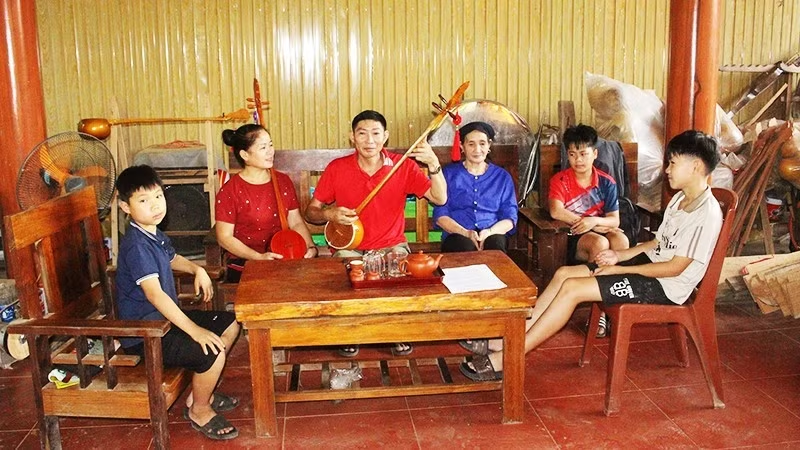
Even before we entered the courtyard, the clear, resonant notes of the dan tinh filled the air. Beneath the veranda, hundreds of dried gourds were arranged by size, and stacks of timber in one corner gave off a faint scent. Inside the main living area, it felt like stepping into a small showcase of traditional music. Dan tinh lutes hung prominently on the dark wooden walls, while neatly kept notebooks of transcribed ancient Then lyrics bore the marks of time.
“Then singing and dan tinh playing are crafts our ancestors passed down through the generations. They are not only part of our spiritual life but also a livelihood,” said Phung Thi Hanh, Truc’s mother, who is nearly 80 years old. Her frail hands gently cradled a dan tinh that her son was finishing.
Generation after generation, the men of the Ma family have been respected Then masters, trusted by villagers to perform rituals for peace and good harvests during festivals and New Year celebrations. Truc is the fourth generation to carry on the tradition.
His younger sister, Ma Thi Day, who performs under the stage name Bao An, has also been immersed in the sounds of the dan tinh and Then singing since childhood. At just 10, she took to the stage with confidence at a national singing competition. Every member of the family has chosen to pursue the traditional arts of their ethnic group.
In 2019, Day founded the Sac Cham Club, which has since grown into one of the largest and most active folk arts clubs, operating professionally and helping to preserve and promote ancient Then melodies.
Her efforts extend well beyond her local community. Day has brought traditional music to remote villages, organised displays of ethnic attire, and supplied finely crafted dan tinh lutes to enthusiasts of Tay and Nung culture nationwide.
“The more deeply I explore this heritage, the more I realise the vastness of the treasure trove of Then lyrics and dan tinh artistry left by our ancestors. I am proud to have been born into a family with such a rich cultural tradition, and I always seek out veteran artisans and respected researchers to broaden my knowledge and refine my skills,” Day said.
Recalling his childhood, Truc said: “I was born in Vi Huong Commune, formerly part of Bach Thong District, at a time when life was still very difficult. Simply being able to attend school was a major achievement, let alone receiving formal training in arts and culture. But the sounds of the dan tinh and Then singing performed by our grandparents and parents had been ingrained in us since we were toddlers. My sister and I learnt to pluck the strings and sing along with the adults from an early age. As I grew older, I wanted not only to sing but also to make instruments with the finest possible sound, so that the melodies could reach further.”
Truc’s bond with traditional music deepened in 2009 when, while working at the Culture and Information Office of the former Ba Be District, he met Dong Thi Vien, a colleague who sang Then sweetly and played the dan tinh skilfully. The two fell in love and married.
United by the same passion, the couple decided to devote themselves to making instruments, teaching, and performing at events that promote local culture.
Their perseverance over the years has earned them certificates of merit and medals from both national and local authorities. In late 2023, Truc was awarded the title of Folk Artisan by the Viet Nam Folk Arts Association. He is currently under consideration for the Meritorious Artisan title.
What keeps the Ma Van Truc family’s cultural tradition so vibrant is not formal instruction but the way knowledge is passed down through everyday life. Music and singing are integral to the household, as natural as the rhythms of the surrounding mountains and forests.
The Ma family’s love of Then singing continues to flourish among its younger members. Truc’s daughter, Ma Ngoc Anh, now a Grade 12 student, began singing Then at three and was playing the dan tinh proficiently by six. She regularly accompanies her parents to performances in various localities.
“My most memorable experience was taking part in the 2018 National Then Singing and Dan Tinh Festival in Ha Giang with my parents. Our group’s performance won an A prize, and I was honoured to receive a special award for being the youngest participant,” Anh said.
Inspiring a love of playing and singing
Truc carefully worked a small plane along the curve of a lute neck. Paper-thin shavings fell to the ground, swirling in the afternoon breeze.
Beside him, his youngest son, 13, curiously examined the angles of the instrument’s soundboard. From time to time, he gently plucked the nylon strings waiting to be fitted and tuned, then turned to watch his father intently and imitate his movements.
A dan tinh lute consists of just a dried gourd, a wooden neck and three nylon strings. Yet crafting an instrument that truly captures the soul of traditional music demands meticulous attention and exceptional skill.
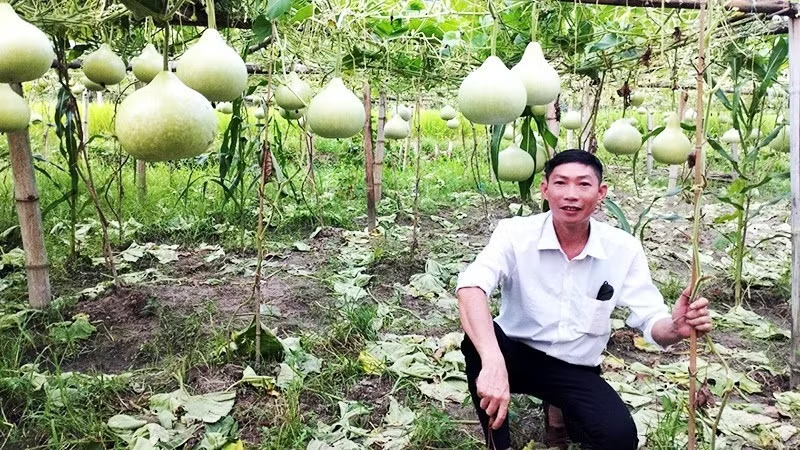
The gourd determines half of the instrument’s sound quality. It must be round, with a base and shell of the right thickness. After harvest, the pulp is removed and the gourd is either soaked in clear limewater or left in the night dew for months, so that its shell reaches the ideal hardness and resists decay and insect damage.
The length of the neck is carefully gauged by the player’s hand size or by traditional measurements, then manually carved to give the instrument both an attractive appearance and a comfortable balance when held.
The most demanding stages are fitting the soundboard and tuning the instrument.
When fitting the soundboard, the craftsman must stretch the material tightly and drive the securing pins in evenly. Even the slightest deviation can make the sound dull or shrill, robbing it of its natural warmth and depth.
When carving the sound holes and tensioning the strings, the craftsman needs an exceptionally keen ear. He repeatedly plucks the strings and adjusts the tuning pegs until the notes sound both resonant and mellow.
Every dan tinh Truc crafts is built to these exacting standards, which give his instruments their distinctive tone.
His instrument-making business has also created jobs for local residents. To secure a reliable supply of quality materials, he has partnered with many households to buy the gourds they grow.
For many years, Truc and his wife have crafted instruments while also running classes for learners of all ages.
Whenever local authorities organise traditional arts courses, the couple put aside their own work to teach, striving to pass on every melody and playing technique.
In 2016, Truc established a Then singing and dan tinh club, which brought local enthusiasts together to share knowledge and offered free lessons to children in the neighbourhood.
What began with just a handful of young learners gradually grew into a wider movement. The sounds of lutes and traditional melodies once again echoed through the stilt houses, inspiring the creation of more clubs, with Truc’s family playing a central role.
Tho, a Ban Hon resident who recently joined the club, shared: “I wasn’t interested in it before, but when I saw how beautifully the women in the neighbourhood played and sang together, I overcame my embarrassment about learning at my age and decided to join. Since learning to play and sing, I pick up my lute and sing a few lines every evening. It has made me feel so much more positive about life.”
Nong Hoai Thuong, a lower-secondary school student, said: “At first, I found it really difficult, but Truc taught me so patiently that I became passionate about it without even realising. Now, whenever I have free time, I pick up my lute and sing. I also record videos and post them on TikTok and Facebook, where I receive lots of compliments. I hope that one day I can play and sing as well as Truc.”
Ma Van Thuyen, Secretary of the Phuc Loc Commune Party Committee, noted: “Truc’s family has made great contributions to preserving local intangible cultural heritage. With dedicated individuals like Truc at the heart of these efforts, the commune has helped set up Then singing and dan tinh clubs, brought these traditional arts into schools, and facilitated the display of his lutes at One Commune One Product (OCOP) fairs.”
He added: “We believe that combining the dedication of artisans with the support of local authorities is the key to keeping cultural heritage thriving in modern life.”