In recent years, folk culture and arts clubs have flourished in many localities, becoming a familiar form of community cultural activity.
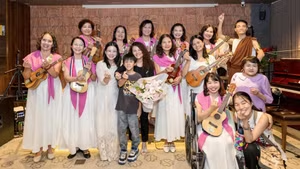
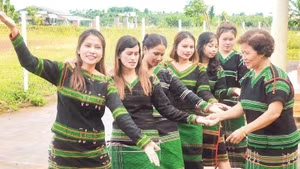
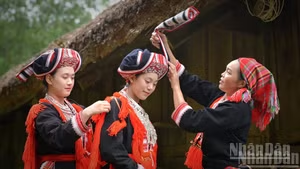
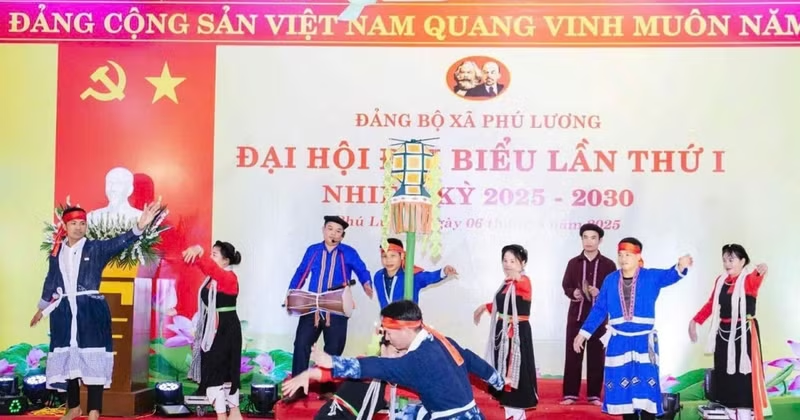
In Phu Luong Commune, Tuyen Quang Province, the Cao Lan Ethnic Culture Club has been operating for more than 20 years. Established on August 15, 2005 with around 20 members, the club now has nearly 100.
According to its head, Sam Van Dao, the club focuses on preserving and promoting distinctive aspects of Cao Lan culture, including “sinh ca” folk singing, folk dances, the Cao Lan language, traditional costumes and cuisine. The “sinh ca” folk singing of the Cao Lan people in Tuyen Quang Province was recognised as national intangible cultural heritage in 2015.
In addition to maintaining traditional cultural practices that remain part of everyday life, the club has revived forms of heritage at risk of fading away. Its members seek out artisans, elders and people knowledgeable about local customs to collect and restore traditional dances. The club also organises classes for schoolchildren. According to Dao, folk dances are currently more appealing to young learners than “sinh ca”. While learning “sinh ca” requires perseverance in mastering ancient lyrics, pronunciation and distinctive melodies, dance has more immediately accessible rhythms and movements. The club therefore uses dance to spark children’s initial interest before encouraging them to explore Cao Lan culture in greater depth.
Regular activities have helped keep these cultural values closely connected with community life. In Man Hoa Village, the Cao Lan language continues to be used in everyday communication, while traditional costumes are worn at meetings and community events. Such seemingly simple practices create an environment in which traditional culture can be maintained naturally in daily life.
Do Khac Thap, Vice Chairman of the Phu Luong Commune People’s Committee, described the Cao Lan Ethnic Culture Club as an “extended arm” of the local authorities in preserving, restoring and promoting traditional cultural values. Through regular gatherings, performances and competitions, many cultural practices are kept alive, helping strengthen community bonds.
Beyond Phu Luong, various forms of folk culture are also being preserved through clubs in other localities. In Trieu Viet Vuong Commune, Hung Yen Province, the Da Trach “trong quan” folk singing club maintains a cultural tradition closely associated with the life and history of the locality.
The club was revived in 1993 and, in 2012, was officially granted a seal by the commune authorities and began operating under formal regulations. Twice a month, members gather for activities. Newcomers are taught breathing techniques, articulation, drumming and rhythm, while experienced members continue practising traditional pieces as well as collecting and composing new ones.
The club also works with schools to introduce “trong quan” singing into teaching activities. According to club head Nguyen Van Han, students have responded with enthusiasm and seriousness. The club currently has eight young members, three of whom are already capable of teaching the tradition. One member has directly taught “trong quan” singing at Trieu Viet Vuong 2 Secondary School.
Closely associated with the legend of Chu Dong Tu and Tien Dung and the history of the Da Trach area, “trong quan” carries the cultural memory of the locality. By maintaining performances at community events, the Da Trach “trong quan” club helps keep this folk art present in contemporary life while creating a space for local people to meet, interact and express pride in their cultural heritage.
Experience from localities shows that the club model is increasingly becoming an important means of preserving folk culture. Dr Tran Huu Son, Director of the Institute for Applied Research on Culture and Tourism and former Vice Chairman of the Viet Nam Folk Arts Association, noted that folk culture and arts clubs have developed strongly in recent years and can now be found in almost every province.
According to Son, this growth has had a positive impact, first and foremost by raising public awareness of the value of cultural heritage. When clubs maintain regular activities, folk songs, dances and traditional performance forms have more opportunities to be practised. Heritage can thus continue to live through the cultural activities of communities — a process he describes as “living preservation”.
However, to ensure the long-term transmission of these traditions, clubs still need support in terms of venues, funding and people capable of teaching younger generations.
Thap noted that artisans with extensive knowledge of cultural heritage are growing older, while resources available for club activities remain limited. The locality is therefore seeking to strengthen training, mobilise social resources, and link the preservation of Cao Lan culture with the development of cultural villages and community-based tourism.
Son also stressed that club activities need to remain connected with the cultural spaces in which these traditions originally developed. As many folk traditions are closely linked to beliefs, customs and community life, preservation efforts need to respect their traditional settings so that clubs can continue their activities while maintaining strong ties with local communities.
Promoting the community’s role as the principal actor in preserving and transmitting grassroots heritage through folk culture and arts clubs is also a practical way of translating into reality the spirit of Politburo Resolution No. 80-NQ/TW dated January 7, 2026, on the development of Vietnamese culture.
As long as communities continue to practise and pass on their traditions, the lifeblood of folk culture will continue to flow from one generation to the next.