Diverse folk culture
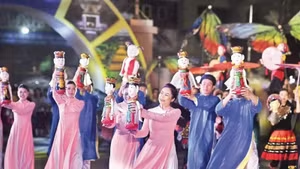
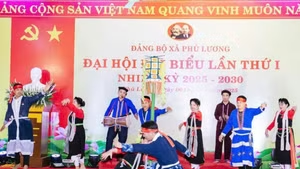
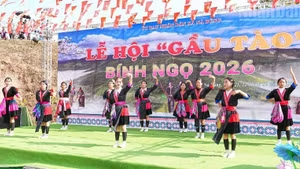
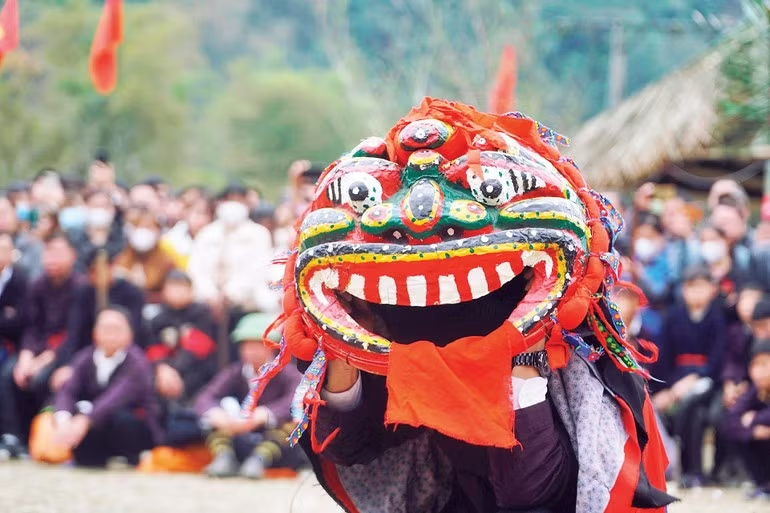
The land of Lang Son preserves a wide range of traditional folk arts, including Then singing accompanied by the Tinh lute, Sli singing, cat-lion dance performances of the Tay and Nung ethnic minorities, Pao Dung singing of the Dao ethnic minority, and folk songs of the Black H’Mong. Among these, the practice of Then rituals by the Tay and Nung ethnic minorities stands out as a unique form of folk performance that reflects both spiritual life and community cultural activities. The province is currently home to more than 600 Then artisans, including 34 people have been honoured as Meritorious and People’s Artisans.
According to artisan Ha Mai Ven from Dong Dang Commune, the language of Then songs embodies profound cultural depth, conveying humanistic values, love for nature, romantic love, the marital relationship, moral principles, and love for the village and homeland.
In contrast, Sli singing is closely tied to the daily life of the ethnic minority. In the Nung language, “Sli” means poetry; Sli singing is a form of love duet between men and women. In Lang Son, several variations exist, including Sli slinh lang of the Nung Chao group, Sli sloong hao of the Nung Phan Slinh group, Sli Inh of the Nung Inh group, and Heo phun of the Nung An group.
In 2019, Sli singing of the Nung ethnic group in Lang Son Province was officially recognised as a national intangible cultural heritage by the Ministry of Culture, Sports and Tourism. During holidays, festivals, and major events, it's common to see many Nung people meeting and exchanging through Sli songs amidst the vibrant life in the provincial centre.
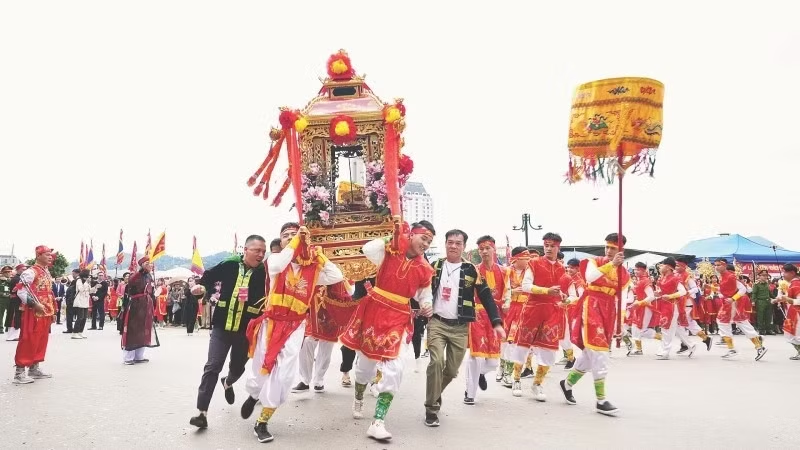
According to historical documents, the worship of Mother Goddesses appeared in Lang Son around the late 19th – early 20th century, through interaction and adoption with indigenous folk beliefs, when a group of Kinh people settled there, traded, and brought their beliefs with them. So far, the worship of Mother Goddesses has blended into the spiritual and cultural life of the people of Lang Son, alongside the indigenous beliefs of the ethnic minority groups.
According to Assoc Prof, Dr Tran Tan Van, a senior expert on geoparks, Lang Son has long been a favourable area for border trade activities. This, along with historical changes, led to the settlement of a segment of the Vietnamese (Kinh) population, bringing their beliefs with them. In Lang Son, several historical sites dedicated to deities associated with the Four Realms immortalised in folk songs, such as Bac Le Temple dedicated to Chau Be Bac Le; Mo Ba Temple dedicated to Chau Muoi; the Suoi Ngang and Suoi Lan temples dedicated to Lieu Hanh Goddess and other saints in the Four Realms system.
Lang Son now has nine heritages recognised as national intangible cultural heritage; and two intangible cultural heritage sites representing humanity (the Then practice of the Tay and Nung ethnic groups and the Mother Goddess Worship belief of the Vietnamese people). These folk cultural values are the pride of the people of Lang Son, containing a great source of internal strength.
Linking preservation with tourism development
Lang Son Province has identified the need to ensure a harmonious and balanced approach between folk cultural value preservation, conservation, and promotion and tourism development, thereby creating momentum for socio-economic development. According to Nguyen Dang An, Director of the Provincial Department of Culture, Sports and Tourism, the province has effectively implemented many projects and programmes since 2016.
Specifically, in 2019, the province issued Plan No. 117/KH-UBND on the implementation of the project on “Preserving and promoting traditional costumes of ethnic minorities in Viet Nam” with a total budget of approximately 35.3 billion VND; in 2021, it issued Decision No. 741/QD-UBND on the implementation of the project on “Preserving and promoting the value of lion dance of the Tay and Nung ethnic groups in Lang Son Province during the 2021-2030 period”; and in 2022, the Provincial People's Committee issued Plan No. 42/KH-UBND on the implementation of the project on "Preserving and promoting the value of folk songs, folk dances, and folk music of ethnic minorities associated with tourism development in the period of 2021-2030" with a total budget of over 80 billion VND.
"Within the implementation of Project 6 of the National Target Programme for socio-economic development in ethnic minority-inhabited and mountainous areas during the 2021-2030 period, since 2022, the department has coordinated with functional agencies and localities to actively implement a number of sub-projects. The department has also established 12 community cultural clubs to preserve and transmit folk cultural activities, thereby creating characteristic cultural tourism products," An shared.
The recognition of Lang Son Geopark as a Global Geopark by UNESCO also marks an important milestone in the province's cultural development. The province aims to preserve, restore, and rehabilitate at least five historical sites per year; organise three classes on teaching and transmitting intangible cultural heritages; and continue researching and reviving traditional festivals of the ethnic minorities in the geopark area, thereby developing distinctive tourism products.
Hoang Xuan Thuan, Director of the Provincial Centre for Investment, Trade and Tourism Promotion, said that the unit has developed tourist routes and sites within the geopark area with the theme "The flow of life in the sacred land," based on connecting typical sites related to the evolutionary history and the belief of the Mother Goddess Worship, unique cultural heritage sites, and natural landscapes. The tourist routes mainly follow National Highways 1A, 1B, 4B, and 279, making travel convenient for tourists.
Resolution No. 80-NQ/TW of the Politburo (dated January 7, 2026) on the development of Vietnamese culture is considered a strategic policy for localities to expand their space as well as identify internal resources and the driving force for indigenous culture development in the new development phase. To effectively implement the resolution, Lang Son Province needs to transform political determination into concrete policies; allocate sufficient and focused resources; and consider the preservation and promotion of indigenous cultural values not only as a task of the cultural sector, but also as a responsibility of every official, Party member, and citizen in Lang Son Province.