At the National Conference on implementing Resolution 79 on developing the state economy and Resolution 80 on developing Vietnamese culture (February 25, 2026), General Secretary and President To Lam clearly stated: “Develop cultural industries so that culture is both a spiritual foundation, an economic resource and the soft power of the nation.” Thus, developing cultural industries is no longer merely a matter for the arts or entertainment, but has become a national development orientation, building the country in a “new era of development” with a growth model shifting strongly from breadth to depth, from exploiting resources to harnessing knowledge, creativity and cultural soft power.
In the context of globalisation, digital transformation and the creative economy, as cultural industries develop and culture increasingly becomes a strategic competitive resource, architecture is viewed as a core creative industry, a tool for organising social life, a foundation of the creative economy and a means of shaping national identity.
Architecture - the spatial foundation of cultural industries
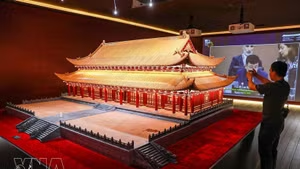
No cultural industry can develop without appropriate architectural spaces. In the past, communal houses with their courtyards and ponds were venues for village festivals, cheo performances and water puppetry. In modern times, the film industry requires studios and urban settings, natural heritage sites, architectural heritage and distinctive modern architectural works. Performing arts require squares, theatres, sports stadiums and public spaces. The night-time economy requires pedestrian streets, wharves and riverbanks. Cultural tourism requires heritage quarters, iconic structures and unique landscapes. Creative design requires innovation centres, co-working spaces and creative urban ecosystems. All these demonstrate that architecture is the physical infrastructure of cultural industries.
Looking at the world, the most successful cities today are those that know how to harness the power of architecture and cultural spaces. Paris has become the “City of Light”, a global symbol not only because of its cultural and historical depth but also thanks to the art of urban structure and its remarkable architectural heritage. Bilbao in Spain was once a declining industrial city, but it experienced a strong revival through a cultural architectural development strategy, with the Guggenheim Museum by architect Frank Gehry serving as a global icon.
Singapore has built its national brand on green urbanism, futuristic architecture and high-quality public spaces. Republic of Korea, centred around Seoul, has developed its creative industries through urban regeneration, the restoration of the Cheonggyecheon stream and the use of entertainment industries (K-pop, K-drama and cinema) as powerful soft-power communication tools to project the image of Republic of Korea worldwide.
For Viet Nam, this is an especially important issue. A country with thousands of years of civilisation, a diverse culture and unique landscapes is fully capable of developing cultural industries into a spearhead economic sector. However, to achieve this, there must be a governance system capable of creation, an architecture with identity, attractive cultural spaces and cities capable of competing globally.
According to UNESCO’s approach, architecture belongs to the group of creative industries. The core value of architecture lies not only in materials or construction costs, but in creative thinking, knowledge, identity and the ability to organise living spaces. This means architecture can directly generate substantial economic value. A good urban plan can increase land value and urban quality for hundreds of years. An iconic building can create a national brand and attract millions of tourists. A creative district can become a hub for start-ups and the knowledge economy. An attractive public space can stimulate commerce, tourism and the night-time economy.
After the 14th National Party Congress, the country entered a new era of development, accelerating the transformation of the growth model towards a green economy, digital economy and creative economy. In this context, architecture is no longer a “supporting sector for construction” but must become a cultural economic sector with high added value. This also requires a fundamental change in social perceptions of the architectural profession. Architects are not merely people who design houses, but those who shape cultural spaces, organise community life and define the future of cities.
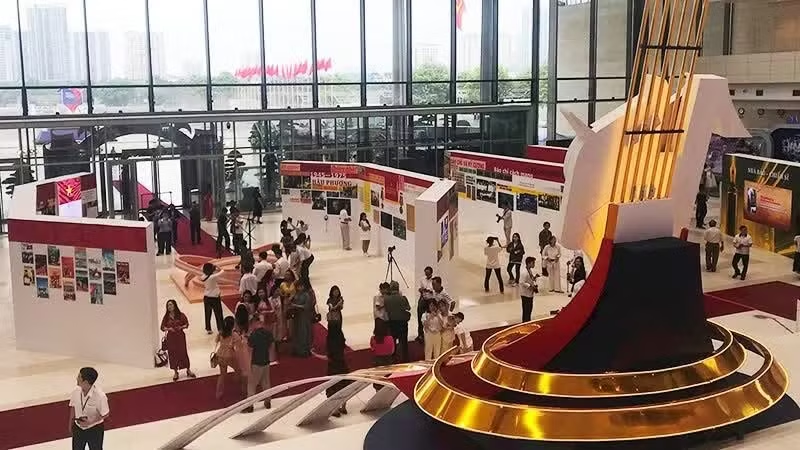
From “building design” to “shaping national soft power”
A country wishing to successfully develop cultural industries must have a clear identity. National identity cannot only be conveyed through slogans, but must be expressed through spaces, landscapes and architecture. This is not merely an architectural matter but a national strategy.
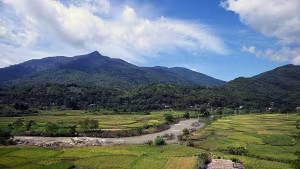
An architecture lacking identity will make cities anonymous, emotionally impoverished and unable to compete internationally. Conversely, architecture that successfully combines tradition and modernity will create a special attraction. Viet Nam possesses major advantages: tropical architecture; village culture; riverside urban structures; diverse natural landscapes; rich natural, cultural and historical heritage; and abundant indigenous knowledge about climate and materials.
In the current context of global competition, cultural soft power often has a more lasting influence than economic power itself. Architecture will therefore be an important tool for enhancing national standing.
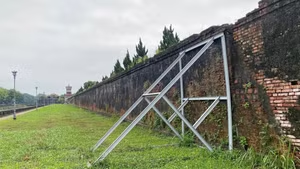
One of the greatest challenges facing Viet Nam today is that many cities are developing without identity and cultural depth. Many places have been swept into the vortex of real estate-driven development, concrete urbanisation and short-term growth. The consequences are shrinking public spaces, encroached heritage, damaged natural landscapes, increasingly similar-looking cities and declining urban quality of life.
In the spirit of the Resolution of the 14th National Party Congress, it can be seen that if Viet Nam wants sustainable development, it must shift from a model of “hot-growth urbanisation” to “cultural and creative urbanism”. In this model, architecture plays a central role: regenerating old industrial zones into creative spaces, restoring urban rivers, developing squares and public spaces, connecting heritage with modern life, forming cultural corridors and creating new urban symbols.
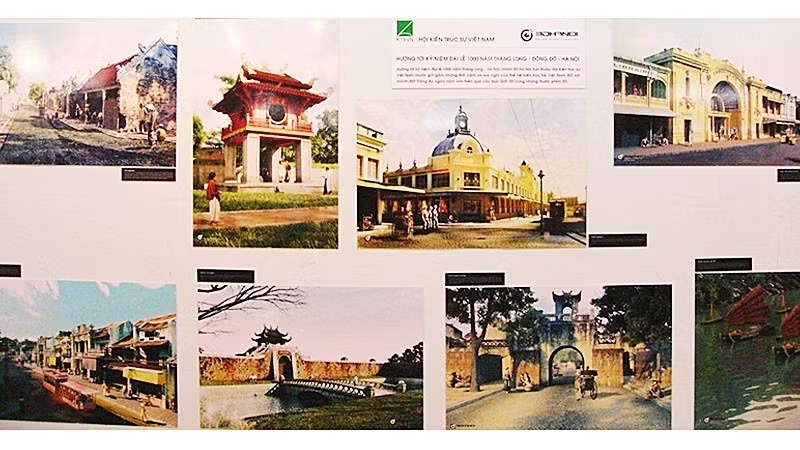
The area surrounding Hoan Kiem Lake in Ha Noi is a typical example. This is not only a cultural-historical landscape area but also effectively the “cultural industry centre” of the capital, where tourism, street art, urban memory, pedestrian spaces, cultural commerce and national historical symbols converge. If properly planned and managed, spaces such as Hoan Kiem Lake, West Lake and the Red River in Ha Noi, as well as heritage cities such as Hue, Hoi An and Da Lat, will become Viet Nam’s internationally competitive cultural industry centres with global influence.
The greatest challenge facing Vietnamese architecture today is not a lack of talent, but a lack of long-term development philosophy. Development thinking must fundamentally change: architecture should not only create buildings but also create quality of life, place people at the centre, culture as the foundation, ecology as the limit and communities as the target of service. This is the condition for cultural industries to develop sustainably instead of merely becoming commercialised entertainment activities.
In place of a conclusion
Developing cultural industries is not only a cultural goal but also a national development strategy in the era of the creative economy and competition through soft power. In this strategy, architecture holds a particularly important role because it is where culture and economy, tradition and modernity, art and technology, national identity and global integration intersect.
In that context, architecture will no longer merely be an activity of designing and constructing buildings, but must become the spatial foundation of cultural industries; a driving force for urban regeneration, heritage preservation and restoration; a tool for improving quality of life; a means of building a national brand; a resource for the creative economy; and an expression of Viet Nam’s soft power.