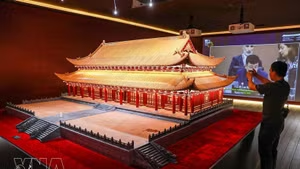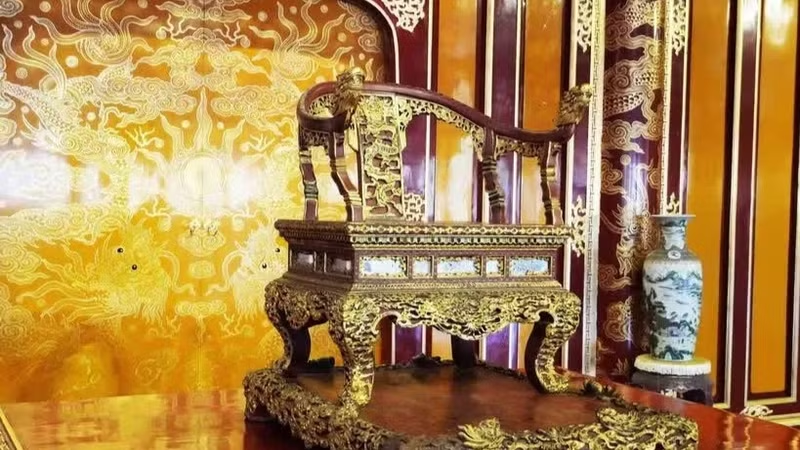
The throne has been reinstated at its original central position inside Thai Hoa Palace, the ceremonial heart of the former imperial court. Its return has attracted significant interest from visitors and heritage enthusiasts eager to see one of Viet Nam’s most important royal artefacts back on display.
The natural treasure was taken off display after an incident on May 24 last year, when a man showing signs of unusual behaviour entered the palace, climbed onto the throne and damaged it. The attack left the throne's left armrest shattered into 14 pieces.
Immediately after the incident, the artifact was transferred to the storage facility of the Hue Museum of Royal Antiquities for preservation. The broken fragments were collected by the Investigation Police Agency of the Hue Police as part of the investigation and were later handed back to the museum for restoration in accordance with legal procedures.
Restoration work was carried out between April 22 and May 4, 2026, at the museum, with funding from social contributions.
According to the Hue Monuments Conservation Centre, the restoration complied fully with the Law on Cultural Heritage, the Government’s Decree No. 308/2025, and a restoration plan approved by the muncipal People’s Committee.
Ngo Van Minh, Director of the Hue Museum of Royal Antiquities, said the restoration strictly followed principles, preserving the maximum amount of original material, using compatible restoration materials, applying minimal intervention techniques, avoiding unnecessary alterations, and making full use of the original fragments recovered after the damage.
The project also ensured that the throne’s authenticity, structural stability and historical value were preserved without introducing new decorative elements or altering its original appearance.
Throughout the restoration process, the expert council closely inspected and supervised every stage to ensure compliance with scientific, technical and heritage conservation standards. The entire restoration was documented through video recordings, photographs and detailed records, which have been archived in accordance with regulations to support management, research, long-term preservation and transparency of the restoration process, Minh said.
Following the restoration, the Nguyen Dynasty imperial throne has been structurally stabilised, with its damaged armrest successfully repaired and restored to its original shape, dimensions and colour as recorded in the dossier recognising it as a national treasure in 2015.
The work was carried out in strict adherence to the principle of preserving the artifact’s original features to the greatest extent possible, without adding or creating any new decorative motifs or patterns. Factors that could cause further deterioration, including termites and mould, were also treated to enhance the artifact’s durability.