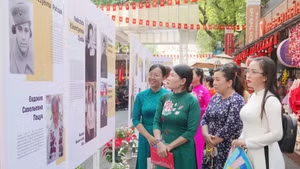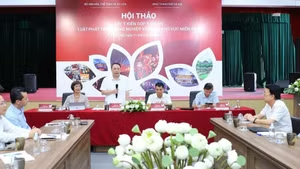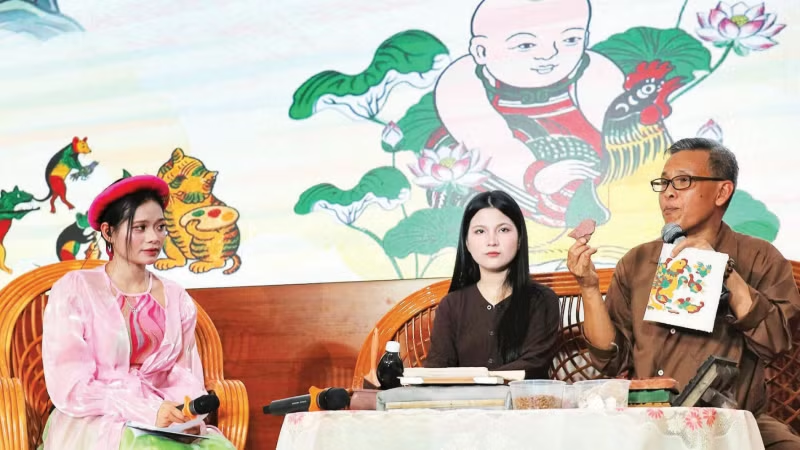
Recently, the campus of the Viet Nam Youth Academy in Ha Noi became a vibrant cultural hub, hosting a programme designed as an emotional journey of connection, creating opportunities for young people to enter the world of Dong Ho paintings and engage with the heritage in their own way. Participants not only experienced the process of printing and colouring paintings firsthand but also explored modern products inspired by Dong Ho motifs, including notebooks, postcards, tote bags, paper fans, and lanterns, helping them gain a deeper understanding of this artistic tradition.
One of the most popular activities was “Nhap vai di san” (Becoming the Heritage), where participants could have their photographs taken via webcam and be transformed into characters from Dong Ho paintings using AI-powered image-processing technology. This creative solution personalised the experience, enabling young people not merely to observe the paintings passively but to step directly into the heritage space.
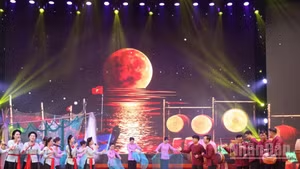
Notably, the programme also presented the contemporary dance drama which tells the story of passing heritage from one generation to another. Without relying heavily on dialogue, the performance conveyed its message through movement, music, and stage imagery, recreating the painting-making process while highlighting the beauty of the heritage. The most moving moment featured a young person willingly receiving a woodblock from an artisan, serving as a powerful metaphor for the continuation of cultural traditions.
In addition, the programme dedicated considerable time to enabling young people to engage in dialogue and listen directly to artisans from Dong Ho Village, helping them better understand the journey of practising the craft and the concerns surrounding its preservation in contemporary society.
The programme aimed at promoting the cultural heritage of Dong Ho folk paintings from a youth perspective. The initiative was organised by students majoring in public relations at the Viet Nam Youth Academy.
According to Phan Nguyen Tam Anh, Head of the Organising Committee, field trips to Dong Ho Painting Village in Bac Ninh Province revealed that each painting is not only an artistic creation crafted by skilled artisans but also a repository of cultural memories accumulated over generations.
“This art form once played a significant role in Vietnamese life through festivals, Tet celebrations, and folk tales, yet it is gradually becoming unfamiliar to today’s youth. That realisation inspired us to devote three months of effort and passion to this project,” Tam Anh shared.
Tam Anh noted that young people today are not indifferent to traditional heritage; rather, they often lack opportunities to engage with it in ways that resonate with them. Therefore, the project team sought innovative forms of interaction, ranging from hands-on experiences and technological applications to performance arts, empowering young people to appreciate and understand heritage through the language of their own generation.
Earlier, several other projects focusing on Dong Ho folk paintings had also been launched. A notable example is the “3D Hoa tranh Dong Ho” project by students from the Ha Noi University of Architecture, which created charming 3D models based on characters and details from Dong Ho paintings, opening promising opportunities for Viet Nam’s interior decoration and souvenir markets.
In addition, a performance staged by the Viet Nam National Opera and Ballet brought the beauty of famous Dong Ho paintings to life through a combination of classical ballet, contemporary dance, and traditional folk dance.
As a result, the paintings were no longer static images but appeared fresh and vibrant through the fluid body language.
A common goal shared by these projects is to renew approaches to Dong Ho paintings and create new pathways for this ancestral heritage to reach contemporary audiences. These efforts have become even more meaningful since the craft of Dong Ho folk painting was officially inscribed by UNESCO on the List of Intangible Cultural Heritage in Need of Urgent Safeguarding at the end of 2025.
This recognition represents a proud international acknowledgement of the value of a Vietnamese folk-art tradition. At the same time, it serves as a serious reminder of the challenges facing the heritage, particularly as the number of people still devoted to the craft continues to decline, the space for practising the tradition narrows, and the appreciation of folk paintings in modern life wanes.
To bring new vitality to the heritage, conditions must be created for it to continue being recognised, practised, and promoted by today’s public. For Dong Ho paintings, overcoming the risk of decline requires not only preserving woodblocks and traditional techniques but also restoring the heritage’s vitality within the community. This lesson has already been demonstrated through the successful revival of Phu Tho Xoan singing.
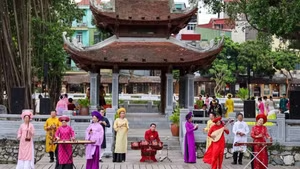
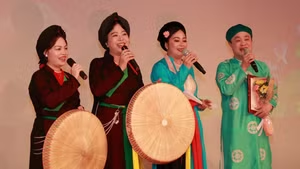
Phu Tho Xoan singing was inscribed by UNESCO on the List of Intangible Cultural Heritage in Need of Urgent Safeguarding in 2011. However, just six years later, in 2017, it was removed from that list and recognised as an Intangible Cultural Heritage of Humanity.
This achievement was the result of a comprehensive process involving education, transmission of knowledge, restoration of performance spaces, support for artisans, and the combined efforts of local authorities, cultural experts, researchers, artisans, and communities.
These experiences offer valuable lessons for developing a comprehensive strategy to revive and develop the craft of Dong Ho folk painting. These projects are especially valuable, serving as bridges connecting traditional heritage with contemporary life.