From fragments of the past
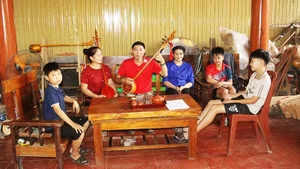
Deeply devoted to preserving traditional folk songs, Pham Thi Lam, born in 1962 and living in Cao village, Tuyen Lam commune, Quang Tri province, said that every time she steps onto the stage to perform, she cannot help feeling moved because “the songs belong to my people, but the clothes I wear tell a different story”.
Lam said that, due to the absence of traditional costumes, Chut people have had to wear modern clothes or borrow costumes from other ethnic groups during festivals, Lunar New Year celebrations or major events. What troubles her most is that during the Viet Nam Ethnic Groups’ Culture Day, the Chut community, lacking its own distinctive attire, has been unable to take part in a truly complete way.
That concern became the motivation for Dr Bui Thi Bich Lan, Deputy Director of the Institute of Anthropology and Religion under the Viet Nam Academy of Social Sciences, and her colleagues to embark on a journey to rediscover a cultural identity that had been lost in the memory of the Chut community.
In 2024, the Institute of Anthropology, now the Institute of Anthropology and Religion, was assigned by the Department of Culture, Sports and Tourism of the former Quang Binh province to carry out a scientific project to shape the community costume of the Chut ethnic group. It was a truly challenging period for the researchers. Within only four months, and with a modest budget of VND600 million, they had to produce the first design proposal.
The challenge was multiplied by the fact that there were no surviving artefacts. The scientists had to shape the costume of an ethnic group based on scattered memories that were on the verge of fading away entirely. Yet the pressure of time was still less daunting than doubts from within the academic community about the authenticity of the restoration process. Was this an effort to revive values already embedded in the community, or merely the creation of a “new tradition” through the eyes of researchers?
Dr Bich Lan said that, in the face of such sceptical questions, it was the Chut people themselves who provided the most convincing answers. The research team brought the design room directly into villages formerly located in Bo Trach, Minh Hoa and Tuyen Hoa districts of Quang Binh province, allowing local people to directly “design” the costume of their own ethnic group.
The researchers patiently returned to the villages many times, bringing with them the roughest sketches to consult local residents, listen to their views and carefully record their thoughts. A total of 258 survey forms and 25 group discussions were conducted to ensure that the community remained at the centre of the costume restoration process.
Moving beyond dry scientific reports, the study became a living entity, breathing with the life of the community. The bright colours on the chest and sleeves of the garments seemed to add new shades to the promising future of the Chut people in the highlands.
To a journey of reviving identity
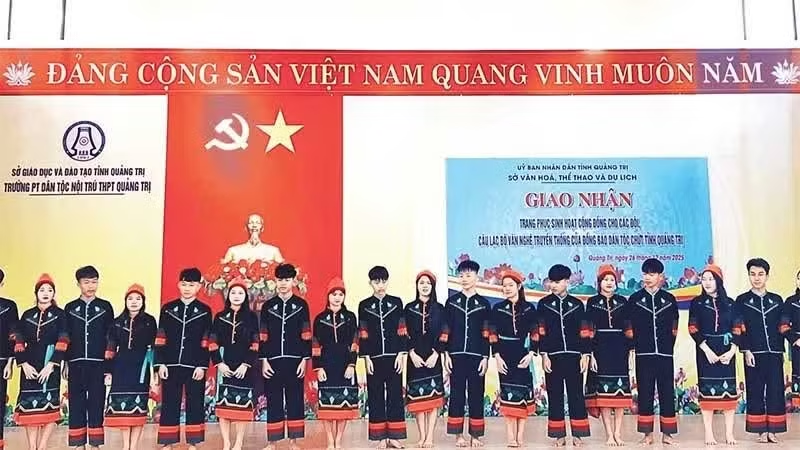
After a process of research and restoration, by the end of 2024, the team had completed several sets of costumes, with each colour and pattern carrying a story about the community’s roots.
Designer and Master of Arts Nguyen Thi Phuong Tu, a member of the research team, “decoded” five main colour tones distilled from the living environment of the Chut people: bright red symbolises the sun; deep brown and earthy orange evoke the caves and primitive shelters that protected them in ancient times; while the smooth transition of green shades from dark to light recreates the layered beauty of the old forest.
Most notably, the quadrilateral motif recalls the leaves of the rau rang plant, whose bark was once used as material for making clothes. Today, the motif appears as a “thread of heritage” connecting the past with the present. Every piece of fabric was carefully considered using materials available on the market. Sewing techniques were also simplified as much as possible to suit the still-unfamiliar hands of local people. Tu poured her dedication into the design through the principle of “three easies”: easy to wear, easy to carry and easy to produce.
By the end of 2025, the final design had been agreed upon. More than 600 completed sets of costumes crossed the mountains to reach Chut communities and art troupes in communes across Quang Tri. Holding the new garments in their hands, Pham Thi Lam and the people of Cao village were moved with joy: “Now we have new clothes for Tet!” From now on, whenever they take part in major events, the Chut people in Quang Tri can wear their own traditional costumes.
However, the journey to revive cultural identity does not end with these gifts. A more sustainable future has opened through cooperation with UNESCO and Craft Link. Sewing classes will be organised right in the villages, where Lam is actively encouraging local women to take part. Hands once accustomed to working on upland fields are beginning to hold scissors and needles. Notably, the Viet Nam Museum of Ethnology has recently brought the costume into its exhibition space to introduce it to the wider public.