“Quantifying” the value of identity
After boundary adjustments, Lao Cai Province is home to 34 ethnic groups. With the advantage of possessing the special national landscape site of the Mu Cang Chai terraced fields, along with four UNESCO-recognised intangible cultural heritages and more than 100 traditional festivals held year-round, the locality has developed distinctive tourism products.
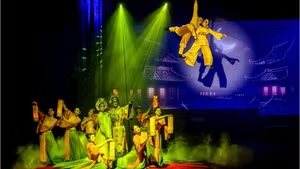
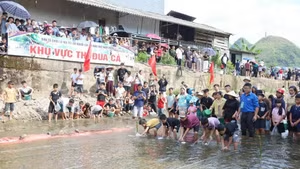
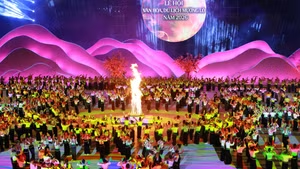
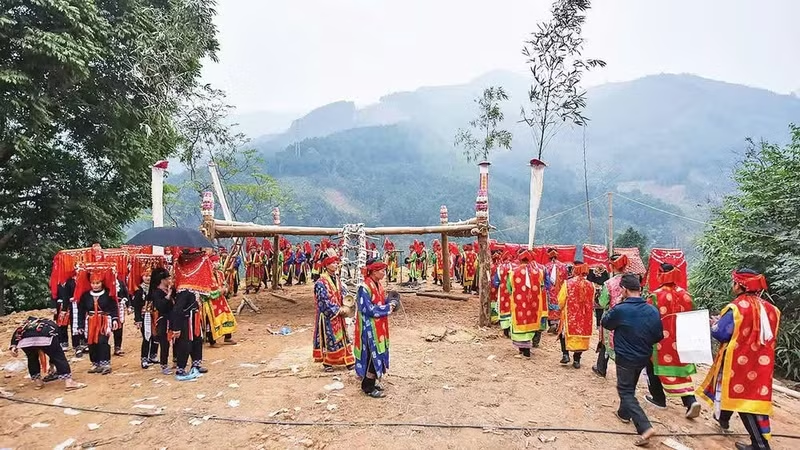
In addition to traditional cultural village models linked to community livelihoods that have become attractive destinations, festivals have helped shape local brands, such as the “Xuong Dong” (field-opening) festival of the Tay, Nung, and Giay ethnic groups; the Gau Tao festival of the H’Mong ethnic group; and the fire-jumping ritual of the Red Dao ethnic group. Lao Cai has also placed special emphasis on restoring rituals, folk knowledge, and performing arts through grassroots folk art clubs. The policy that each commune and ward should have at least one cultural, artistic, or sports club has fostered a widespread cultural movement.
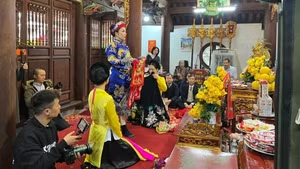
In Kien Lao Hamlet, Quy Mong Commune, Then singing and Tinh lute clubs maintain regular activities, contributing to preserving ancient Then melodies and restoring traditional rituals. At the ethnic folk song club in Yen Thanh Commune, many artisans actively collect, compile, and compose new lyrics, contributing to spreading Dao, Tay, and Cao Lan cultural values.
From these community-based activities, younger generations are trained and gradually become key participants in local cultural life. This continuity also opens effective pathways for combining heritage preservation with community-based tourism development. Under the guidance of artisans, selected folk melodies and rituals have been developed into tourism products.
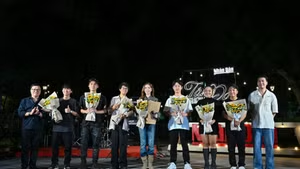
Devoted to preserving and passing on Tay culture, Meritorious Artisan Hoang Tuong Lai (Xuan Lai Hamlet, Yen Thanh Commune) shared: “My love for ethnic culture, nurtured from my mother’s lullabies, has inspired me to collect, translate, compose new lyrics, and practise folk melodies. Everyone should cherish their roots, preserve, and spread traditional cultural values to future generations.”
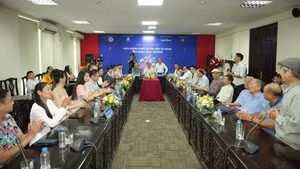
Sharing experience in preserving and promoting cultural heritage values in combination with tourism development, Lai Vu Hiep, Deputy Director of the Lao Cai Provincial Department of Culture, Sports, and Tourism, said the province provides initial support of 150 million VND for each commune or ward to establish cultural, arts, and sports clubs, along with about 30 million VND annually for their activities.
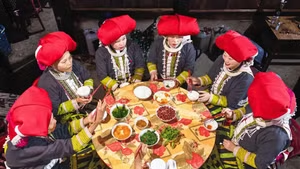
In addition, the province has issued a dedicated resolution on developing culture and arts in association with tourism, creating further resources for clubs to operate sustainably. From a rich repository of folk knowledge, Lao Cai is also orienting to develop culinary tourism products, including 34 distinctive meal sets selected from 99 typical dishes of 99 communes across the province. This approach not only promotes traditional culinary culture but also enhances visitors’ experiences. Local cultural values are thus transformed into resources for tourism development, contributing to increasing the locality’s appeal.
New value from ethnic culture
The Politburo’s Resolution No. 80-NQ/TW dated January 7, 2026, on developing Vietnamese culture clearly defines the requirement to fully identify and effectively exploit cultural resources; taking cultural heritage as the centre and digital cultural resources as a strength, aiming at preserving, promoting, and sustainably developing cultural values, while emphasising strengthening local brands by developing unique and distinctive cultural products and services. These are important orientations for localities to transform cultural potential into a driving force for development.
Following administrative unit mergers, Tuyen Quang Province is home to more than 40 ethnic minority groups, accounting for around 80% of its population. The province has 871 inventoried intangible cultural heritage sites and 135 festivals, creating a unique cultural space and expanding experiences for tourists.
Many typical festivals have helped define the locality’s brand, such as the Thanh Tuyen Festival, the buckwheat flower festival, and the Khau Vai Love Market. With abundant heritage potential, the province is developing community-based tourism in association with cultural preservation, building 54 community tourism models, including 28 cultural tourism villages meeting service standards.
Some notable models, such as Lo Lo Chai and Nam Dam community tourism cultural villages, have been recognised by international organisations, contributing to affirming the appropriateness of developing tourism based on cultural identity.
Ma Thi Thao, Deputy Director of the Tuyen Quang Provincial Department of Culture, Sports, and Tourism, said that income from ethnic cultural tourism accounts for about 70% of the province’s total tourism revenue. In the coming time, to further develop cultural industry products, the province will build conservation centres with functions such as training in traditional crafts, designing brocade clothing in association with tourism, organising exhibition spaces on culture for each ethnic group, and developing performing arts and cuisine for visitors.
At the same time, performance centres will be established so that local people can directly practise rituals and present them to tourists.
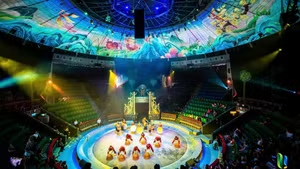
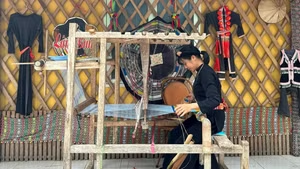
In practice, when designed to meet market demand, elements such as traditional housing, clothing, handicrafts, cuisine, and performing arts can all become cultural industry products that generate economic value. With synchronous policies and proactive participation of the community, indigenous culture is preserved and becomes a resource that contributes to improving livelihoods for local people and promotes socio-economic development in the locality.