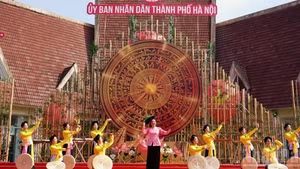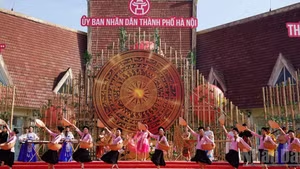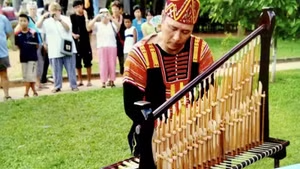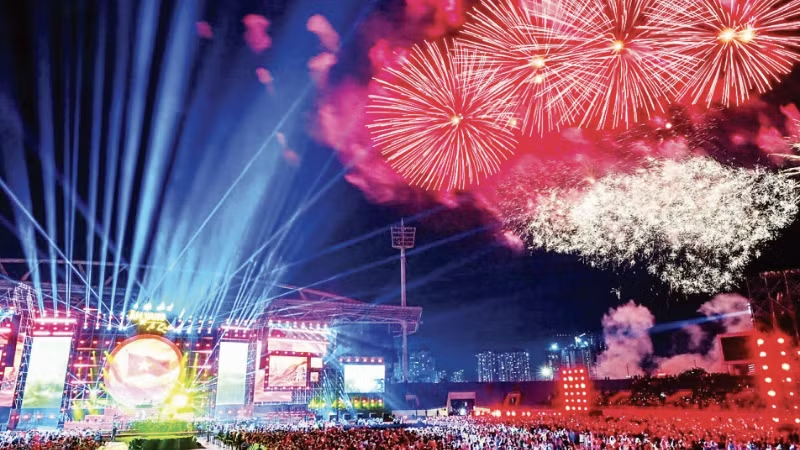
At the same time, the upgrading of infrastructure serving major programmes and events in a modern, multi-functional direction has also provided strong momentum for the industry’s breakthrough development. Alongside venues such as the National Convention Centre, My Dinh National Stadium, and the Ha Noi Opera House, a series of strategic infrastructure projects have been invested in and put into operation, including the Viet Nam Exhibition Centre and Ho Guom Theatre, helping to enhance Viet Nam’s capacity to host events meeting international standards.
According to Le Quoc Vinh, Chairman of Le Bros Company, the capabilities of domestic firms have developed rapidly in recent years, especially in the fields of entertainment events, live performances, and large-scale programmes. At present, the majority of personnel and units involved in implementing national concerts and major entertainment events with wide public appeal are Vietnamese.
“We are no longer in a position where we merely ‘hire’ services or depend entirely on foreign partners. Vietnam’s capabilities in event organisation, production, and operation have reached regional standards in many aspects. In some fields, Viet Nam even possesses outstanding strengths compared to many other countries,” Vinh emphasised.
From a management perspective, Lam Thi Phuong Thanh, Minister of Culture, Sports and Tourism, noted that the events, exhibitions, and advertising industry is gradually affirming its role as an important link in the cultural industries value chain, contributing to market connectivity, fostering creativity, promoting the national image, and creating momentum for many other economic sectors.
However, the rapid development of the events and exhibition industry has also exposed numerous challenges, particularly as infrastructure capable of hosting large-scale events remains concentrated mainly in a few locations such as Ha Noi, Ho Chi Minh City, and Da Nang. The shortage of internationally standardised venues, along with the absence of globally aligned operational criteria, has been identified as a major obstacle causing Vietnam to miss opportunities to host “mega-events.”
In addition, the market remains relatively fragmented, lacking a sufficiently large common platform to connect businesses, share knowledge, leverage collective strength, and build a long-term vision for the industry as a whole.
Vu Ngoan Hop, Chairman of the Viet Nam Exhibition Fair and Event Association (VECA), assessed that Viet Nam’s events and exhibition ecosystem has already gathered a large and highly capable workforce with strong creativity. However, activities remain scattered, with each organisation operating differently, while industry standards, coordination procedures, management mechanisms, and development orientations still require further improvement. This has created difficulties for organisers during implementation, while management agencies often lack sufficient practical foundations for governance and support measures.
This is why VECA has decided to coordinate with relevant organisations to launch the Viet Nam Event & Exhibition Week 2026 (VEEW 2026), where, for the first time, professionals in the exhibition, events, and entertainment sectors will come together to create a dedicated “playground” for their own industry.
With the message “Shaping Viet Nam’s Experience Economy”, VEEW is not merely a professional conference, but also a platform bringing together businesses, organisers, producers, directors, technology companies, service providers, and stakeholders across the industry’s value chain. It will provide participants with opportunities to showcase their capabilities, demonstrate innovation, and present outstanding creative products to the market.
Scheduled to take place from July 30 to August 2, 2026, at the Viet Nam Exhibition Centre (VEC) in Dong Anh District, Ha Noi, VEEW 2026 will feature a wide range of activities, including business networking events, specialised seminars, technology showcases, fashion performances, and cultural experiences.
The event is being developed with a five-to-10-year vision to become a major annual gathering for the industry, opening a new position for Viet Nam’s creative economy.
Resolution No. 80-NQ/TW of the Politburo on the development of Vietnamese culture sets the target that by 2030, cultural industries will contribute 7% of GDP; between five and ten national cultural industry brands will be established; and Vietnam will become an attractive destination for major regional and international cultural and artistic events.
To realise this goal, it is crucial to create cultural and artistic events, fairs, and exhibitions of national stature that bear a strong Vietnamese identity. This requires enhancing Viet Nam’s capacity to host and organise major regional and international events on the basis of improving the competitiveness and integration capabilities of Vietnamese enterprises.
Cao Ngan Ha, Deputy Chief Executive Officer of Sun Group’s Marcom Division, affirmed that connectivity among investors, artists, local authorities, and the media is the key factor in building a sustainable foundation for the industry.
A successful event or high-quality performance can only fully realise its value when it is “packaged” into a complete destination product linked with accommodation, cuisine, entertainment, and experiences.
Therefore, investment is not simply about “pouring money” into a stage, but about building an entire surrounding ecosystem. With close cooperation and strong partnerships among all stakeholders, Vietnamese cultural identity will gain greater opportunities to be elevated and promoted more powerfully to the world.