
Publishing growth outpaces reading habits
The Vietnamese publishing industry continues to sustain its growth momentum. In 2025, more than 51,000 book titles and over 500 million copies were released to the market, with total industry revenue exceeding 4.1 trillion VND. The distribution system is expanding and increasingly vibrant online.
Books are becoming richer in both content and format, yet behind this growth lies a pressing question: are Vietnamese people actually reading more?
Although the industry has entered a phase of digital transformation and electronic books are abundant, statistics show that while the number of e-book titles rises rapidly—sometimes by nearly 50% year-on-year—reader accessibility remains modest and does not yet match the potential of this format.
This suggests that technological transition does not necessarily equate to a change in reading habits, and the gap between "having books" and "reading books" remains wide.
Moreover, Vietnamese books are now produced with great care, as many publishers invest in printing and pay close attention to both content and presentation. In terms of appearance, many books rival foreign publications; some editions are even highly praised for their design, materials, and production techniques.
Competition from smartphones, social media, and short-form content platforms is reshaping these habits. Time once dedicated to reading is increasingly replaced by quick scrolls, short videos, and endless streams of information, causing reading to lose its place in everyday life.
Alongside diversity for different audiences, limited editions and hand-crafted, numbered books are being created for collectors and enthusiasts, contributing to a more vibrant literary life than before.
Statistics reveal that, on average, each Vietnamese person reads about 1–4 books per year, but if voluntary reading alone is counted, the figure drops to just 1 book per person annually. Approximately 26% of the population does not read books at all, and only about 30% maintain a regular reading habit.
Competition from smartphones, social media, and short-form content platforms is reshaping these habits. Time once dedicated to reading is increasingly replaced by quick scrolls, short videos, and endless streams of information, causing reading to lose its place in everyday life.
The presence of books—whether for reading, gifting, or display—still carries cultural significance, but to truly build a reading culture, what matters is not merely owning books but reading them with persistence.
The challenge of deep reading in the AI era
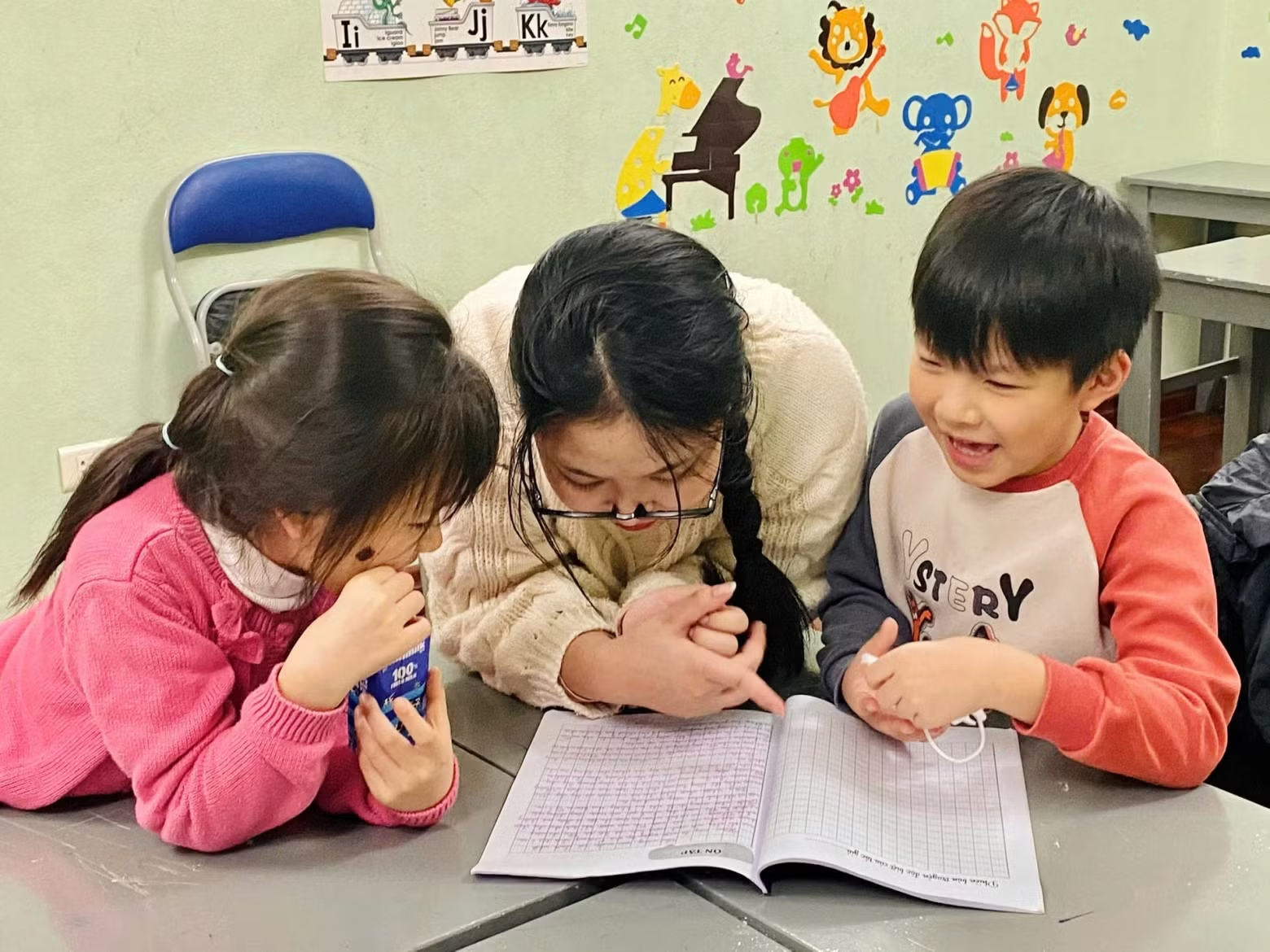
On the occasion of the 2026 Viet Nam Book and Reading Culture Day (April 21), many forums were organised to discuss books and reading habits in modern society. During these events, a seemingly simple but thought-provoking question was raised: "What if we don’t read books?" As AI permeates daily life, that question is no longer rhetorical but has become a practical issue each person must answer for themselves.
Google can provide almost any information in seconds; AI tools can summarise a book of hundreds of pages in minutes and even interpret complex concepts in simplified ways. This very convenience is reshaping how humans approach knowledge, as "knowing quickly" gradually replaces the need for "understanding deeply." The ease of grasping information can mislead people into believing they truly comprehend an issue.
Professor Phan Van Truong, founder of the Cay Nen ecosystem, argues that reading not only helps people access knowledge but also enables them to understand their roots, history, and the layers of humanity’s sediment.
Reading is a journey of self-discipline and development, because it is through reading that people gradually shape their thinking, discover their abilities, and identify values to strive towards.
Professor Phan Van Truong, founder of the Cay Nen ecosystem
He emphasises that reading is also a journey of self-discipline and development, because it is through reading that people gradually shape their thinking, discover their abilities, and identify values to strive towards.
Dr Nguyen Thi Ngoc Minh is a lecturer at Ha Noi National University of Education and founder of the ‘Sach Oi Mo Ra’ (Books, Open Up) project, which was launched in 2014 to promote reading culture among schoolchildren in Ha Noi. Minh highlights that when reading books, readers must analyse, connect, imagine, and critique. This process helps form the capacity for knowledge processing—something skimming or receiving information quickly cannot provide.
In the context of AI development, this capacity becomes even more vital, because without a foundation of knowledge and critical thinking skills, people are easily led to absorb information passively.
In a world where information is increasingly dense, the problem is no longer a lack of data but a lack of understanding. When everything accelerates, reading slowly becomes a difficult but necessary choice. AI can provide answers in seconds, but it cannot replace the human process of thinking independently, asking questions, and seeking meaning—because it is that very process which constitutes true understanding.