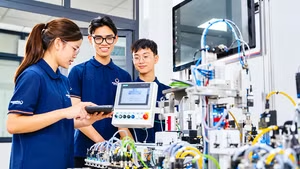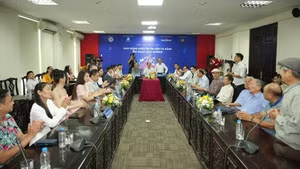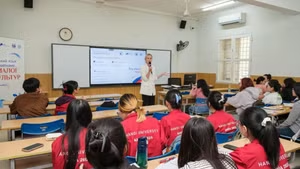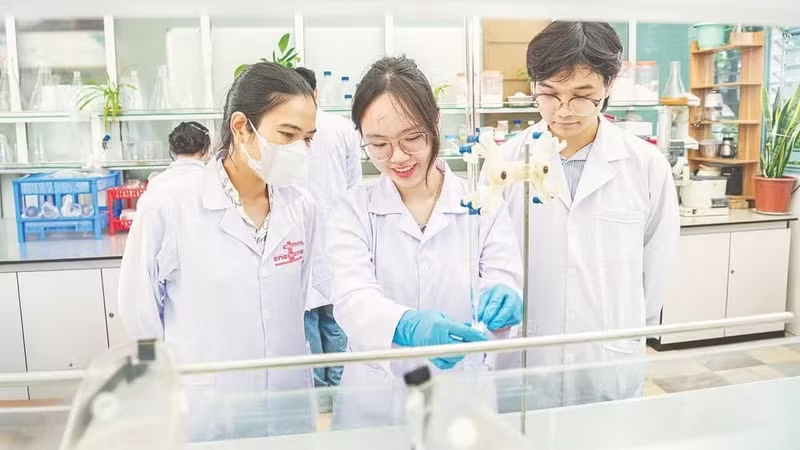
According to Professor Dr Nguyen Tien Thao, Director General of the Higher Education Department under the Ministry of Education and Training, the scholarship policy will apply to Vietnamese citizens enrolled in full-time programmes, ranging from undergraduate and engineering students to master’s and doctoral candidates. The scholarships will not only support tuition and living expenses, but also create opportunities for learners to engage in sectors considered vital to the nation.
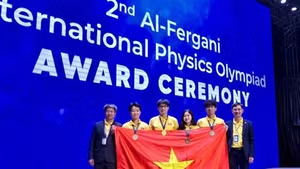
He said this is not merely tuition support, but also a launching pad for future careers. Under the draft decree, scholarship recipients will fall into two main groups. The first includes students who have won first, second or third prizes in national or international academic competitions within the past three years. The second group consists of students achieving a total score of at least 22.5 points in university entrance combinations including Mathematics and two of the following four subjects: Physics, Chemistry, Biology and English. In addition, they must rank among the top 30% of admitted students nationwide within the same field of study.
To maintain scholarships throughout their studies, recipients must meet requirements relating to academic performance, credit accumulation progress and discipline. Postgraduate students must also satisfy research capability requirements.
According to Professor Dr Chu Duc Trinh, Rector of the University of Engineering and Technology under the Viet Nam National University, Ha Noi the scholarship policy not only provides financial support but also demonstrates the commitment of the Government, the Ministry of Education and Training and higher education institutions to investing in talent development for the country.
The policy opens opportunities for outstanding students, including those from disadvantaged economic backgrounds, to access high-quality training programmes. More importantly, it serves as one of the key pillars for building confidence among domestic and international business communities, thereby attracting major corporations to invest in Viet Nam while also promoting the growth of the domestic technology business ecosystem.
Professor Chu Duc Trinh said the broader value of the policy lies in strengthening links between the State, businesses and universities within a high-quality workforce development ecosystem. When students can clearly see career prospects after graduation, along with stable employment opportunities and favourable research environments, they will gain greater confidence in choosing and committing to science and technology fields over the long term.
At the same time, Viet Nam needs a deeper development strategy for technology, engineering and high-tech industries. Once effectively implemented, such a strategy will help attract more major enterprises and create additional high-quality jobs.
From the perspective of a higher education institution with strengths in engineering and technology training, Ha Noi University of Science and Technology believes the draft decree will provide a sufficiently strong boost to attract talented and high-performing students into strategic sectors.
Associate Professor Dr Nguyen Phong Dien, Vice President of Ha Noi University of Science and Technology, noted that when choosing fields of study, parents and students typically focus on two key factors: career opportunities and training costs. For many families, especially those in economically disadvantaged localities, financial pressure remains a major barrier preventing many excellent students from accessing disciplines with significant future value.
Meanwhile, STEM students currently account for only around 30% of all university applicants in Viet Nam — lower than in many other countries and showing a declining trend in recent years. This presents a major challenge in the context of Resolution No. 57-NQ/TW issued by the Politburo on December 22, 2024 regarding breakthroughs in science and technology development, innovation and national digital transformation, which identifies STEM human resources as critically important to the country’s development.
Without an abundant and highly skilled workforce in science, technology and engineering, Viet Nam will face considerable difficulties in achieving its goals of rapid and sustainable development.
According to Associate Professor Dr Nguyen Phong Dien, beyond financial support, the attractiveness of career paths and employment prospects also plays an especially important role. To sustainably develop STEM human resources, coordinated participation from the State, universities, businesses and secondary schools is essential.
In particular, the State should introduce scholarship schemes and preferential credit policies through the Viet Nam Bank for Social Policies and other support sources. Universities should continue modernising curricula and investing heavily in laboratories and research environments, while schools should foster students’ passion for science and provide career guidance from an early stage.
Dr Nguyen Thanh Binh, Head of the Student Affairs and Communications Department at the VNU University of Science under Viet Nam National University, Ha Noi, said that if implemented consistently and over the long term, the scholarship programme would positively affect both the quality of incoming students and their career orientation.
At undergraduate level, scholarships ranging from approximately 3.7 million VND (140 USD) to 5.5 million VND (208 USD) per month could significantly reduce pressure relating to tuition fees, study materials, dormitory costs and basic living expenses. For master’s students and doctoral candidates, support of up to 8.4 million VND (318 USD) per month would enable learners to devote more time to research and participate in university and institute research groups.
The proposed scholarship fields include 15 groups of disciplines: Biology, Applied Biology, Physical Sciences, Earth Sciences, Mathematics, Statistics, Computer Science, Information Technology, Mechanical and Mechatronic Engineering, Electrical-Electronic and Telecommunications Engineering, Chemical-Materials-Metallurgical and Environmental Engineering, Engineering Physics, Geological-Geophysical and Surveying Engineering, Mining Engineering, and Construction Engineering.