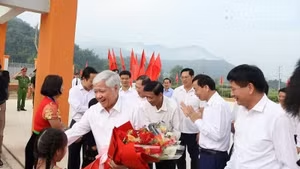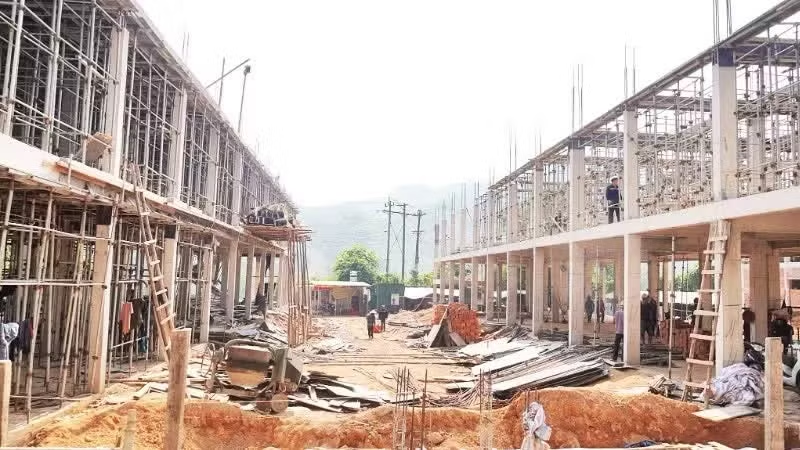
Overcoming numerous difficulties, localities are striving to complete the projects on schedule, ensuring learning opportunities for students in border areas and gradually narrowing the education gap between regions.
In late May, across land border communes, tens of thousands of workers have been working day and night on the construction of inter-level primary and secondary boarding schools, under the policy of the Politburo and the government on investing in school construction for border communes. Localities and relevant units have mobilised maximum human and material resources to speed up progress, aiming to put the new schools into operation from the 2026-2027 academic year.
At the construction site of the Pa Tan semi-boarding ethnic primary and secondary school in Lai Chau Province, more than 500 workers have been mobilised to work continuously under a “three shifts, four teams” model, with the determination to complete the project by June 20, 2026.
Phan Van Thuan, site commander of Viet Nam Construction Investment Development Joint Stock Company under Amacao Group, said the unit has so far completed about 70% of the workload. Although local labour is scarce, the unit has had to mobilise more than 100 workers from other provinces; material and labour costs have risen sharply. However, the contractor has still deployed the maximum number of machines and vehicles and proactively transported supplies from many localities to ensure the project’s progress.
According to a report by Lai Chau Province, among the five schools whose construction began in 2025, two schools in Phong Tho and Pa Tan are expected to be completed and put into use in June 2026; the schools in Bum Nua and Hua Bum will be completed before August 30. The Dao San school is facing particular difficulties due to weak geology, with subsidence appearing on the slope and affecting nearby houses. Contractors are focusing on handling the problem.
In Son La Province, 13 inter-level primary and secondary boarding schools are being built simultaneously in 13 border communes, with total investment of more than 3.448 trillion VND. So far, construction progress has reached 42-79% across the projects, with many schools in Yen Son, Long Phieng and Muong Hung Communes more than 70% complete. Ha Trung Chien, Standing Vice Chairman of the Son La Provincial People’s Committee, said the province aims to complete all the schools before August 30, 2026. To ensure progress, the province has launched a “Campaign to build schools for border Communes” and a “100-day-and-night emulation campaign”, maintained weekly briefings, reviewed progress for each project, and organised work under the “three shifts, four teams” model, including weekends and public holidays.
In Quang Tri Province, four inter-level boarding schools in the border communes of Huong Phung, Dan Hoa, Dakrong and Thuong Trach are all being accelerated. Many projects have moved from foundation work to the construction of main structures and finishing. A representative of the Quang Tri Provincial Construction Investment Project Management Board said the unit has required contractors to mobilise maximum manpower and machinery, increase shifts and teams, and closely follow developments on site. For delayed components, the board reviews each task, adjusts construction methods, and concentrates resources to ensure progress while strictly controlling quality.
In An Giang Province, the Vinh Gia inter-level primary and secondary boarding school project has reached about 75% of construction volume; Giang Thanh has reached 62.5%; and Khanh An has reached 98%. Le Van Hieu, Director of HAG Investment Consulting and Construction Co., Ltd., the contractor for Vinh Gia school, said the contractor is maintaining about 300 workers across three shifts a day. The target is to complete more than 97% of the project by June 30, two months ahead of the contractual deadline.
Ly Thi Hien, Vice Chairwoman of the Pa Tan Commune People’s Committee in Lai Chau Province, said the commune will have more than 2,100 primary and secondary students in the 2026-2027 academic year. Once completed, the inter-level boarding school will meet about 50% of local students’ learning needs, bringing great joy to local residents. The school has a plan to prioritise students from ethnic minority groups, those living far from the commune centre, and children from policy beneficiary families.
Do Thi Ha, Principal of Chieng Khuong Secondary School in Son La Province, said that with more than 1,140 students but only 12 classrooms, the school has had to organise two shifts of classes. In the next academic year, when the new school comes into operation, students will be able to study in better conditions, while those living far from school will be provided with boarding facilities.
In Vinh Gia Commune, An Giang Province, students at Vinh Gia School have faced difficulties in studying and travelling for many years. Dinh Thi Kieu Tien, an eighth-grade student at Luong An Tra Lower Secondary School, said that because their homes are far from school, many students have dropped out midway to help their parents earn a living. Meanwhile, Phan Thi Tuyet Minh, a teacher with 13 years of service in the locality whose home is more than 75km from the school, still has to live in cramped official housing.
“My colleagues and I all hope that once the boarding school project is completed, students will have better learning conditions and will no longer drop out as before, while teachers living far from home will also be able to stay at the school,” Minh shared.
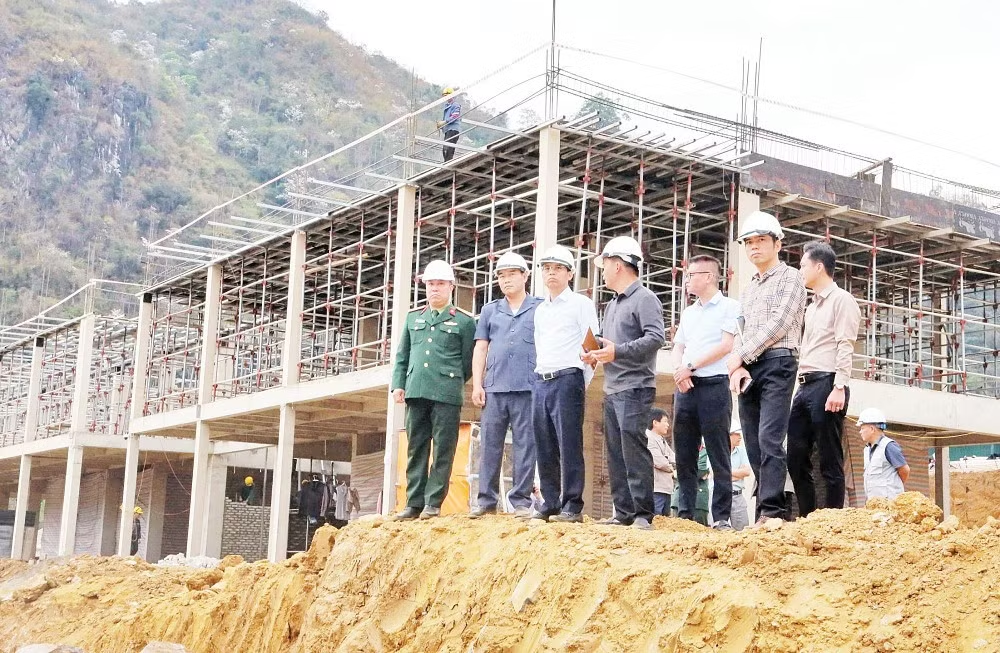
Alongside the bustling construction atmosphere, localities are also facing many difficulties. In Cao Bang Province, some projects have completed only 11-13.5% of the workload, with the Tong Cot inter-level boarding school recording the slowest progress.
Nguyen Huy Hoang, Director of the Cao Bang Provincial Investment and Construction Management Board, said many projects are being built in areas with complex geological conditions, requiring the unit to continuously handle technical issues on site and adjust construction plans. In addition, labour shortages and rising fuel and construction material prices are putting great pressure on signed contracts.
Many schools in Nghe An Province are located in remote and isolated areas, hundreds of kilometres from the provincial centre, with complex terrain, frequent landslides and difficult conditions for transporting materials, causing construction costs to rise by 15-20%. Among them, the Nhon Mai inter-level boarding school has had to adjust its design due to slope landslides, delaying progress by about one month compared with the plan.
In addition to building physical infrastructure, localities are also purchasing equipment and preparing conditions for the operation of the schools. In Son La Province, communes have completed school establishment plans, reviewed enrolment demand, and developed plans to arrange managers, teachers and staff.
In An Giang Province, Thieu Van Nam, Deputy Director of the Department of Education and Training, said the projects are all being built according to level-2 facility standards, with integrated information technology infrastructure to support digital transformation. The provincial education sector is purchasing equipment, preparing enrolment plans and arranging human resources, with the goal of putting the schools into use before August 30.
Inspecting project progress in Quang Tri Province, Chairman of the Provincial People’s Committee Le Hong Vinh requested investors and construction units to continue reviewing detailed progress, mobilise maximum manpower and equipment, and organise construction scientifically to make up for delays. Time is running short. Tightening construction discipline, enhancing contractors’ responsibility and ensuring flexible management will be decisive factors in completing the projects on schedule and with guaranteed quality.