From “hot majors” to future career choices
In previous years, university admissions seasons often saw economics, finance, marketing and languages emerge as the most popular fields. In 2026, however, the trend shifted noticeably.
According to statistics from the Ministry of Education and Training (MOET), 467,590 applicants applied for STEM disciplines, accounting for 53.4% of all applicants. Of these, nearly 332,000 chose 15 groups of basic sciences, key engineering disciplines and strategic technologies prioritised for development by the State. Computer Science and Information Technology remained the most popular fields, attracting more than 154,000 applicants, while Natural Sciences, traditionally regarded as a field that appeals to relatively few students, also saw a significant increase in interest.
Nguyen Thi Hong Nhung, an applicant in Ha Noi, said she had chosen Data Engineering after learning about demand for human resources in artificial intelligence (AI), big data and cybersecurity. She said she was seeking not only a job after graduation but also the opportunity to work in a modern technological environment and adapt to rapid changes in the labour market.
According to Professor and Doctor Nguyen Tien Thao, Director of the Department of Higher Education under the MOET, the sharp increase in the number of applicants choosing STEM is not a temporary phenomenon. In recent years, alongside the development of AI, semiconductors, digital technology and other strategic technology sectors, students and parents have become increasingly aware of the role of science, technology, engineering and mathematics. Scholarship policies, student support, businesses' demand for human resources and increasingly effective career guidance have also encouraged more students to choose STEM disciplines.
However, he noted that application figures only reflect initial interest. The success of this shift will only be confirmed through enrolment figures, training quality, graduation rates and graduates' ability to meet labour-market requirements.
The shift is taking place as Viet Nam implements major policies to develop science and technology, innovation and national digital transformation. Politburo Resolution No. 57-NQ/TW, together with human-resource development programmes for the semiconductor industry, AI and strategic technologies, has sent a clear message about the country's development orientation in the new period.
In particular, Decree No. 179/2026/ND-CP, which provides scholarships for students studying 15 priority groups of disciplines, not only eases the financial burden on students but also demonstrates the State's strong commitment to investing in high-quality human resources.
The race to improve training quality
The surge in applications for STEM disciplines is placing unprecedented pressure on higher education institutions. The challenge is not simply to increase enrolment but also to reform training programmes.
Fields attracting the largest numbers of students, including AI, semiconductors, data science, cybersecurity and digital technology, are developing at a rapid pace. Technology innovation cycles are becoming shorter, while university programmes typically last four to five years. If curricula are not regularly updated, students risk entering the labour market with knowledge that is already out of step with reality.
This also requires investment in facilities, the development of teaching staff and closer links with businesses to ensure that graduates can meet practical requirements immediately after graduation.
These demands are prompting many universities to shift from the mindset of “opening new majors to meet enrolment demand” towards building training ecosystems linked to research, innovation and business.
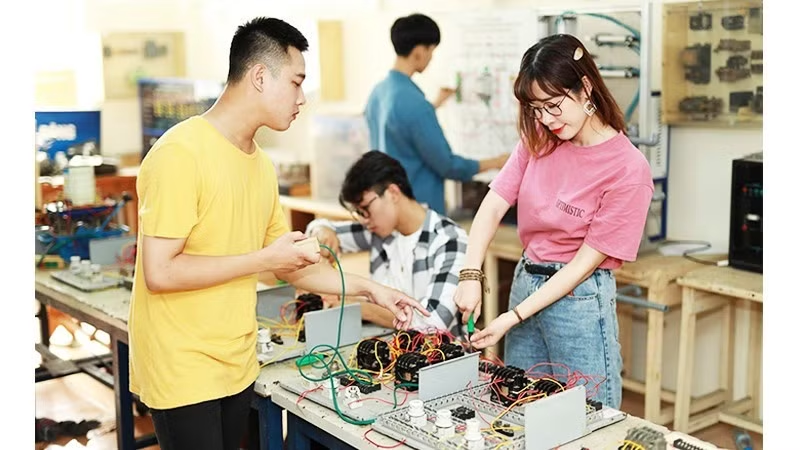
At Ha Noi University of Science and Technology, rather than simply increasing enrolment quotas for STEM disciplines, the university is investing in an interdisciplinary Innovation Space that connects research institutes, laboratories and businesses within the same ecosystem.
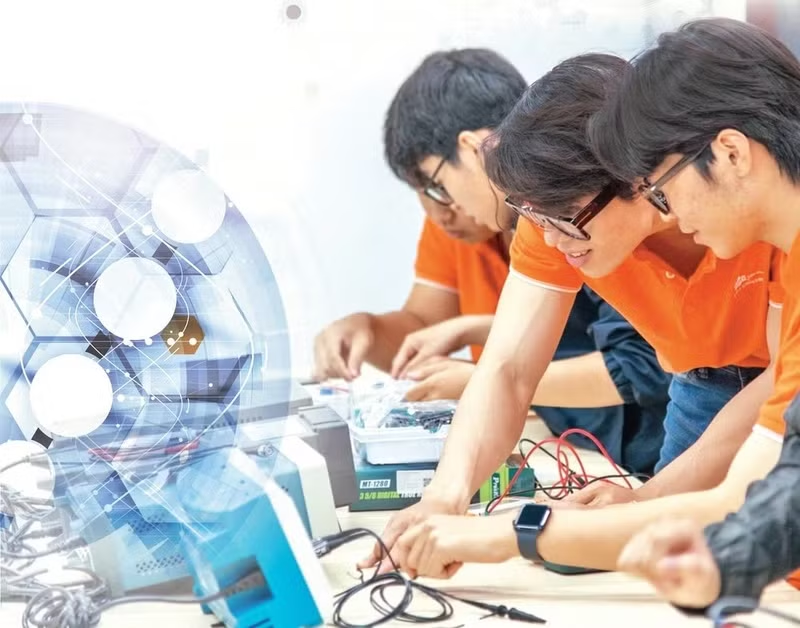
According to Professor and Doctor Le Anh Tuan, Director of Ha Noi University of Science and Technology, the university's goal is not only to train technically proficient engineers but also to develop students' research, innovation and product-development capabilities. Many courses are designed around project-based learning, allowing students to participate in research, work in modern laboratories and tackle problems set by businesses from their first years of study.
At Ha Noi University of Mining and Geology, 30 of its 48 training disciplines are in STEM fields. The university has also introduced talented-engineer programmes in emerging fields such as AI and digital twins of the Earth, automation in mining and energy, smart mining engineering and technologies for the exploitation of strategic minerals. These programmes are accompanied by scholarship policies to attract high-achieving students.
Meanwhile, Phenikaa University has expanded investment in laboratory facilities, encouraged students to engage in scientific research from their first year and strengthened cooperation with businesses so that students can undertake internships and participate in real-world projects during their studies.
In practice, the key difference between universities is no longer the number of STEM disciplines they offer, but their ability to create an environment in which students can learn with businesses, conduct research with businesses and gradually develop innovation capabilities throughout their training.
According to Associate Professor and Doctor Tran Quang Anh, Deputy Director of the Posts and Telecommunications Institute of Technology, engineers working in AI, semiconductors, big data and cybersecurity need a strong professional foundation, project implementation skills, foreign-language proficiency, critical thinking, teamwork skills and the ability to adapt quickly to new technologies. These are also among the capabilities that businesses particularly value when recruiting technology professionals.
From lecture halls to the labour market
Viet Nam's demand for STEM human resources is growing rapidly alongside the development of high-tech industries. The semiconductor industry development strategy aims to establish hundreds of chip-design companies, develop packaging and testing plants, and gradually master a number of core technologies.
Investment by businesses in AI, digital transformation, big data and automation is also expanding. In the semiconductor industry alone, many businesses are recruiting not only design engineers but also specialists in testing, packaging, materials and automation — positions that require specialised training from university level.
However, strong demand does not mean that all STEM graduates will easily find suitable jobs. The high-tech labour market currently has no shortage of vacancies, but requirements for the quality of human resources are becoming increasingly stringent.
Nguyen Hoang Duong, Chief Executive Officer of ezCloud Global Technology Co., Ltd., said technology is changing at a very rapid pace, much faster than the university training cycle. Therefore, the role of universities is not to chase every immediate requirement of businesses, but to build a solid knowledge base that enables students to learn independently, adapt to and master new technologies in the future. Businesses, he said, need engineers with problem-solving abilities, creative thinking and a capacity for continuous learning rather than people who are merely proficient in a specific technology.
According to many technology companies, the time available for newly graduated engineers to become capable of participating immediately in major projects is becoming shorter. This makes practical skills and the ability to learn independently just as important as professional knowledge.
Experts say the main concern is not the rapid increase in the number of STEM students, but the risk of a mismatch between labour supply and demand. If the development of high-tech industries fails to keep pace with the scale of training, many engineers may struggle to find jobs suited to their expertise. Conversely, if businesses expand faster than universities' training capacity, the shortage of high-quality human resources will persist.
According to Professor and Doctor Nguyen Tien Thao, businesses can participate in developing curricula, jointly organising training, accepting students for internships and assessing learning outcomes. When students gain exposure to production, research and business environments during their studies, the gap between training and employment can gradually be narrowed. At the same time, this provides a basis for universities to update their curricula more closely in line with practical demand and improve the quality of human resources in strategic technology fields.