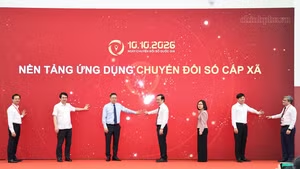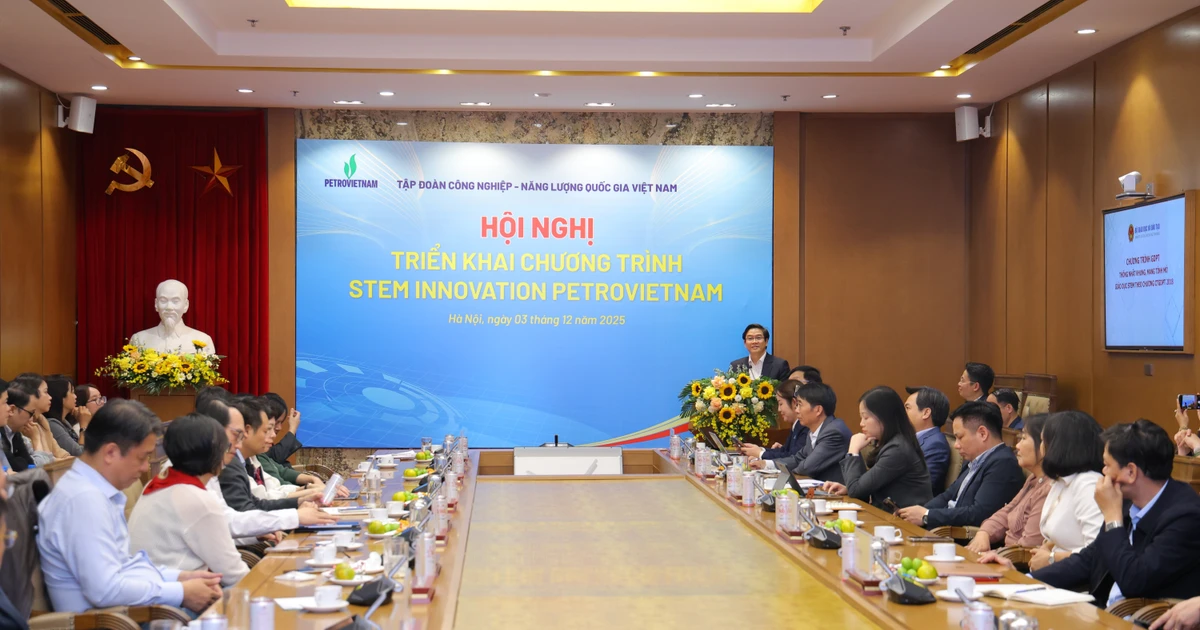
Speaking at the conference in Ha Noi on December 3, Tran Quang Dung, Permanent Deputy Secretary of the Party Committee of the Viet Nam National Oil and Gas Group, noted that, inspired by the idea of General Secretary To Lam, the Group proposed launching the Petrovietnam STEM Innovation Programme — a large-scale educational project aimed at upgrading educational infrastructure and supporting the training of young people in science, technology, engineering and mathematics, thereby meeting the demand for high-quality human resources in the new development period.
The programme began on September 21, 2025, and according to the plan, within 100 days, by the end of 2025, Petrovietnam will implement three international-standard STEM classrooms in each province and city, including two classrooms for high schools and one for secondary schools.
Petrovietnam’s decision to invest in STEM education, particularly through the model of 100 STEM laboratories across 34 provinces and cities, is not only socially meaningful but also reflects a strategic approach to developing the nation’s future workforce, an action embodying the spirit of “investing in the future through knowledge”.
These STEM classrooms will become centres for spreading knowledge, serving both as spaces for students to experience various levels of STEM education and as “incubators” to train core teachers, generating widespread impact across tens of thousands of schools nationwide.
All 100 STEM laboratories under the programme are expected to be handed over to schools no later than December 31, 2025.
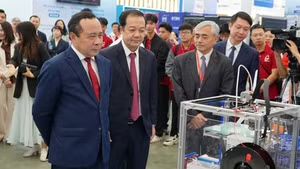
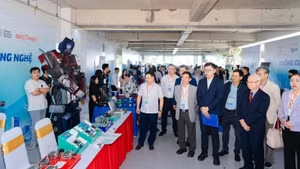
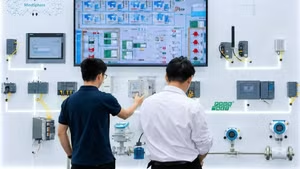
The STEM laboratories are designed according to the model of “speed – standardisation – sustainability”, fully equipped with advanced technologies such as smart interactive boards, AI-IoT systems, VEX Robotics, 3D printers, CNC cutting machines and energy–environment–themed experimental kits.
Recently, the Ministry of Education and Training also issued additional documents assigning tasks to localities and educational institutions to further promote and expand STEM education activities in the coming period, in accordance with the orientations of the Politburo’s Resolution No. 57-NQ/TW and Resolution No. 71-NQ/TW, thereby broadening STEM-related subject groups at the general education level.
From that foundation, Viet Nam aims to build sources for university-level STEM majors to have high-quality human resources according to the development orientation of the country's science and technology sectors in the coming period.