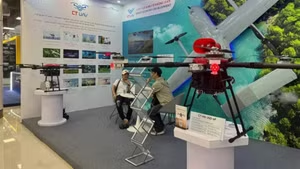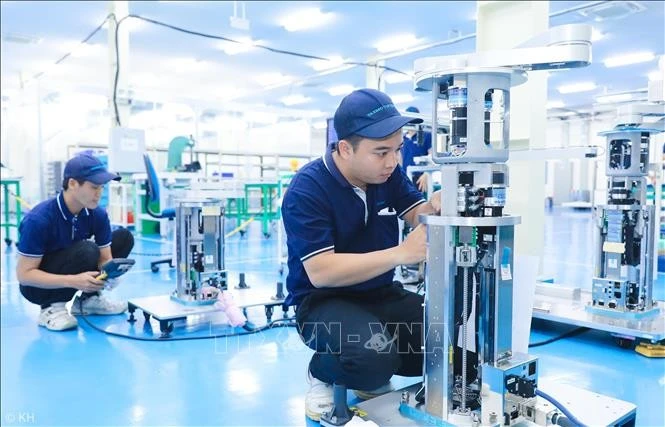
The objectives of Viet Nam's current strategy for developing science, technology and innovation (STI) make good sense, and they are certainly reachable and doable, said Israeli expert Mel Shalev.
Shalev, a senior Israeli expert who has over 40 years of working in the field of technology, including 37 years with IBM and decades of working in Viet Nam, made the comment during a recent interview granted to the Viet Nam News Agency.
Viet Nam is aiming to become a high-tech economy with the pillars identified as the enablers, he said, noting that the local conditions enable their rapid development.
He held that too much is expected of the private sector and too little of the public sector. If FDI is part of the private sector support for the strategy and the desired FDI objectives are met, the strategy should succeed and even exceed expectations. However, if FDI is not part of the private sector support, this may lead to insufficient total funding to ensure maximum success.
Talking about opportunities and challenges for Viet Nam in advancing its technology and innovation landscape over the next decade, Shalev said there are many opportunities, each with their own particular challenges. The trick is not to put too many eggs in one basket nor to put too few eggs in too many baskets.
Software is one area which has already proved successful and appropriate for Viet Nam, he went on. “Probably, software is the greatest opportunity for Viet Nam. The sector has advanced rapidly with home-grown companies such as FPT leading the way, especially in software services and in training of the new generation.”
“Hardware – unless we are talking about integration – is much more difficult, as it is capital intensive at most levels. This is especially the case for semiconductors, where local initiative, such as was there for software, will not be enough.”
He also mentioned the agro-technology sector, given the importance which agriculture and aquaculture play in the economy. For example, increasing both yields and quality of yields would require leveraging both new hardware and new software.
The expert took the coffee sector as an example, saying it could become more productive and more profitable by using robotics and AI for selective picking, intelligent sorting, and intelligent processing. Given the amount of fertile land in Viet Nam, new crops and new varieties of crops could also be grown, leveraging technologies such as tissue culture.
“Thus, software is a key, if not the key stepping stone for many of those opportunity areas in Viet Nam's STI strategy,” he opined.
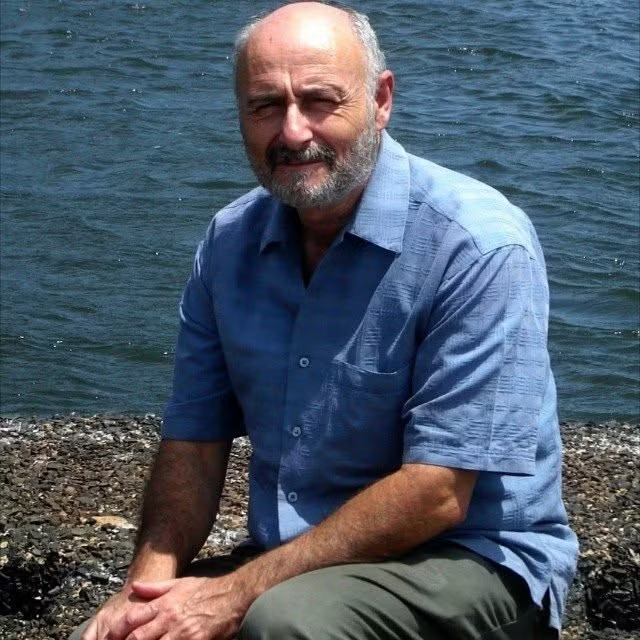
Regarding how Viet Nam can leverage international partnerships and local talent to become a more competitive player in the global tech industry, Shalev suggested the top three ways in which international partnerships can be mixed with local talent to become a significant global player.
The first is to realise that the partners do not have to be more advanced than Viet Nam for both of them to benefit from an STI relationship, and one way to start would be in education and training. Improving skills in English comprehension and conversation would also be important for such a strategy as English has become the paramount global language of science, technology and trade.
Second, there are large Vietnamese communities, numbering in the millions in key technology countries such as the US, Japan, France, Australia, and Canada. Shalev suggested Viet Nam make greater efforts to attract more of them home, or at least to their second home, as they are a bridge between Viet Nam and some key high-tech partner countries.
The third is to attract on-site expats of any nationality among those top partner STEM countries, something he described as worth investing in.
Currently, two main technology hubs are in Ho Chi Minh City and Hanoi. He thought that it would be wise – and for the good of Viet Nam's main cities – not to grow them further but to grow some five tech hubs, spread in a logical fashion in the northern, central, and southern regions of the country, in Tier-2 cities with a maximum population of 1 million residents, and which have at least one university with a strong STEM focus.
Some candidates could be Da Nang, Hai Phong, Vinh, Hue, etc. These would be magnets for young Vietnamese families seeking a higher quality of life combined with a lower cost of living than the two megacities. Also, they would be cities where expats would be comfortable living in and even bringing their families to.
There are a mix of necessary conditions which catapult a country from insignificant global STI player to one which is making a significant impact. They include a culture which abhors indolence; a culture which cherishes individualism, creativity and entrepreneurship; a nation with a sense of urgency; a nation which cherishes and promotes education for the masses as well as for the elite; and neither last nor least and somewhat counter-intuitively, a culture which tolerates indolence as long as it is not extreme, according to the expert.