Social sciences and humanities and the process of innovation
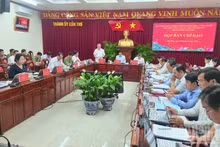
In the new era, the social sciences and humanities are not only explanatory disciplines, but must also become sciences that create social value and pave the way for new development models.
#innovation
In the new era, the social sciences and humanities are not only explanatory disciplines, but must also become sciences that create social value and pave the way for new development models.
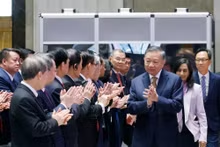
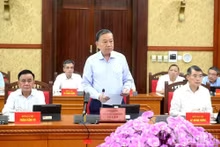
A forthcoming resolution on Viet Nam’s new development model must affirm that the country's core development philosophy in the new era is to build national capacity for innovation, self-reliance and adaptation, Party General Secretary and State President To Lam said on June 4.
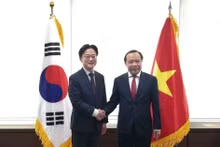
Vietnamese Ambassador to the Republic of Korea (RoK) Vu Ho on June 2 held talks with Koo Huck Chae, First Vice Minister of the Ministry of Science and ICT (MSIT) of the RoK, to discuss measures to strengthen cooperation in science, technology, and innovation between Viet Nam and the RoK.
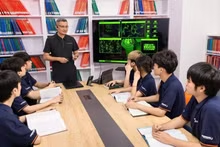
In the global technology race, developing high-quality human resources has become a matter of survival for many countries.
Viet Nam and the United Nations (UN) are stepping up efforts to build a new cooperation framework for the 2027–2031 period to support the country’s long-term development goals.
The elevation of bilateral ties to a Comprehensive Strategic Partnership during European Council President Antonio Costa’s January visit to Viet Nam has opened up new room for cooperation, particularly in science-technology and innovation, Deputy Prime Minister Ho Quoc Dung told visiting European Commissioner for Startups, Research and Innovation Ekaterina Zaharieva on May 26.
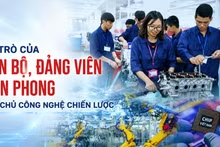
Human resources are regarded as the decisive factor in achieving breakthroughs in the development of science, technology, and innovation. Numerous directives and policies issued by the Party and the State have clearly identified the tasks of training, attracting, and effectively utilising intellectuals, experts, and highly skilled workers.
Building on the strong foundations of bilateral cooperation, Minister of Foreign Affairs Le Hoai Trung expressed Viet Nam’s wish for Sweden to remain one of its foremost partners in Europe in the fields of science and technology, innovation, digital transformation and green development.
In the context of the growing Comprehensive Strategic Partnership between Viet Nam and France, Hai said GCVF should position itself as a bridge for knowledge and technology transfer, bringing scientific and technological achievements from France and Europe to support Viet Nam’s practical development needs.
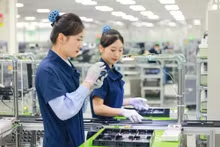
Politburo member and Secretary of the Party Central Committee (PCC) Nguyen Thanh Nghi, who is also Head of the PCC’s Commission for Policies and Strategies visited the Samsung Viet Nam Research and Development (R&D) Centre in Ha Noi on May 14.
Prime Minister Le Minh Hung reiterated Party General Secretary and State President To Lam’s demand for breakthrough action delivering tangible and measurable results while chairing the third meeting of the Government’s Steering Committee for science and technology, innovation, digital transformation and Project 06 in Ha Noi on May 11.
Amid intensifying global technological competition, many countries are shifting decisively towards growth models based on knowledge and technology. For Viet Nam, innovation has been identified as a key driver to enhance productivity and competitiveness.
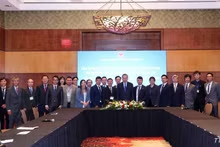
The Viet Nam – Republic of Korea (RoK) forum on science, technology and innovation, part of the state visit to Viet Nam by RoK President Lee Jae Myung, took place in Ha Noi on April 24.
Politburo member and Chairman of the Party Central Committee’s Organisation Commission Nguyen Duy Ngoc on April 15 paid a working visit to Zhongguancun Science Park in Beijing while accompanying General Secretary of the Communist Party of Viet Nam (CPV) Central Committee and State President To Lam, his spouse, and a high-level Vietnamese delegation on a state visit to China.
Viet Nam’s start-up ecosystem is entering a phase of rapid growth, supported by a range of breakthrough policies aimed at promoting entrepreneurship and innovation. However, a deeper look shows that the start-up ecosystem still faces many bottlenecks, making it difficult for projects to move into real-world application and establish a foothold in the market.
Deputy Prime Minister Bui Thanh Son has signed Decision No. 540/QD-TTg approving a plan to implement the agreement on cooperation in science, technology and innovation between the Governments of Viet Nam and France.
A series of new economic policies will come into force, focusing on innovation, technology transfer and enhancing transparency in the economy, from April 1, 2026.
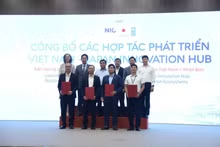
Viet Nam and Germany are stepping up efforts to connect their innovation and startup ecosystems following the signing of a memorandum of understanding (MoU) between Viet Nam's National Innovation Centre (NIC) and the Centre for Entrepreneurship (CfE) of the Technical University of Berlin (TU Berlin).
Viet Nam attaches importance to its Comprehensive Strategic Partnership with the US, with cooperation in science, technology, innovation and digital economy serving as one of the key groundbreaking pillars, Minister of Public Security General Luong Tam Quang said on March 17.
The National Innovation Centre (NIC) under the Ministry of Finance, in coordination with the Consulate General of Viet Nam in San Francisco, has recently organised a seminar titled “Connecting the Viet Nam Innovation and Experts Network in Silicon Valley to advance strategic technology development.”