In May 2025, General Secretary To Lam raised the issue of introducing AI into education from general education through to higher education. Subsequently, the Ministry of Education and Training piloted AI education content at a number of schools during the 2025-2026 academic year; based on the pilot results, nationwide implementation in general education schools will begin in the 2026-2027 academic year. For vocational and higher education, the government has set the goal of equipping learners with AI capabilities and training highly specialised AI personnel by 2030.
The journey towards bringing AI into schools
On September 5, General Secretary and President To Lam sent a letter to teachers and students on the occasion of the opening of the new academic year. In the letter, he stressed: “In the face of profound changes in science, technology, and artificial intelligence, education must proactively expand access to knowledge and improve the quality of teaching and learning. Technology must serve people and make education better. The more modern technology is applied, the more schools must nurture independent thinking, academic integrity, responsibility, civic awareness, and humanistic values that no machine can replace.”
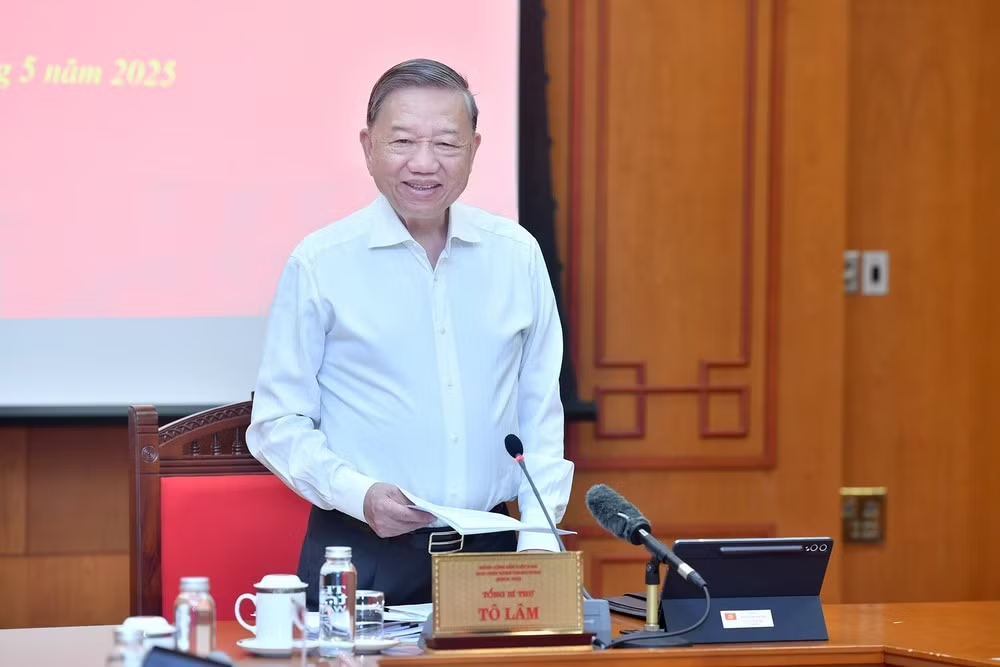
More than a year ago, in his speeches, General Secretary To Lam raised the issue of introducing AI into education from general education through to higher education. At a meeting of the Standing Committee of the Central Steering Committee for the Development of Science, Technology, Innovation and Digital Transformation in May 2025, the general secretary called on the education sector to determine from which grade AI should be taught, where to begin, and what the curriculum should look like.
In response to these requirements, AI has gradually been incorporated into a roadmap covering multiple levels of education, from general education to vocational and higher education. Politburo Resolution No. 71-NQ/TW on breakthroughs in education and training development, issued in August 2025, identified the need to enhance digital and AI capabilities among learners and teachers; study the incorporation of AI knowledge into the general education curriculum; and integrate data analysis and AI into higher education while applying the technology in educational management and organisation.
From the first pilots
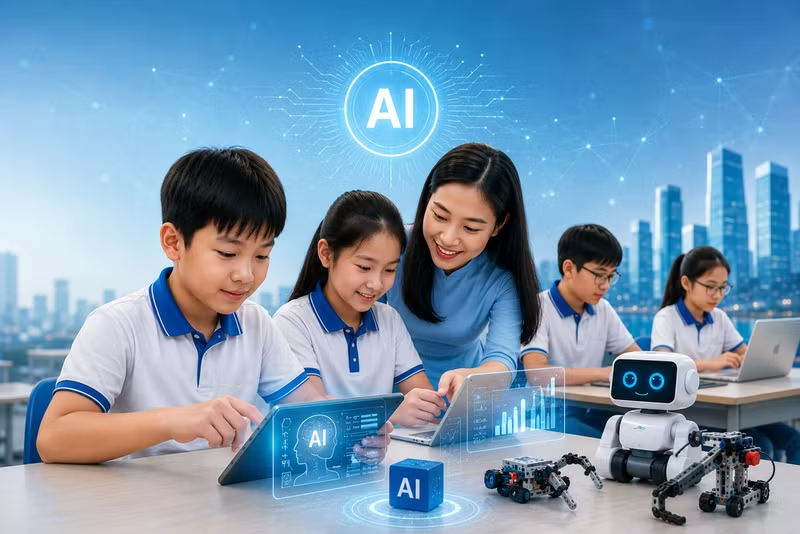
At general education level, the first step was to experiment rather than implement AI on a large scale at once. At the end of 2025, the Ministry of Education and Training issued a Framework for pilot AI education content for school students and guidance on its implementation during the 2025-2026 academic year. Rather than requiring schools to introduce a separate subject, schools could choose approaches suited to their actual conditions, such as integrating AI into existing subjects and organising thematic activities, STEM activities, clubs, projects, or experiential activities.
The pilot process was also monitored so that adjustments could be made before the programme was expanded. In 2026, the ministry required localities to compile information on the scale of implementation, forms of organisation, training results, and difficulties at grassroots level; it then continued to survey education managers, teachers, and students.
Reports from localities and schools show that AI has begun to enter classrooms, but the level of implementation varies depending on infrastructure, personnel, and the way each school organises the programme.
In Lam Dong, 47 schools piloted the programme during the 2025-2026 academic year, including 16 primary schools, 16 lower secondary schools, and 15 upper secondary schools.
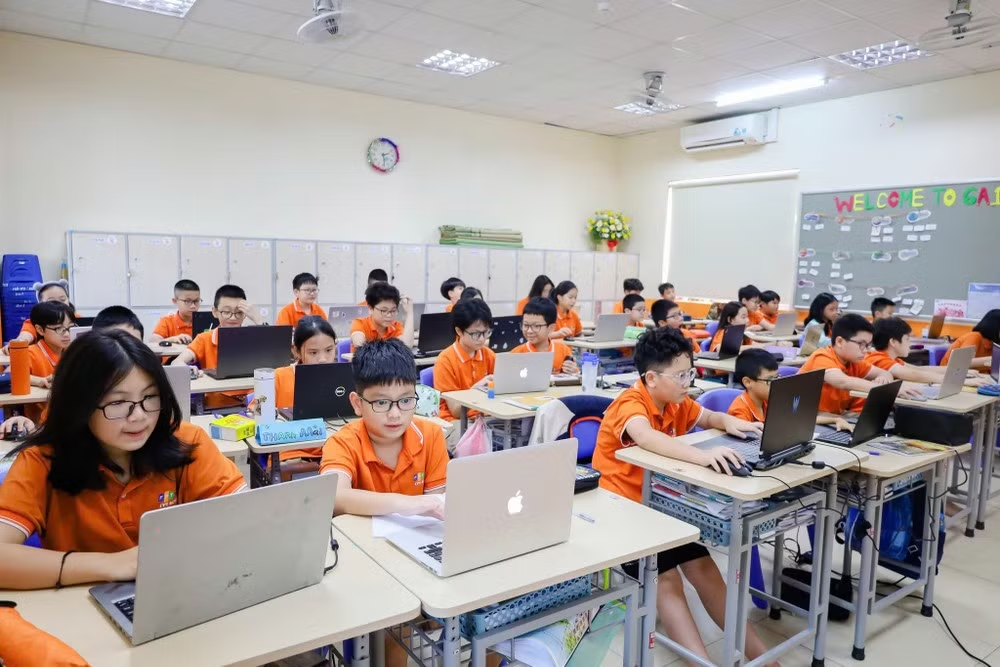
In Dien Bien, Thanh Yen Primary School introduced AI content to 20 classes with 572 students, after two education managers and 34 teachers took part in training and professional development. The school noted difficulties such as a lack of dedicated teaching time, inconsistent technological equipment, and the limited ability of some teachers to access new technologies.
Similarly, Hai Phuong Lower Secondary School in Ninh Binh reported that 100% of its students had access to AI integrated into Information Technology lessons, but internet connectivity, computer configurations, and teachers’ ability to integrate AI remained bottlenecks.
From the pilot phase, policy has begun to shift towards expanding the scale of implementation and establishing long-term targets. In August 2026, the government approved the National Programme for Developing Artificial Intelligence Human Resources, setting the target that at least 80% of general education students will be equipped with basic AI knowledge and skills by 2030, while at least 80% of vocational education learners and 100% of higher education learners will be equipped with AI knowledge and skills.
The programme also aims to train, retrain and provide further training for at least 50,000 people with university-level qualifications or higher who possess AI application capabilities, including at least 10,000 highly qualified AI personnel.
Towards nationwide implementation
For general education, the 2026-2027 academic year marks the transition from pilot programmes to nationwide implementation. Under the AI Education Content Framework issued by the Ministry of Education and Training on August 18, 2026, the core content comprises 12 periods per class each academic year, while schools remain free to choose flexible forms of organisation. The aim is not only to help students learn how to use tools, but also to develop their ability to verify information, critical thinking, and habits of using AI safely and responsibly.
Against this backdrop, AI is being piloted not only as content for students to learn but also as a tool to support the teaching and learning process itself.
At FPT Thanh Hoa Primary, Lower Secondary and Upper Secondary School, Year 2 teachers use AI to create characters to support lessons, convert text into speech, generate images and videos, and compile learning materials. The school requires students to cross-check information provided by AI against multiple sources, avoiding turning the tool into something that “does their homework for them.” FPT is one example of an institution providing AI education from general education through to college and university, with different focuses for different groups of learners.
At general education level, FPT Schools have developed technology-based experiential learning activities from Year 1 to Year 12. Primary school students become familiar with algorithmic thinking, AI recognition, and safe interaction with technology; at lower secondary level, the content expands to data, programming, interdisciplinary AI, and critical evaluation of machine-generated information; at upper secondary level, students gain deeper exposure to algorithms, AI combined with robotics, scientific research, and applied products.
FPT is one example of an institution providing AI education from general education through to college and university, with different focuses for different groups of learners.
At college level, FPT Polytechnic offers a major in Artificial Intelligence Application Programming under the Computer Programming field, with a two-year programme covering data, machine learning, deep learning, natural language processing, computer vision, internships, and graduation projects.
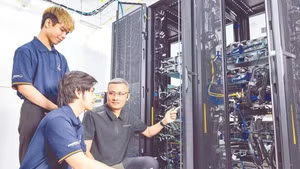
At university level, FPT University offers a major in Artificial Intelligence; in 2026, it added a Robotics and Artificial Intelligence pathway, combining AI with robotics, embedded systems, and computer vision. FPT also supports the Artificial Intelligence Olympiad team selection examination organised by the Ministry of Education and Training, providing the examination platform on the FPT AI Factory infrastructure; the preliminary round attracted 1,188 contestants from 32 organisations.
Maintaining independent thinking to master technology
From the policy objectives and models currently being implemented, it is apparent that AI requirements increase according to learners’ levels of education, but they do not constitute a rigid boundary. In general education, the focus is on foundational understanding, use, verification, and responsible conduct in relation to AI; in vocational and higher education, the requirements expand to the application of AI in professional fields, system development, and the training of highly specialised personnel. “Mastery” should therefore be assessed through learners’ actual capabilities rather than simply through the names of subjects or training programmes.
On August 25, 2026, when reviewing one year of implementation of Resolution No. 71, General Secretary and President To Lam noted that the past year had primarily focused on laying the foundations, while qualitative changes in teachers, learners, and human resources had not yet become truly evident.
With regard to AI, the General Secretary stressed that technology must serve education — not replacing learners’ thinking but rather helping them to think more deeply, think better, and become more creative.
More than a year after the initial directives, the question has shifted from “should AI be introduced into education?” to a more difficult challenge: how to introduce AI in a way that turns it into a genuine capability for learners, while preserving independent thinking, creativity and the guiding role of teachers.
As in his letter to the education sector on the occasion of the opening of the new academic year, General Secretary and President To Lam sent the following message: “The world is changing every day. What has been learned may quickly become outdated, but the spirit of eagerness to learn, resilience, creativity, honesty, and determination to move forward will always have value. I hope you will nurture your dreams, persevere in your studies, master technology, learn to rise again after failure, and use your talents to serve the People and the country.”