Grassroots efforts to make digital transformation deliver tangible results
In Trung Son Commune, local authorities mobilised additional personnel and assigned specific responsibilities to different working groups to implement the 100-day campaign to digitise the records of 300 Party members. Despite a shortage of specialised staff and occasional internet connection disruptions, officials have worked hard to process documents, determined to complete their tasks on schedule.
Phung Xuan Lien, Head of the Party Building Commission of the Trung Son Commune Party Committee, said the locality assigned tasks based on the principle of clearly defining responsibilities, specific duties and expected outputs. One group was responsible for reviewing, organising and scanning records; another focused on cleaning the party membership database 4.0; while the third collected missing information. This arrangement allowed different stages of the work to be carried out simultaneously, minimising overlaps and facilitating the verification of results.
Meanwhile, in Hung Viet Commune, where the number of Party members is more than five times that of Trung Son, the volume of records requiring processing is considerably greater. The locality had to reinforce the party building commission with additional personnel to ensure that work remained on schedule. Tran Thi Quyen, an official at the party building commission of the Hung Viet Commune Party Committee, said some records of members admitted to the Party many years ago had lost certain documents during storage. Consequently, officials had to devote considerable time to reviewing and cross-checking information, working day and night to complete their assignments in accordance with the provincial plan.
Bui Ba Dat, Permanent Deputy Secretary of the Hung Viet Commune Party Committee, said the locality had reviewed and reorganised Party membership records in accordance with guidance from the Provincial Party Committee’s Organisation Commission. The records were scanned and digitised in line with prescribed procedures only after the review and reorganisation process had been completed. Thanks to the strong determination of local officials, the commune had largely achieved the targets of the 100-day campaign at the time of reporting.
In Doan Hung Commune, the Party Committee has introduced the Electronic Party Member Handbook application and cleaned and standardised data on the Party Membership Data Management 4.0 software. It has also established rapid-response teams that visit residential areas to help Party members install and use digital applications. The use of AI virtual assistants to answer questions about professional procedures, together with short videos disseminating Party directives and resolutions on social media platforms, has also helped modernise information and communication activities.
Nguyen Van Van, Secretary of the Doan Hung Commune Party Committee, said the committee had developed a project entitled “Renewing party member admission in association with digital transformation”, aimed at addressing shortcomings in the organisation, management and admission of new Party members. The project’s core objective is to gradually reform the entire process, from identifying potential candidates, providing training and monitoring their progress towards Party membership to organising admission ceremonies, assigning duties and evaluating probationary Party members.
In practice, digitising Party membership records is not merely a technical operation but also a process of reviewing and verifying information. For older records containing missing or inconsistent data, officials must proceed carefully in accordance with professional guidance to ensure accuracy and preserve the validity of original documents. Despite the results achieved, implementation continues to face difficulties involving personnel, equipment, internet connectivity and digital skills.
The large volume of records, limited implementation time and stringent requirements for accuracy and confidentiality have forced many units to mobilise additional staff and extend working hours. Cases involving missing information or lost documents require even greater care and timely professional guidance.
To make digital transformation a regular working practice, Phu Tho needs to continue improving operational procedures, strengthening training, providing direct support to grassroots units and maintaining data quality inspections.
Alongside investment in equipment, greater attention should be paid to improving officials’ digital skills to ensure that systems are used consistently, securely and effectively. Following the intensive data-cleaning phase, Party committees at all levels must maintain regular information updates and cross-checks to ensure that data remain complete, accurate and up to date.
Standardising data and modernising Party membership management
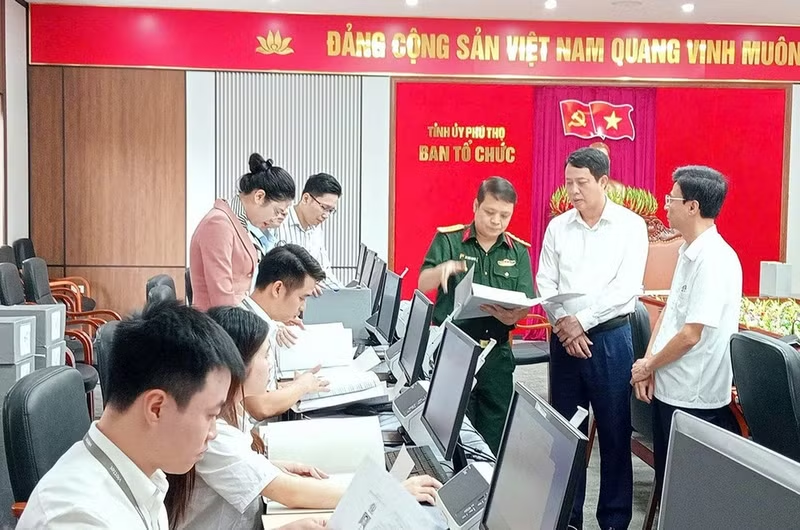
During the 100-day campaign to digitise Party membership records, the atmosphere at the Organisation Commission of the Phu Tho Provincial Party Committee was consistently busy. Files were reviewed one by one, and information was carefully cross-checked before being entered into the system.
To support localities in implementing the campaign, the commission focused on improving its methods of providing guidance, conducting training and monitoring progress. Specialised officials regularly monitored developments and promptly addressed difficulties, helping grassroots units overcome obstacles in reviewing, reorganising and digitising records.
According to Nguyen Quang Hung, Deputy Chief of Office of the Phu Tho Provincial Party Committee’s Organisation Commission, the agency has strengthened both in-person and online guidance while proactively applying technology to develop data aggregation software and progress-monitoring dashboards. These tools enable provincial authorities to keep track of implementation at the grassroots level, identify delays and provide timely assistance.
To date, Party organisations across the province have updated nearly 100% of the general information relating to more than 266,000 Party members. They have also reviewed and standardised the lists of Party organisations covering nearly 2,500 grassroots Party organisations and more than 9,000 Party cells.
Efforts have focused on cross-checking and standardising detailed information fields in Party membership records, ensuring progress in line with the established roadmap. Alongside data standardisation, the province has accelerated the rollout of the electronic party member handbook, gradually shifting the distribution of documents, resolutions and notices, as well as information exchanges, from paper-based methods to digital platforms.
The application has been introduced in all 150 Party organisations covered by the programme. To date, more than 95% of Party members have logged in and used the application, while nearly 97% of Party cells have held their regular meetings through it.
Bui Dinh Thi, Head of the Organisation Commission, said one of the most notable developments has been the acceleration of digital transformation in Party membership management, with a particular focus on standardising the Party Membership Database 4.0 and introducing the electronic party member handbook.
These tasks have received close attention and direction from the Provincial Party Committee’s Standing Board, reflecting the need to renew leadership methods and improve the management of Party organisations and members in the new context. The application of digital technology is gradually becoming a regular practice, directly integrated into the day-to-day activities of Party organisations.
Digital transformation within the province’s Party agencies has also been accelerated in document processing, work administration, and data connectivity and sharing. Currently, 95.1% of outgoing documents and 94.4% of incoming documents are processed entirely through digital systems.
These achievements provide an important foundation for the province to continue renewing leadership methods and improving the quality of Party organisations and members, contributing to building an increasingly clean, strong, modern, substantive and effective provincial Party organisation.