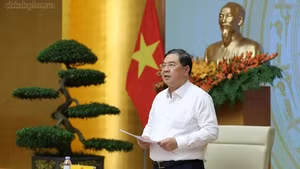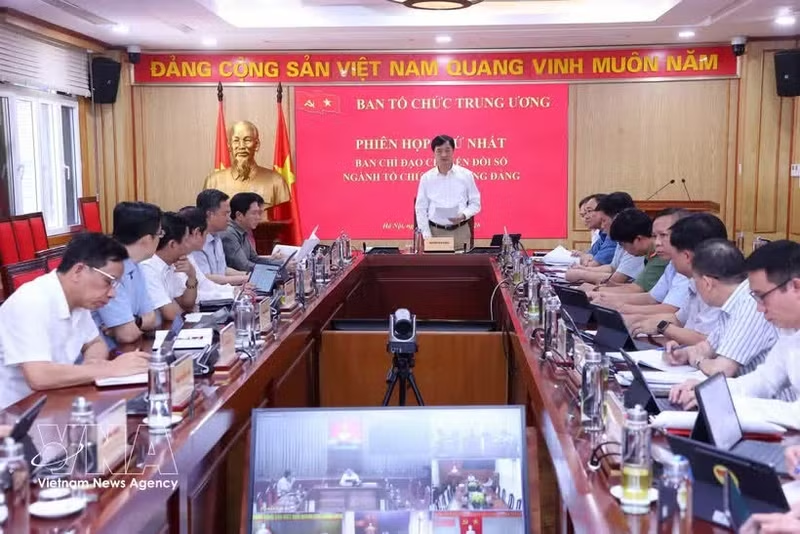
The official made the appeal while chairing the first meeting of the steering committee for digital transformation in the Party organisation and personnel sector in Ha Noi on May 13. The meeting announced the establishment of the steering committee, comprising 29 members and headed by Ngoc.
The committee is tasked with directing and coordinating digital transformation efforts across the Organisation Commission and the Party organisation and building sector, ensuring alignment with reforms in leadership, advisory work, implementation and data-based governance.
It will also oversee the development and implementation of the sector’s master digital transformation plan through 2030.
In addition, the committee will direct the development of a large-scale database system covering Party organisations, Party members, officials, civil servants, public employees, organisational structures, staffing, job positions, training, personnel policies and internal political protection.
Ngoc urged provinces and cities to review legal frameworks, decentralisation mechanisms, assigned tasks and administrative procedures, while ensuring synchronisation between local infrastructure systems and the central platform, including equipment, cybersecurity solutions and resource allocation.
He stressed that digital transformation must go hand in hand with reforms in leadership, governance and operational management. Departments, agencies, units and localities, he said, must regard digital transformation as a core and long-term political task rather than a symbolic campaign or a race for achievements.

Ngoc underscored that information security must be prioritised from the outset, with tangible outcomes and efficiency serving as the key benchmarks. Each task, he said, must have clearly defined deliverables, responsible personnel, timelines and evaluation criteria, ensuring that outputs can be inspected, accepted, applied and measured effectively.
He also reiterated the principle of “clear tasks, clear personnel, clear responsibilities, clear procedures, clear timelines and clear products,” with each task assigned to a single focal point throughout implementation.
Regarding key priorities, Ngoc requested all departments and units to comprehensively review professional procedures under their management, identify priority workflows, define processing contents, delegation mechanisms and implementation timelines.
He highlighted the need to streamline cumbersome, intermediary and manual procedures while focusing on data standardisation and cleansing as core tasks. Data, he said, must remain live and continuously updated, with priority given to frequently used and shared datasets.
The office of the committee was tasked with coordinating with relevant units to urgently review the current status of infrastructure, end-user devices, transmission systems, digital signatures, user accounts and operational capacity. Based on the assessment, priority plans should be proposed to address urgent needs first and ensure stable, seamless and secure operations from the central to grassroots levels.
Ngoc also stressed the importance of strengthening training, user support and changes in working methods. Each unit, he said, must establish its own digital transformation team comprising officials with strong professional expertise, innovative thinking and support capabilities, while leaders must directly monitor progress and resolve bottlenecks through digital platforms.
He further called for the management and use of artificial intelligence (AI) based on the principles of safety, control and efficiency, stressing that AI should serve as a support tool while final decisions must remain under human responsibility.
Ngoc urged members of the steering committee to effectively roll out a 45-day peak campaign aimed at removing bottlenecks in digital transformation. The campaign, running from May 15 to June 30, is expected to serve as a decisive launch phase to tackle foundational obstacles, with weekly priorities, key deliverables, regular briefings, inspections, monitoring, troubleshooting and acceptance reviews.