The border area is a strategically important region for national defence, security, foreign relations, and development. However, in many places, especially in remote areas and areas inhabited by ethnic minorities, the gap in technology and digital skills compared to urban areas still exists.
Without strong determination, the right approach, and a force directly working alongside the people, digital transformation will be difficult to implement in the lives of people in border regions. Based on this reality, the model “Border Guards accompany digital transformation in border areas” was created.
A digital milestone in border areas
This is not simply a social welfare activity continuing the achievements of the 22 exemplary models and programmes such as “Teacher in Military Uniform,” “Helping Children Go to School,” “Warm Spring at the Border for the People,” etc., but rather marks a strategically significant step in building a comprehensive border defence system involving the entire population.
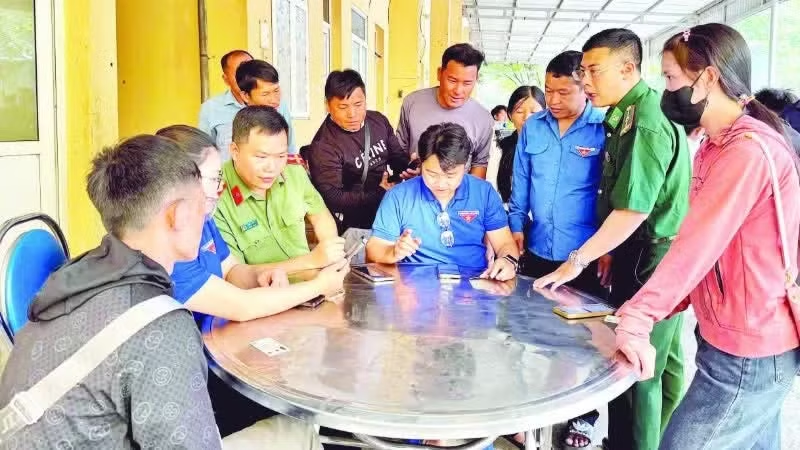
A highlight of the model is the mobilisation of local forces, establishing working groups of three to five officers who directly “go to each village, to each household,” “hands-on guidance,” instructing people on the safe use of smartphones and the Internet, accessing online public services, using VNeID, and selling goods on e-commerce platforms.
In addition, the implementation of an “email box for receiving crime reports and denunciations” model via QR code helps people easily provide information, assisting functional forces in promptly detecting and handling cases, contributing to maintaining security and order in border areas.
Affirming the determination of the entire force, Lieutenant General Nguyen Anh Tuan, Political Commissar of the Border Guard, affirmed: This model is a political determination of the entire force to concretise the policies of the Party, the Central Military Commission, and the Ministry of National Defence on the development of science, technology, innovation, and digital transformation.
This is also a commitment to stand alongside the people of all ethnic groups in all periods and in all aspects of social life.
With the motto “The outpost is our home, the border is our homeland, and the people of all ethnic groups are our brothers and sisters,” the border guard force has determined to put the people at the centre, use technology as the key tool, and use the capacity, enthusiasm, and responsibility of the soldiers as the main subjects in carrying out the work, and use perseverance, patience, and love... as catalysts for long-term companionship.
One of the typical models is the Mong Cai International Border Gate Border Guard Post (Quang Ninh Provincial Border Guard) coordinating with the local Youth Union to install QR codes at marker 1368 (3), next to Xa Tac Temple — a cultural and spiritual destination in the Northeast region since 2022.
With just a scan of the code, tourists and people can access a vibrant electronic information page, integrating images and videos about the border, border markers, and a border region tourism guide.
Continuing in that spirit, in April 2025, the “Digital Border Information” model of the Bac Xa Border Guard Station (Lang Son Provincial Border Guard) disseminated official information, raised legal awareness, and strengthened the people’s security posture in border areas that still face many difficulties and have scattered populations.
The Bac Xa Border Guard Post also coordinated with local authorities to install QR codes at cultural centres, committee headquarters, patrol routes, and checkpoints… As a result, the model was quickly accepted and widely used by residents and tourists.
Closing the digital gap
During the implementation process, many units created models suitable to the reality. For example, the Vang Ma Chai Border Guard Post (Lai Chau Province) quickly established a “Team of Military Teachers in Green Uniforms — Accelerating Digital Transformation,” and a “Digital Skills Consulting Team” to assist households in verifying phone SIM card ownership, integrating electronic documents, and guiding the use of digital platforms to serve daily life.
Not stopping at guiding basic digital skills, for the first time, the Lai Chau Provincial Border Guard Command collaborated with the Online Centre (VTVCab) to guide the people in livestreaming skills, e-commerce, and the use of smart devices.
Colonel Truong Minh Duc, Commander of the Lai Chau Provincial Border Guard, affirmed: This is not simply a community outreach activity, but a shared responsibility of the Border Guard in the era of digital transformation.
In Dien Bien Province, digital transformation is clearly demonstrated through the model of an “Anonymous electronic suggestion box for reporting crimes and illegal immigration.”
In 2024, the Na Co Sa Border Guard Post implemented this model, opening a two-way dialogue channel between border guards and local people. To expand their “eyes and ears” from the grassroots level, officers and soldiers of the Community Mobilisation Team went down to each village, coordinating with self-governing groups, village elders, and village heads to guide people on how to scan QR codes and fill out feedback information concisely, easily understandable, and appropriate to their level of understanding.
During the implementation process, the Border Guard Command of provinces from Lai Chau and Dien Bien to Da Nang and An Giang proactively connected with and donated hundreds of smartphones to the people, while coordinating with telecommunications companies to gradually eliminate areas with poor internet coverage. These silent efforts are gradually narrowing the digital divide between border regions and urban areas.