Implementing digital transformation, the Ha Noi City Fatherland Front has deployed many solutions to disseminate information, mobilise support, and receive public opinions, thereby helping the Fatherland Front to be closer to the people and grassroots, truly becoming a bridge connecting “the Party’s will and the people’s hearts.”
“One axis – multiple channels”
The Fatherland Front Committee of Nghia Do Ward recently launched the model “Three entities – One goal: Consensus for the community.” The most notable aspect is the development of a “digital mailbox” integrated with QR codes.
These digital mailboxes are placed at the Party Committee, People’s Committee of the ward, and public spaces such as cultural centres and community centres in 87 residential areas to allow residents to contribute opinions, suggestions, and recommendations on all aspects of life, from Party and government building; monitoring the lifestyle and activities of officials and Party members; to issues such as illegal markets, temporary markets, and waste disposal.
Residents only need to scan the QR code to send their opinions and recommendations. The receiving department of the Ward Fatherland Front will compile, classify, and forward them to the authorities for timely resolution. The “digital mailboxes” are also widely publicised on Facebook and Zalo communities so that people can report issues anytime, anywhere.
Ha Noi has many interactive information channels between the government and the people, especially the iHanoi application. In this context, the city has integrated the “Digital Front” application into iHanoi so that people can easily access the activities of the Fatherland Front, contributing to the practice of democracy, improving the effectiveness of social supervision and criticism, and increasing openness and transparency.
However, with a “one axis – multiple channels” mindset, communes and wards are promoting the implementation of various digital interaction methods between the Fatherland Front and the people.
Ngoc Ha Ward has been a pioneer in implementing the digital model of “Listening to the People” since the early days of the two-tiered local government system. This model has actively contributed to resolving pressing issues and bottlenecks in the area.
For example, during the land clearance process for the project to complete the technical infrastructure connection between the 7.2-hectare Vinh Phuc area and Buoi Street, the Fatherland Front encouraged residents to provide feedback and opinions by scanning the QR code of the “Listening to the People” model.
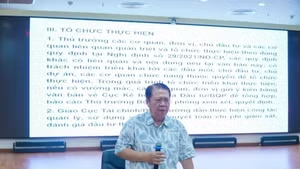
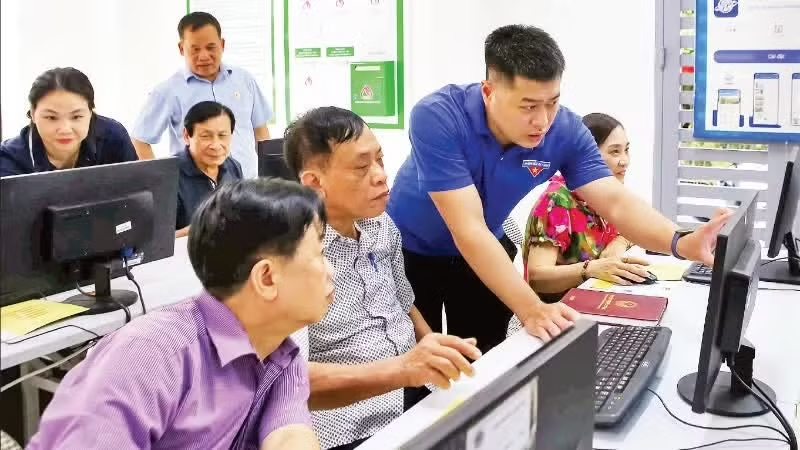
As a result, many opinions were conveyed to relevant authorities through the Fatherland Front and were subsequently addressed and resolved. Recently, the Ngoc Ha Ward Fatherland Front organised training for officials on the application of artificial intelligence (AI) in their work.
After participating in technology training in early May 2026, Tran Dinh Thanh, Secretary of the Party Branch and Head of the Front Committee of Residential Area 27, said: “Currently, I can use AI to design the content of the Central Committee's resolution in slide format, linked to the tasks of the Ngoc Ha Ward Party Committee. I see that age is not a barrier to accessing technology. Once I get used to it, I will see that technology supports my work a lot.”
Currently, I can use AI to design the content of the Central Committee's resolution in slide format, linked to the tasks of the Ngoc Ha Ward Party Committee. I see that age is not a barrier to accessing technology. Once I get used to it, I will see that technology supports my work a lot.
Tran Dinh Thanh, Secretary of the Party Branch and Head of the Front Committee of Residential Area 27
Not only in central areas, but also in remote and rural communes, digital transformation has brought positive results to the activities of the Front Committee. Minh Chau Commune — Ha Noi's only island commune located in the middle of the Red River — is also undergoing a strong digital transformation.
Nguyen Danh Chuong, Chairman of the Minh Chau Commune Fatherland Front Committee, said: “The application of digital transformation has been particularly effective in propaganda and mobilisation work serving the 16th National Assembly election and the People’s Council elections at all levels for the 2026–2031 term.
Information is updated promptly to each citizen, allowing them to follow official and complete news. Because they are provided with complete information, people are less confused by “unofficial” information. During the recent election, many short videos, infographics, and digital media products were created by the Fatherland Front at all levels, helping information spread quickly and easily to the people.”
Strengthening the bridge role
Previously, those working for the Fatherland Front were proud of their close ties with the people through actions like "going door to door." Now, this image has changed as Fatherland Front officials connect with the people through both online and in-person channels.
Hoang Thi Huyen Trang, Chairwoman of the Viet Nam Fatherland Front Committee of Kien Hung Ward, said: “Fatherland Front officials now go to the grassroots to meet with people, both to understand their living conditions and to operate digital dialogue channels. Technology doesn't replace people, but it helps make the connection between the government and the people faster and more effective, contributing to building a transparent government that serves the people better.”
Although Ha Noi has various channels of interaction between the government and the people, the Fatherland Front’s interaction channels still hold their own unique significance.
According to Truong Nhat Minh (Alley 678, La Thanh Street, Giang Vo Ward), when people discover violations such as improper garbage disposal or excessively loud music, they can send the information through iHanoi for the authorities to take action. However, sometimes, living in the same alley or neighbourhood, many people want to contribute their opinions so that violators have a chance to correct their behaviour, thereby building a civilised urban lifestyle.
In this case, sending information through the Fatherland Front channel, so that Fatherland Front officials and organisations can provide feedback to the violators, is very important. Previously, people had to meet with officials in person to give feedback, which made them hesitant. Now, everyone can send information conveniently. “In our area, people contribute their opinions to the Fatherland Front through the Giang Vo Ward Fatherland Front’s Zalo OA page,” he noted.
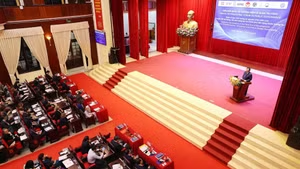
To further enhance the effectiveness of digital transformation in the activities of the Fatherland Front, in late May 2026, the Ha Noi City Fatherland Front Committee organised three training courses for the chairpersons and vice-chairpersons of the Fatherland Front Committees of all 126 communes and wards, covering many new and practical topics.
Key areas included: improving the effectiveness of AI use in work; social monitoring and criticism; and enhancing the effectiveness of the Fatherland Front's propaganda and public opinion guidance in the context of digital transformation.
More importantly, trainees were required to immediately apply what they learned to “standardise” the training outcomes. Instead of writing assignments on paper, the entire assessment system was designed using Google Forms, with trainees answering questions via smartphones or computers. This allowed the City Fatherland Front to assess the level of knowledge acquisition and the ability to apply that knowledge.
Digital transformation is not simply the application of technology, but a revolution in thinking, methods, and the spirit of serving the people. While digital government aims at social governance, the digital transformation of the Fatherland Front aims at building connections, listening to the people, and promoting socialist democracy.
Establishing a two-way exchange mechanism in the digital environment will help people easily express their thoughts and aspirations, and support the Fatherland Front and the government in listening and providing timely answers, thereby creating genuine consensus at the grassroots level.
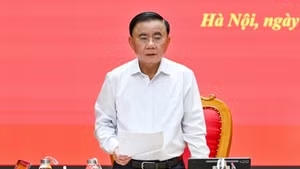
Bui Huyen Mai, Chairwoman of the Viet Nam Fatherland Front Committee of Ha Noi City
According to Bui Huyen Mai, Chairwoman of the Viet Nam Fatherland Front Committee of Ha Noi City, establishing a two-way exchange mechanism in the digital environment will help people easily express their thoughts and aspirations, and support the Fatherland Front and the government in listening and responding promptly, thereby creating genuine consensus at the grassroots level.