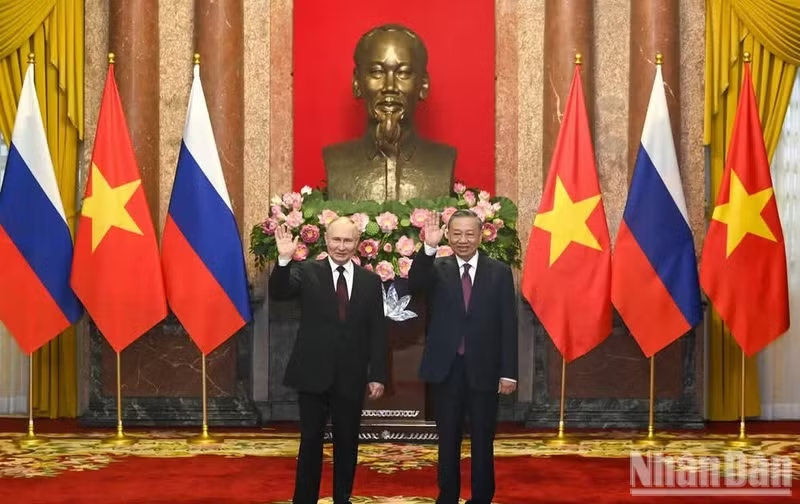
The visit carries particular historical significance for relations between Viet Nam and Russia, as it is the first state visit to Russia by the head of the Party and State since 1991. It takes place following the successful 14th National Party Congress and the completion of the leadership appointments following the elections to the 16th National Assembly and People’s Councils at all levels for the 2026-2031 term.
The visit sends a strong message that Viet Nam continues to attach importance to its traditional friendship and comprehensive strategic partnership with Russia, while affirming its desire to strengthen bilateral cooperation in the new era of development.
Viet Nam and Russia are comprehensive strategic partners that are reliable, natural, and sustainable in all circumstances and conditions.
Viet Nam and Russia are comprehensive strategic partners that are reliable, natural, and sustainable in all circumstances and conditions. In recent years, bilateral relations have developed positively and now face new opportunities to bring cooperation to greater depth and substance. Against this backdrop, the state visit to Russia by General Secretary and President To Lam and his spouse will mark a new milestone, creating a strategic shift in bilateral cooperation and further deepening the strategic trust and enduring friendship between Viet Nam and the Russia.
The visit also provides an opportunity to further strengthen the close and trusted relationship between General Secretary and President To Lam and Russian leaders. It reaffirms the foreign policy of the Party and State in the new era, as set out in the Resolution of the 14th National Party Congress, and promotes to the fullest extent the role of head-of-state diplomacy in mobilising and leveraging resources from relations with partners for national development, thereby enhancing Viet Nam’s standing in the region and the world.
The more than 75-year journey of cooperation and partnership between Viet Nam and Russia is a strong affirmation of a steadfast relationship that has transcended geographical distance and withstood all fluctuations in regional and global affairs. The Party, State, and people of Viet Nam have always cherished the sincere sentiments, valuable support, and assistance extended by the former Soviet Union and today’s Russia during Viet Nam’s struggle for national independence and reunification, as well as in its current period of vigorous development. In the hearts of generations of Vietnamese people, Russia, with its rich literary and artistic heritage and warm, generous people, has always held a special place.
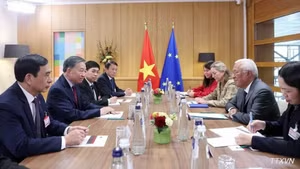
Viet Nam-Russia Comprehensive Strategic Partnership has made strong progress in recent years. Political trust has continued to deepen through frequent exchanges of delegations, meetings, and dialogues at all levels, particularly at the highest level. Russia regards Viet Nam as an important partner in Southeast Asia and the Asia-Pacific region. Meanwhile, strengthening relations with Russia has always been one of Viet Nam’s top foreign-policy priorities. The two sides coordinate closely at multilateral forums and international organisations. They maintain the Intergovernmental Committee on Economic, Trade, Scientific and Technical Cooperation, which was established in 1992 and elevated to the deputy-prime-ministerial level in 2011. The Intergovernmental Committee meets annually.
Bilateral trade has continued to grow positively, reaching 2.16 billion USD in the first five months of 2026, up 6.4% year on year. Viet Nam and Russia have placed importance on promoting and achieved positive results in key areas of strategic significance, including defence and security, economic and trade cooperation, energy and oil and gas, and science and technology. The two countries are also coordinating to organise numerous activities as part of the Year of Science and Education 2026.
Education and training cooperation is a bright spot. In the past, the Soviet Union helped Viet Nam train nearly 40,000 highly qualified officials and specialists across various fields. Since 2019, Russia has increased the number of scholarships to around 1,000 per academic year. There are currently more than 3,000 Vietnamese students studying in Russia. In science and technology, the two countries have implemented research and technology-transfer projects. Scientific research cooperation under the framework of the Viet Nam-Russia Tropical Centre has produced many positive results. Meanwhile, the Vietnamese community in Russia, numbering nearly 80,000 people, continues to make steadfast contributions to the development of both countries and bilateral relations.
The proud achievements Viet Nam and Russia have attained throughout their more than 75-year journey of cooperation are a major source of momentum for the two countries as they enter a new phase of bilateral relations. As Viet Nam works to realise its national development aspirations and goals, support from international friends — including Russia as Viet Nam’s comprehensive strategic partner — is of great importance.
The state visit to Russia by General Secretary and President To Lam and his spouse reaffirms Viet Nam’s foreign policy of independence, self-reliance, resilience, peace, friendship, cooperation, and development, as well as the diversification and multilateralisation of its external relations. On the solid foundation of traditional friendship and the comprehensive strategic partnership, Viet Nam and Russia both seek to maximise their respective strengths in service of a new stage of development in each country. The visit will provide strong fresh impetus for the two countries to further strengthen their close ties, deliver tangible benefits to their peoples, and make important contributions to peace, stability, cooperation, and development in the region and the world.