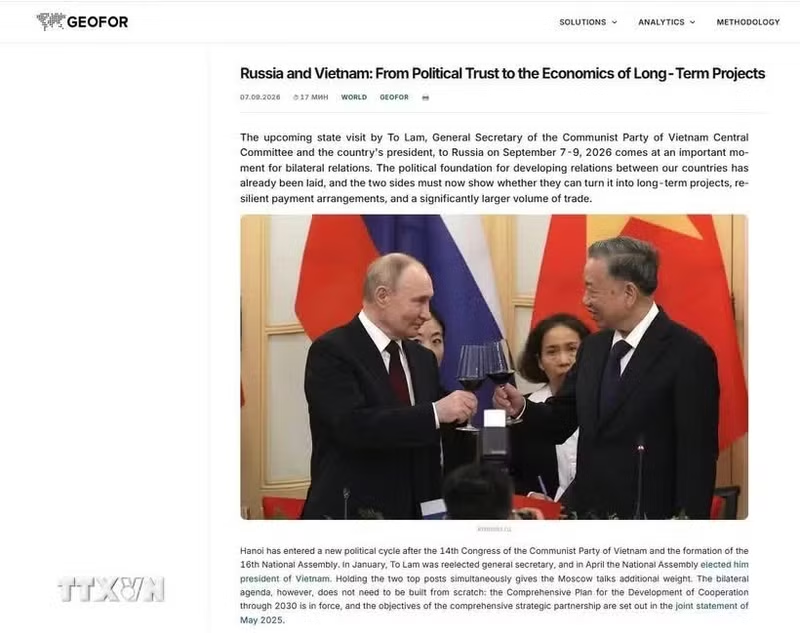
Published on the occasion of General Secretary of the Communist Party of Viet Nam Central Committee and President To Lam's state visit to Russia from September 7 to 9, the analysis described the visit as a milestone that could reshape the quality of bilateral economic cooperation and reaffirm Viet Nam's distinctive geopolitical position in Asia.
According to Geofor, the visit is expected to inject fresh momentum into the implementation of the bilateral cooperation master plan through 2030 and the 2025 Joint Statement.
The article said Viet Nam's drive for industrialisation, higher productivity, technological mastery and deeper international integration creates significant room for Russian businesses and technology providers to expand their engagement in the country.
Energy continues to be the most mature and resilient pillar of Viet Nam–Russia cooperation, Geofor said, citing the fruitful decades-long joint ventures such as Vietsovpetro in Viet Nam and Rusvietpetro in Russia.
The visit is expected to help advance major investment decisions to sustain the resource base as output from existing oil and gas fields declines. The two sides are also negotiating Zarubezhneft's access to new oil and gas blocks on Viet Nam's continental shelf.
Cooperation could also expand into renewable energy, including wind power equipment production and supply chains, building on existing links in the oil and gas sector.
Geofor highlighted the Ninh Thuan 1 nuclear power plant as another strategic project with long-term implications. Under an intergovernmental agreement signed on March 23, 2026, the project is designed to include two VVER-1200 reactors with a combined capacity of 2,400 MW.
For Viet Nam, the plant will provide stable baseload power to support industrialisation and strengthen energy security. For Russia, it will create a long-term technological presence spanning fuel supply, maintenance and technical services. The two sides are accelerating negotiations on financing and contractual arrangements to move the project towards implementation.
Bilateral trade reached 4.77 billion USD in 2025, up 4% from the previous year, with leaders of both countries setting an ambitious target of 15 billion USD. Current trade flows remain highly complementary, with Russia supplying products such as coal and fertilisers and Viet Nam exporting apparel, coffee and aquatic products.
To reach the 15-billion-USD target, Geofor said, the two countries need to move beyond expanding trade volumes of traditional products towards direct investment and local production capable of creating more stable and sustainable supply chains.
Viet Nam has also called on Russia to ease technical barriers and expand the list of licensed Vietnamese seafood processors, helping businesses make fuller use of preferential tariffs under the Eurasian Economic Union–Viet Nam Free Trade Agreement.
In addition to FESCO's arterial sea route linking Vladivostok with Ho Chi Minh City and Hai Phong, an international rail route connecting Viet Nam with the Moscow region via China and Mongolia was launched in July 2025.
Viet Nam Airlines' resumption of direct Hanoi–Moscow flights in May 2025 and plans to expand charter services are also boosting tourism and business exchanges. More than 1 million Russian visitors travelled to Viet Nam in the first eight months of 2026.
Educational and people-to-people ties remain another strong foundation of the relationship.
Nearly 3,000 Vietnamese students are currently studying in Russia, which continues to offer Viet Nam more than 1,000 scholarships annually, according to Geofor.
Human resources development will be particularly important for Viet Nam's nuclear power programme. The Ninh Thuan 1 and Ninh Thuan 2 projects alone are expected to require around 3,900 operating personnel by 2030, while Viet Nam will need tens of thousands of specialists for its broader nuclear programme. Russia has pledged to support Viet Nam in training engineers and specialists in nuclear safety, management and radioactive waste treatment.
Scientific cooperation is also advancing through the Viet Nam–Russia Tropical Centre, which is implementing applied research programmes for 2025–2029 in areas including materials science and medicine.
The relationship is further underpinned by a Vietnamese community of around 80,000 people in Russia and more than 500 cooperation agreements between universities and scientific institutions of the two countries.
Beyond bilateral projects, Geofor said the visit raises a broader strategic question about Viet Nam's place in Russian businesses' pivot towards Asia.
While China remains the primary focus of Russia's East-oriented economic agenda due to the size of its market, Viet Nam deserves a distinct position, the analysis said.
With a population of 102.3 million in 2025, economic growth of 8.02% that year and realised foreign direct investment of 27.6 billion USD, Viet Nam has emerged as a large, potential and highly open economy. The World Bank has forecast growth of 6.8% for the country in 2026.
For Russian investors, Viet Nam is more than a consumer market. It offers an independent and focal direction for diversifying business strategies in Asia, Geofor went on.
Viet Nam's extensive network of high-quality free trade agreements, covering ASEAN, RCEP, CPTPP, the EU, the UK and the Eurasian Economic Union, offers Russian companies a potential gateway to Southeast Asian and wider global markets.
However, companies seeking to benefit from these agreements must establish substantive production in Viet Nam and comply with rules of origin, including regional value content requirements under the ASEAN Trade in Goods Agreement, rather than simply carry out final-stage assembly.
Geofor concluded that Russian businesses in Viet Nam do not have to start from scratch. Decades of cooperation in oil and gas, the emerging nuclear partnership and strong mutual understanding between the two peoples provide a solid foundation for expanding into supporting industries, high-tech equipment, after-sales services and localised production.
The success of General Secretary and President To Lam's state visit to Russia, Geofor said, should ultimately be measured not by the number of documents signed but by concrete progress in turning shared plans into projects.
Viet Nam is increasingly asserting itself as an independent and focal direction for Russian firms seeking to diversify business strategies and deepen their footprint in Asia, the analysis concluded.