This reality requires human development to place greater emphasis on factors related to digital capacity. Linking human development with the development of culture, education, and healthcare, especially science-technology and innovation, is an important prerequisite in contributing to the country’s rapid and sustainable development.
Competitive advantage
The Party’s viewpoint on comprehensive human development has consistently placed people at the centre. All policies must stem from the legitimate rights, interests, and happiness of the people, taking public satisfaction and trust as the measure of development.
The documents of the 14th National Party Congress clearly state the need to “maximise the human factor; people are the centre, the subject, the principal resource and the objective of development.” The Party particularly emphasises that development achievements should not only be assessed through growth indicators but also through quality of life, the level of civilisation, creative capacity, and the ability to expand opportunities for all people to participate in and benefit from development achievements.
Comprehensive human development includes knowledge, physical well-being, morality, skills, adaptability, and continuity of development.
According to the United Nations Human Development Report 2025 themed “The age of artificial intelligence and human development choices”, Viet Nam’s Human Development Index (HDI) reached 0.766, placing the country among nations with high human development (ranking 93rd out of 193 countries and territories).
This result reflects Viet Nam’s outstanding efforts in digital transformation and AI application, as well as the Government’s commitment to promoting human development.
In the digital era, technology, knowledge, data, and innovation are becoming the main drivers of growth. Alongside science-technology and innovation factors, institutional quality and the quality of human resources are becoming key competitive advantages for nations.
This is closely linked to policies on comprehensive human development. Digital transformation and AI are opening major opportunities such as creating lifelong learning opportunities, narrowing gaps in access to knowledge, and improving the management and care of human health.
Technology supports fairness in healthcare provision, enhances labour productivity, empowers people, and expands access to services for all groups, especially vulnerable groups. However, comprehensive human development is also facing many challenges.
These include widening digital divides; shortages in digital skills and adaptive capacity; issues relating to ethics, culture, and human character in the digital environment; risks concerning personal data, privacy, and digital safety; as well as technological dependence reducing human autonomy.
In such a context, improving people’s digital capacity is considered an effective solution.
Assoc Prof, Dr Bui Quang Tuan, former Director of the Institute of Viet Nam and World Economy, stated that comprehensive human development is the process of expanding core human capacities in a simultaneous, balanced, and sustainable manner in terms of physical well-being, intellect, skills, spirituality, morality, society, culture, digitalisation, and citizenship.
The ultimate goal is for each person to be able to live healthily, pursue lifelong learning, have decent work, participate meaningfully in society, adapt to change, and develop freely in a safe, equitable, and sustainable environment.
However, in the context of digital transformation, human development can no longer be measured narrowly through health, education, and income alone but must also take into account job quality, mental health, digital skills, resilience to shocks, data security and safety, privacy rights, and the capacity to master AI.
Promoting enhancement of digital capacity
As AI increasingly permeates every aspect of life, with the potential to strongly affect comprehensive human development, a more inclusive perspective is needed in policy orientation.
Tuan stressed that the concept of human development in the new era must be expanded to include capacities such as critical thinking, creativity, lifelong learning, digital skills, technological ethics, and adaptability. The requirement is to design a development model with sufficient capability and creativity so that new productive forces such as AI and science-technology can better serve human life.
Experts believe that the development model relying mainly on cheap labour and resource exploitation is no longer suitable in the AI era. To achieve rapid and sustainable development, in addition to technology factors, upgrading human quality is a matter of survival.
Only high-quality human resources have sufficient capacity to take advantage of new technological waves and scientific achievements, thereby enabling the country to develop rapidly and sustainably and strengthen its international standing.
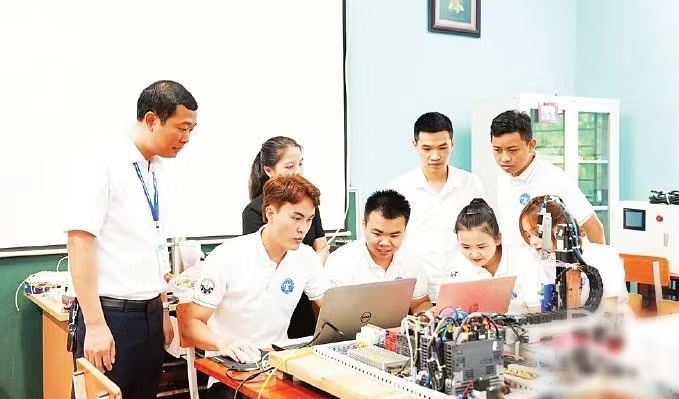
Accordingly, human development policies in the current period need to prioritise fundamental education reform and skills development, shifting from education focused on memorisation to education focused on capacity building, increasing investment in early education, STEM, foreign languages, digital skills, critical thinking, collaborative capacity, and lifelong learning, while closely linking schools with businesses and the labour market.
Policies on industry, innovation, digital transformation, green transformation, and investment promotion must aim at improving human capacity qualitatively rather than merely quantitatively. Priority should be given to growth models that create better jobs, spread knowledge more effectively, and upgrade labour skills more rapidly.
Experience from countries such as the Republic of Korea and Singapore has shown that investment in education, science-technology, and high-quality human resources is an essential condition for breakthroughs.
Digital transformation is not merely the application of digital technology to socio-economic activities, but also the process of establishing a new, advanced, and modern mode of production in which people, as productive forces, must harmoniously combine with AI.
This awareness needs to be deeply instilled across all sections of society, especially among young people. Nguyen Thi Thanh Mai from the Statistics Office stated that in the new context, it is necessary to improve the system of indicators measuring human development in Viet Nam.
Assessing human development solely through the traditional HDI is no longer sufficient. Instead, a multidimensional assessment indicator system needs to be developed, encompassing not only income, education, and health but also aspects such as the environment, living conditions, opportunities to access services, levels of social participation, and quality of life.
At the same time, the expert emphasised the addition of new groups of indicators such as digital and technological capacity, science-technology and innovation, and the environment and sustainable living conditions.
Integrating digital capacity factors into comprehensive human development indicators in the context of digital transformation and AI development today is inevitable.
Experience from pioneering countries has shown that placing greater emphasis on comprehensive human development through education, healthcare, digital skills, and technological ethics will help societies better seize the opportunities presented by AI while reducing the social risks created by technology.