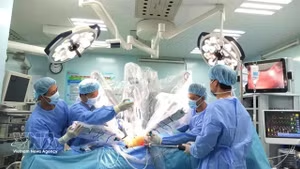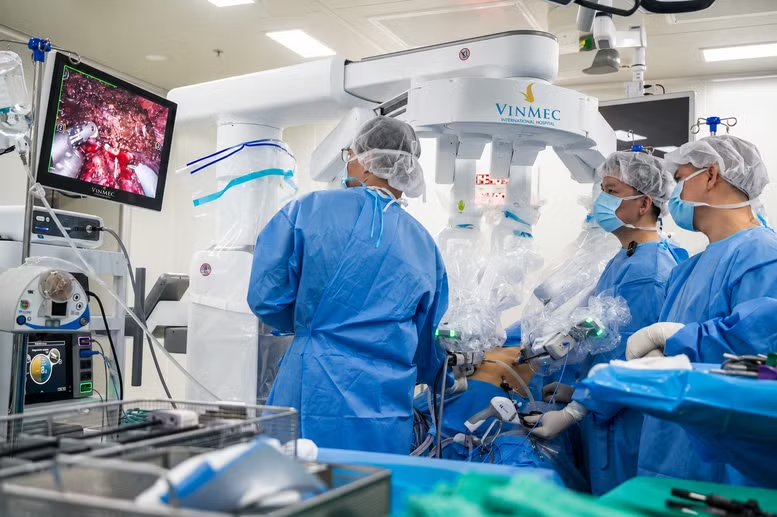
The network links Vinmec Smart City Hospital in Ha Noi and Vinmec Can Tho Hospital. Unlike previous standalone remote robotic procedures, the new model allows either establishment to take turns serving as the command centre, creating an interconnected surgical network rather than relying on a single control hub.
The first patient was a 15-year-old girl diagnosed with a tumour in her right ovary. The primary objective was not only to remove the tumour but also to preserve as much healthy ovarian tissue as possible to maintain hormonal function and future fertility.
During the procedure, the lead surgeon in Ha Noi operated the robotic system remotely, while the surgical team in Can Tho carried out the procedure in the operation theatre. The second patient was a 42-year-old man with cancer in the left lobe of the liver against a background of chronic hepatitis B infection. In this case, the direction of control was reversed: Vinmec Can Tho served as the robotic command centre, while the surgery was performed at the hospital in Hanoi.
This was also the first time in Viet Nam that a remote robotic surgery model with bidirectional control has been implemented between two hospitals within the same healthcare system.
Speaking at the announcement ceremony, Dr Nguyen Trong Dien, Director of the Ha Noi Department of Health, described the achievement as a breakthrough for Vietnamese medicine in applying science and technology to healthcare. He noted that, as of the announcement, Vinmec had successfully performed four surgeries using this model.
He said the milestone represents not only a technological achievement but also clear evidence of the capital’s strategy to develop a modern healthcare system.
Public and private healthcare providers, he added, should be integrated into Hanoi’s healthcare network and make full use of highly qualified medical professionals to improve service delivery and public health protection and management.
According to Dien, the Capital Law and newly introduced policies are providing an important foundation for this development. Since August 1, 2026, the department has been authorised to license a wider range of advanced medical procedures and recognise international practising certificates held by foreign specialists, helping attract highly skilled professionals.
The municipal health sector is also developing proposals that would allow experts from central and municipal hospitals, universities and private healthcare providers to practise across multiple medical facilities in Ha Noi, thereby making more effective use of existing human resources.
In addition, Ha Noi is studying a pricing mechanism for high-tech medical services, including telemedicine, to establish a legal framework for innovations such as remote robotic surgery. The long-term goal is to develop Ha Noi into a high-quality medical centre and a regional hub for smart healthcare and medical tourism.