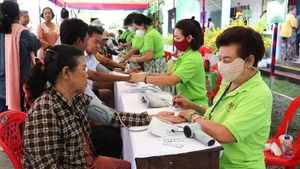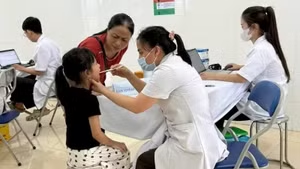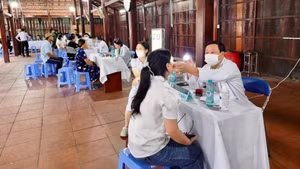
Meanwhile, the focus of people’s healthcare is shifting from treatment to prevention, continuous health management and the strengthening of grassroots healthcare.
This shift is in the right direction, but it must be supported by stable resources and appropriate payment mechanisms. The transition in healthcare financing from passive payment to proactive investment is necessary, but the challenge lies not only in mobilising additional funding, but also in allocating resources effectively and gradually reducing people’s out-of-pocket payments.
Studies show that healthcare financing in Viet Nam comprises six sources: the state budget, social health insurance, voluntary health insurance, non-profit organisations serving households, contributions from enterprises, and direct payments by people. The latest data show that out-of-pocket payments in Viet Nam account for about 39.2% of total health expenditure in 2023, still a fairly high rate compared with the World Health Organisation’s general recommendation of 20%.
According to a report on healthcare financing conducted by the Health Technology Research Group under the London School of Economics and Political Science in the United Kingdom, without reform, the gap between available resources and the needs required to move towards universal health coverage in Viet Nam could increase from 279 trillion VND in 2021 to 510 trillion VND in 2030. With an appropriate healthcare financing reform plan, healthcare investment can be transformed into economic growth, higher labour productivity and stronger national competitiveness.
Accordingly, a strategy and roadmap that combine the mobilisation of public revenue, stronger financial mechanisms and additional mechanisms to improve access to medicines will create the foundation for a sustainable healthcare system.
Without reform, the gap between available resources and the needs required to move towards universal health coverage in Viet Nam could increase from 279 trillion VND in 2021 to 510 trillion VND in 2030.
Politburo Resolution No. 72/NQ-TW in 2026 set the goal of reducing people’s out-of-pocket payments to below 30% of total health expenditure, increasing public health spending and moving closer to universal health coverage by 2030. It sets out six core targets: expanding universal health insurance; providing periodic health check-ups for all citizens; waiving basic hospital fees; strengthening grassroots healthcare; implementing electronic health records for the entire population; and raising the vaccination rate to 95%.
The proposed solutions include mobilising additional financial resources and improving allocation mechanisms, with the top priority being increased state budget allocation.
In addition, taxes on tobacco, alcohol and lottery products can serve as supplementary sources of funding; social health insurance reform should continue to combine with the expansion of supplementary health insurance; and public-private partnership solutions should be promoted to improve people’s access to healthcare.
In recent times, several public-private mechanisms, such as managed entry agreements (MEA) and patient assistance programmes (PAP), have proven effective in helping patients access new medicines. To realise the targets of Resolution No. 72/NQ-TW by 2030, Viet Nam needs a feasible healthcare financing roadmap that prioritises public resources, uses the budget effectively and mobilises intersectoral and public-private coordination.
At the workshop “Breakthrough innovation in healthcare financing to meet the requirements of implementing universal health insurance in the new stage”, a number of international financial experts said Viet Nam has considerable fiscal space to increase healthcare investment as GDP continues to grow strongly towards 2030, while public debt below 30% of GDP and low interest payment costs are favourable conditions for expanding health spending while maintaining fiscal stability.
With clear policy orientations, Viet Nam has an opportunity to expand fiscal space for healthcare and build a more sustainable financial foundation for universal health insurance.