The plan was approved by the prime minister under Decision No. 201/QD-TTg, dated February 27, 2024. At that time, the plan was identified as an important orientation as well as a legal basis for the health sector to develop its network of healthcare facilities, with a view to achieving desired healthcare objectives in the new situation; it also served as a basis for localities to use as a reference, while also providing principle-based guidance for developing healthcare facility networks in their respective areas.
However, following the transition of the government model from four tiers to three tiers, including a two-tier local government system, and after the Politburo issued Resolution No. 72-NQ/TW on September 9, 2025 — setting out many new and breakthrough orientations for the protection, care, and improvement of the people’s health — it became necessary to reorganise and adjust relevant plans for the healthcare system.
According to Associate Professor and Doctor Phan Le Thu Hang, Deputy Director of the Department of Planning and Finance under the Ministry of Health, this adjustment to the healthcare facility network plan does not stem from the previous plan no longer being appropriate, but rather from the need to adapt to major changes in the country’s development context.
Viet Nam is now entering a period of rapid population ageing, accompanied by an increasingly heavy burden of non-communicable diseases. At the same time, science and technology, digital transformation, and precision medicine are developing at a very rapid pace, requiring the healthcare system to be planned in a more flexible and modern direction. Therefore, this adjustment is intended to anticipate the future rather than remedy the past, with the goal of building a healthcare system capable of adapting to the country’s long-term changes, ensuring that everyone has fair, convenient, and sustainable access to high-quality healthcare services.
The Ministry of Health has determined that this adjustment does not constitute the development of a new plan but rather maximises the inheritance of the plan already approved by the prime minister and updates the necessary contents to suit the new context. Notably, the adjustment not only addresses immediate requirements but also creates a basis for localities to proactively review their provincial plans, identify investment portfolios, allocate land funds, prepare human resources, and mobilise social resources for the development of the healthcare system in the years to come.
Hang said that this adjustment to the plan restructures the medical examination and treatment system towards modernisation, reasonable stratification, and enhanced specialised capacity at the local level.
Accordingly, the list of general and specialised hospitals performing regional functions will be adjusted to align with the new administrative boundaries, comprising six socio-economic regions and 34 provinces and cities. At the same time, some hospitals under the Ministry of Health will be reorganised towards being transferred to local management or merged in order to streamline organisational units while still ensuring professional capacity.
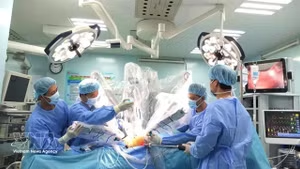
A very important new feature is the focus on developing specialised general hospitals with high-level technical capabilities in each region, enabling people to access more modern technical services locally or within their region, thereby helping reduce overcrowding at central-level hospitals and lowering the costs of referrals. Geriatrics, rehabilitation, traditional medicine, and other fields will also be prioritised for investment to meet comprehensive healthcare needs and the trend of population ageing.
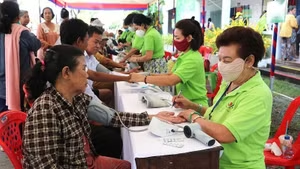
The preventive healthcare system will also be restructured towards enhancing capacity rather than expanding organisational units. The consistent approach is to make maximum use of the existing system, avoid major organisational disruption, and focus investment on professional capacity, equipment, and human resources. Strengthening the preventive healthcare system will help detect and better control disease risks and emergency health situations at an early stage.
The new plan places emphasis on decentralisation and strengthening local capacity in testing, inspection, and calibration, shifting from a model heavily dependent on regional centres towards strengthening capacity at the provincial and municipal levels. Multi-functional provincial testing centres will be invested in so that they have sufficient capacity to carry out testing of medicines, cosmetics, food, and medical devices, contributing to greater local self-reliance.
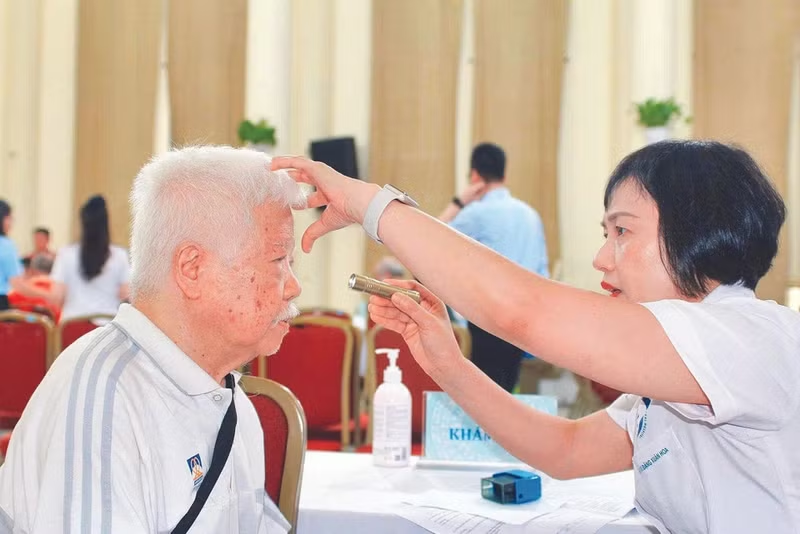
A major challenge for Viet Nam’s healthcare system in the coming decades is how to prepare for the period of population ageing. Therefore, this plan pays attention to developing a network of geriatric hospitals in areas with high rates of population ageing, such as the Red River Delta, the North Central and South Central Coast, the Central Highlands, the Southeast, and the Mekong Delta. This is not merely about building additional treatment facilities but also a step towards establishing a comprehensive healthcare system for older people, meeting the requirements of a society entering an ageing phase.
This adjustment to the healthcare facility network plan is aimed not only at achieving the targets set for 2030 but also at laying the foundations for Viet Nam’s healthcare system towards 2050 in a modern, high-quality, equitable, and effective direction, with the capacity to adapt to new challenges in the future.