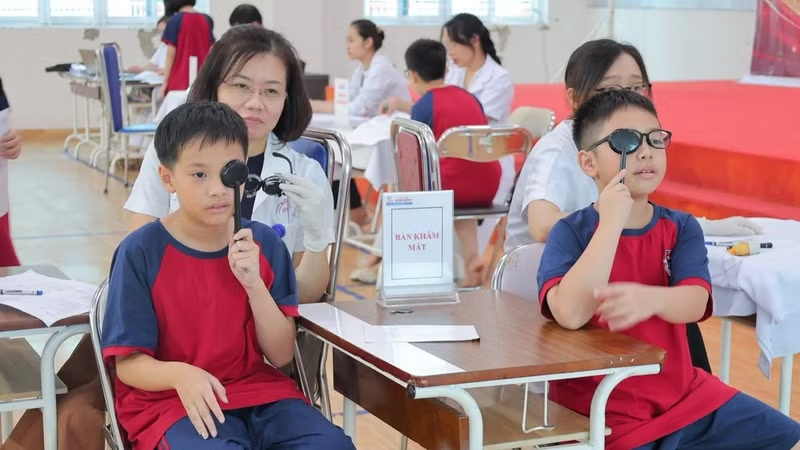
Don’t wait until a child has poor vision to get their eyes checked
A survey by the National Eye Hospital found that around 50% of school-age children in Ha Noi have refractive errors, with myopia accounting for approximately 37.5%. In Ho Chi Minh City, the rate of refractive errors has been reported to reach as high as 75% among pupils in some areas, with myopia accounting for around 37%.
According to doctor Tran Khanh Sam from the Refraction Department at the National Eye Hospital, refractive errors among children and adolescents are currently on the rise, particularly myopia.
Explaining this trend, he said the increase in myopia was associated with various aspects of modern living and learning environments. Children are spending increasing amounts of time using electronic devices such as mobile phones and computers, engaging in more near-work activities, and facing greater learning pressure, while spending less time playing and participating in outdoor activities.
Inadequate lighting while studying, reading or using electronic devices may also contribute to the increased risk.
The Covid-19 pandemic further highlighted these factors as children had to spend more time studying online, with less time outdoors and more near-work activities, including reading books, using computers and mobile phones, watching television, and playing games.
According to doctor Tran Khanh Sam, one of the major challenges today is the high rate of myopia among children, coupled with the growing prevalence of risk factors. The rapid development of electronic devices, prolonged near work, learning pressure, and insufficient outdoor activity are creating favourable conditions for myopia to become more widespread.
Meanwhile, parents and pupils still have limited awareness of myopia prevention, early detection and control. Resources for screening, monitoring, and managing refractive errors among schoolchildren also remain a challenge.
Experts warn that children with high myopia who do not receive appropriate vision correction or adequate management may develop serious eye conditions that can cause irreversible vision loss, including glaucoma, retinal detachment, and macular disease. Myopia must therefore be managed from an early stage, rather than waiting until children experience difficulty seeing before taking them for an eye examination.
Regular eye examinations, early detection of refractive errors, appropriate spectacles, and the establishment of healthy lifestyle habits for children all play an important role in myopia management.
Politburo Resolution No. 72-NQ/TW (dated September 9, 2025), on a number of breakthrough measures to strengthen the protection, care, and improvement of public health, establishes a guiding principle: “Prioritising disease prevention above all else.” It calls for a decisive shift away from a healthcare approach centred on medical examinations and treatment towards proactive disease prevention and comprehensive, continuous health promotion throughout the life course. Within this broader framework, eyesight — the “window” through which people access knowledge and engage with the world — is an inseparable component of individual health and working capacity, particularly for the younger generation.
However, figures released by the ophthalmology sector show that childhood myopia has become more than a specialised medical issue. It is increasingly recognised as a public health concern that requires coordination between the health and education sectors, families, schools, and communities to ensure early detection, monitoring, and intervention.
According to a warning from the World Health Organisation (WHO), without effective intervention and preventive measures, the proportion of children in Viet Nam with myopia could reach 90% by 2050.
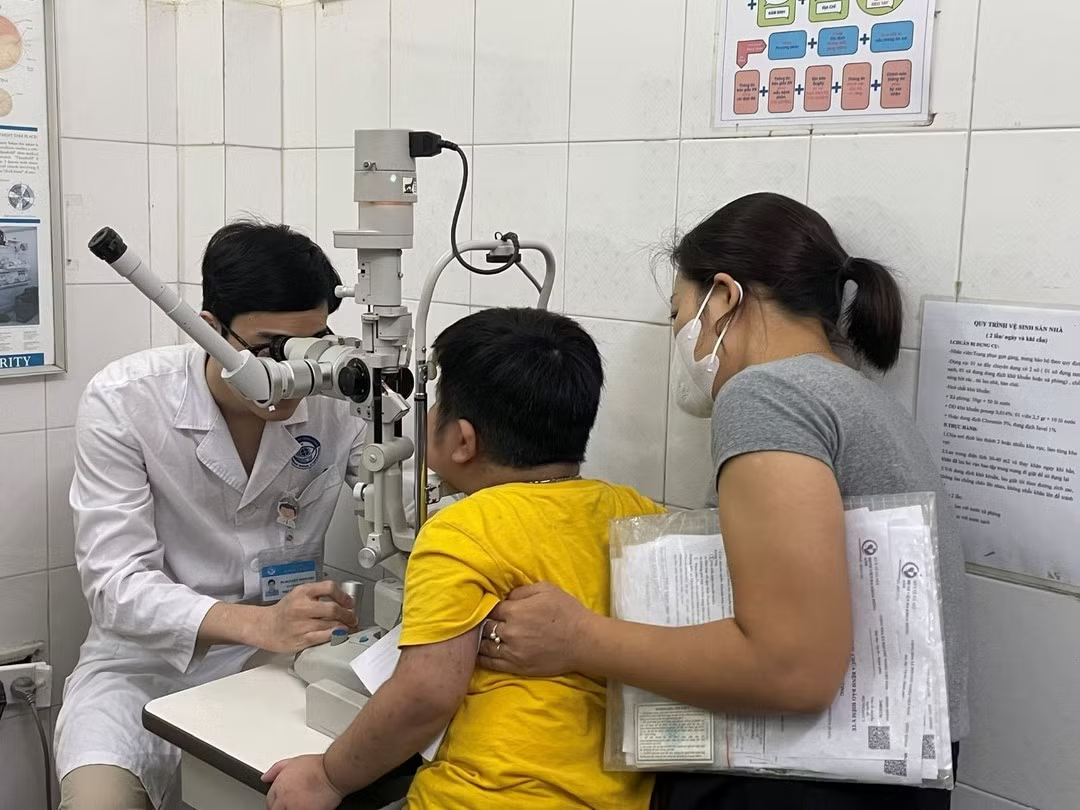
WHO warns that without effective intervention and preventive measures, the rate of children in Viet Nam with myopia could reach 90% by 2050. (Photo: THAI BINH)
Comprehensive solutions for controlling refractive errors among schoolchildren
From a regulatory perspective, Dr Bui Huu Toan, a distinguished physician at the Viet Nam Administration of Disease Prevention under the Ministry of Health, said that addressing refractive errors among children and school pupils required close coordination between schools, families, and the pupils and university students themselves, alongside the involvement of authorities at all levels and the health and education sectors.
Specifically, authorities at all levels and the health and education sectors must first strengthen the policy framework. Dr Toan said that disease prevention in educational institutions has been incorporated into the Law on Disease Prevention No. 114/2025/QH15. The government has also issued Decree No. 165/2026/ND-CP, detailing and guiding the implementation of several provisions of the Law on Disease Prevention. In addition, the government has approved the School Health Programme for the 2026–2035 period, assigning the Ministry of Health to be responsible for reviewing, amending, and supplementing existing professional guidelines and developing new ones on healthcare for learners.
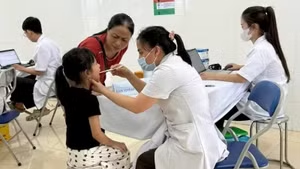
Accordingly, the Ministry of Health is developing guidelines for student health checks and medical examinations, including vision screening. Eye examinations are to be incorporated into annual health checks for pupils to identify refractive errors, declining vision, and other eye conditions at an early stage.
At the same time, the ministry is developing, issuing, and standardising national guidelines on appropriate school eye health, which will serve as the basis for training materials for pupils and teachers at educational institutions ranging from nursery schools to high schools. The Ministry of Education and Training is currently working with the Ministry of Health to implement the project “Integrating eye care into the school health programme”, which includes standardising school eye-care guidance materials tailored to each educational level.
In addition, the relevant authorities should incorporate indicators for monitoring eye diseases and conditions into electronic health records linked to the national population database, supporting management, evaluation, and policymaking.
Another priority is to strengthen the capacity of school health personnel. This includes training teachers, school health staff, and personnel responsible for school healthcare in vision-screening techniques, the early detection of common eye diseases, initial counselling, and higher-level referral procedures. An online training system for school eye care should also be developed to enable teachers and school health staff to access up-to-date knowledge more easily, reduce training costs, and ensure sustainability.
Beyond these measures, the health and education sectors should work together to conduct examinations, detect eye conditions, provide treatment advice, and refer patients for specialist care. The use of digital platforms should be encouraged to manage, report, monitor, and evaluate the implementation results of school eye-care programmes. Classroom lighting systems should be reviewed, renovated, and upgraded to meet school hygiene standards. Desks and chairs should be appropriate for pupils’ height and age, helping them maintain correct sitting postures and reducing risk factors for myopia.
Schools should also be encouraged to provide suitable outdoor learning and recreational spaces to increase exposure to natural light. In line with recommendations from the International Myopia Institute (IMI), pupils should spend at least two hours a day participating in outdoor activities.
The relevant authorities should also integrate eye-care content into the formal curriculum and extracurricular educational activities. Policies should be introduced to support priority groups, including mobilising donations to provide free or subsidised spectacles for disadvantaged pupils with refractive errors, ethnic minority pupils, pupils with disabilities, and other vulnerable groups. School eye-care models should be implemented in ethnic minority communities and areas facing socio-economic difficulties. At the same time, coordination between the education and health sectors should be strengthened in developing plans, providing professional guidance, organising screening and referrals, and monitoring and evaluating school eye-care outcomes.
Commune, ward, and special-zone health stations, together with local healthcare facilities, should play a greater role in working with schools to conduct health checks and medical examinations, screen vision, manage pupils with eye conditions, and facilitate referrals when necessary. Cooperation with international organisations, non-governmental organisations, businesses, and medical examination and treatment facilities should also be expanded to mobilise financial, technical, and professional resources for school eye-care programmes, particularly in disadvantaged areas.
For children, school pupils and their families, Dr Toan said that raising awareness of eye care was the first step towards reducing refractive errors. Each pupil should build sound study habits, maintain a correct sitting posture, keep their eyes approximately 30–35cm from their books, ensure adequate lighting, and take appropriate breaks. The 20-20-20 rule can also be applied: after every 20 minutes of looking at an electronic screen, children should rest for at least 20 seconds and focus on an object more than 20 feet (approximately 6 metres) away to help relax their eyes.
Pupils should limit the time they spend using electronic devices. Mobile phones and computers should be used only when necessary; screen time for entertainment should be reduced; and electronic devices should be avoided before bedtime.
Alongside these measures, children should increase their outdoor activity and engage in regular physical exercise. Spending at least one to two hours a day participating in outdoor activities helps the eyes adjust naturally while also improving overall health.
Importantly, children should follow a balanced diet that includes foods rich in vitamins A, C and E, omega-3 fatty acids, lutein, and zinc, such as carrots, pumpkins, dark green leafy vegetables, salmon, eggs, milk, and fresh fruit.
Children should attend regular eye examinations to detect abnormalities early and ensure that appropriate corrective measures are taken. Protecting eyesight is essential, as healthy eyes provide the foundation for children to learn, play, and develop comprehensively.