From administrative procedure reform to digital transformation, pharmaceutical management is gradually shifting to a new approach: greater transparency, more comprehensive databases and better services for people and businesses.
100% of public services provided online
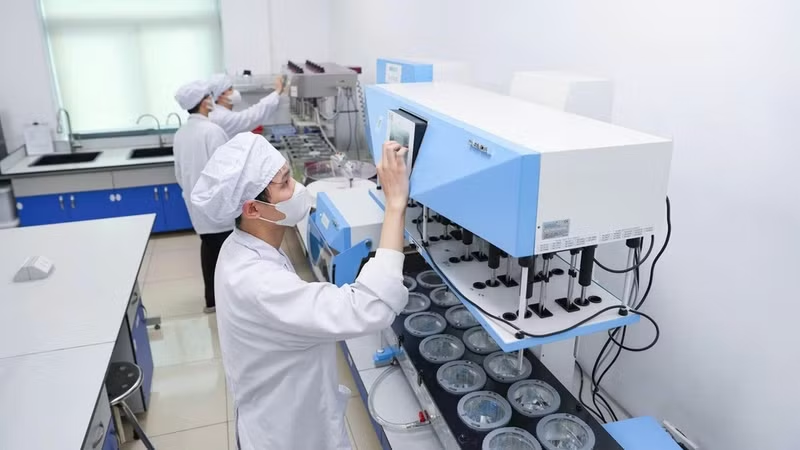
According to a report by the Drug Administration of Viet Nam (Ministry of Health), the country currently has 245 pharmaceutical manufacturing establishments meeting GMP standards, including 26 factories meeting EU-GMP or equivalent standards; some businesses have gradually mastered the technology for producing specialised and high-tech medicines and brought their products to markets with stringent requirements. Domestically produced medicines account for approximately 60% in terms of volume and 46% of total usage value. The increasingly large market, together with the growing number of medicines and pharmaceutical production and business establishments, has created requirements to change the management approach. A safe medicine must be controlled throughout its life cycle, from the registration dossier, production standards and storage conditions to pre-release testing and post-marketing surveillance.
Alongside national digital transformation efforts, pharmaceutical management is gradually shifting from traditional processing methods to data-based governance. From paper dossiers and manual procedures, many activities have been moved to the electronic environment, enabling people and businesses to monitor, measure and supervise them. Digital transformation has brought about a change in governance capacity, namely managing through data, monitoring through data and serving people and businesses through data.
Associate Professor, PhD Le Viet Dung, Deputy Director of the Drug Administration of Viet Nam, said that over the past two years, the comprehensive digitisation of administrative procedures has helped management agencies and businesses save considerable time and costs, while increasing openness and transparency and minimising inconvenience… At present, 100% of public services are provided online, with 47 administrative procedures implemented, including 37 fully online public services. In particular, 24 services have been integrated into the National Single Window Portal. The pharmaceutical database system has been deployed and connected with medicine supply establishments nationwide. All medicine registration dossiers are currently received and processed online, making it more convenient for businesses to carry out production and business activities…
However, applying digital transformation to administrative procedures is only an initial achievement. The greater value lies in the data generated during the digitisation process and how that data is used to manage the pharmaceutical market. For businesses, procedures become clearer, progress can be monitored, and information is made public and transparent. For management officials, data enables more proactive monitoring, analysis and warnings. For the public, channels for looking up information on medicines, medicine prices and pharmaceutical production and business establishments… become more convenient. Data also opens up the possibility of forecasting supply, providing early warnings of the risk of medicine shortages, monitoring quality, managing medicine prices and supporting businesses.
Establishing a national pharmaceutical database
The digital transformation of the pharmaceutical sector is a long-term process, requiring substantial resources in terms of finance, human resources and technology infrastructure, as well as information security. In addition, the high level of specialised expertise and complex management processes in the pharmaceutical sector impose stringent requirements on the design and operation of digital systems. The application of new technologies such as AI, Big Data and Blockchain also requires an appropriate legal framework to be established soon.
Pharmaceutical sector data spans many stages: medicine registration, clinical trials, production, testing, distribution, medicine prices, prescribing, medicine use, pharmacovigilance and post-marketing surveillance. If each system continues to operate separately, management agencies may possess a large amount of data but lack a comprehensive and timely “picture”. In reality, some hospitals and medical facilities have experienced “medicine shortages” without knowing that other facilities still had supplies. This shows that the bottleneck does not always lie in the market lacking medicines, but rather in supply and demand information failing to meet.
Le Viet Dung said that once the national pharmaceutical database is completed and connected from pharmacies and production establishments to distribution points, and ultimately interconnected with national databases, the system will be able to trace the movement of medicines. When a batch of medicines has a quality problem, the system can help identify where the batch has been distributed so that it can be isolated and recalled more quickly. If stocks or supplies of essential medicines fall abnormally, the data can help warn of the risk of shortages or indicate which warehouses still have medicines. When price information is updated and made public, health facilities will have additional reference data when purchasing; people will be better able to check and make choices; and prescription data linked with pharmacies will also make control over prescription medicines stricter.
According to Deputy Minister of Health Do Xuan Tuyen, digital transformation has improved the system for publishing information and enhanced transparency. These are important factors in the process of continuing to improve the national management system for medicines and vaccines. The tasks for the coming period are to continue standardising pharmaceutical codes; identify which data needs to be shared; connect data on registration, testing, distribution, prescribing, pharmacovigilance and medicine use; while ensuring safety and security as the volume of data continues to grow. Alongside this, the pharmaceutical management and distribution system needs to be digitised; a unified database established; and traceability and market monitoring strengthened.
The Ministry of Health is currently developing a “pharmaceutical information system within the national healthcare database”, integrating data from online public services, medicine registration and marketing authorisation… Once operational, the system will help make the origin, quality and prices of medicines more transparent; reduce time and costs for businesses; while increasing the ability to detect counterfeit and substandard medicines and identify the risk of medicine shortages at an early stage. And, most importantly, people will have timely, safe and effective access to medicines.