Implementing comprehensive solutions
Like many localities across the country, Ha Noi’s health sector has been actively reorganising its network of medical facilities, combining management reforms with improvements in service quality delivery.
According to the Ha Noi Department of Health, the reorganisation under the new model reduced the total number of affiliated units from 91 to 61 and consolidated 579 health stations into 126 stations managed directly by commune and ward authorities.
This represents not merely a numerical change but, more importantly, a systemic restructuring aimed at streamlining operations, increasing efficiency, and empowering local facilities with greater autonomy.
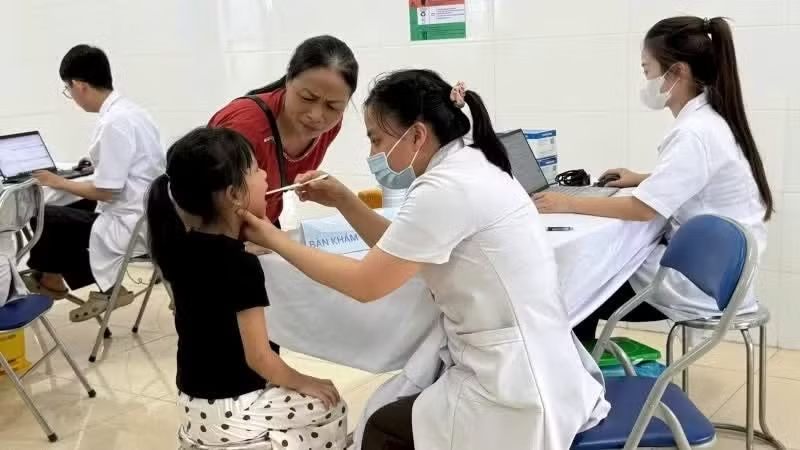
Notably, following the network reorganisation, Ha Noi’s health sector has vigorously implemented a comprehensive set of solutions guided by the motto “six ‘clears’ and one ‘consistent thread.” This approach has driven distinct progress across three key pillars: universal health check-ups, investment in grassroots healthcare, and digital transformation.
To date, over 8.4 million electronic health records have been created (covering 97.4% of the population) and integrated into the iHanoi and VNeID applications, allowing citizens to easily access their medical history, vaccination records, and test results directly on their mobile phones.
In Ho Chi Minh City, since July 1, 2025, the health sector has been reorganising public service units to streamline organisational structures and enhance operational efficiency and service quality.
The Ho Chi Minh City Department of Health transferred all resources from 25 non-inpatient regional health centres to the People’s Committees of wards, communes, and special zones to establish commune-level health stations (these 25 units ceased operations as of January 1, 2026), reducing the total number of hospitals and health centres.
Alongside organisational streamlining, the Ho Chi Minh City Department of Health took over the Ho Chi Minh City Transport Hospital from the Transport Health Department (under the Ministry of Construction).
Several underperforming units were converted into “Campus 2” facilities for major hospitals; for instance, Saigon General Hospital became the second campus of Gia Dinh People’s Hospital, while Can Gio Hospital and the Can Gio Health Centre became the second campus of Tu Du Hospital, operating under a general hospital model with support from the city’s broader network.
According to Nguyen Hoai Nam, Deputy Director of the Ho Chi Minh City Department of Health, the Department currently manages 91 public service units — a reduction of 34 units compared to the pre-reorganisation period — thereby streamlining organisational structures and enhancing the efficiency of resource management and utilisation.
Certain health centres have been reorganised into auxiliary facilities to support medical examination and treatment services, helping to alleviate patient overcrowding at higher-level medical facilities. The city is home to approximately 134 hospitals — or around 167 if central-level and private hospitals are included — with a ratio of about 35 hospital beds per 10,000 residents, meeting the established target.
Mobilising resources for grassroots healthcare
The Ministry of Health recently issued a decision adjusting the master plan for the healthcare facility network for the 2021–2030 period, with a vision towards 2050. The plan targets an increase in the hospital bed ratio to 38 beds per 10,000 residents by 2030 and 45 beds per 10,000 residents by 2050.
This goal applies not only to Ho Chi Minh City but to localities nationwide, requiring a focus on renovating and constructing additional healthcare facilities to meet public demand for medical care.
Nguyen Trong Dien, Director of the Hanoi Department of Health, noted that reorganisation under the new model represents more than just a change in numbers; more importantly, it involves restructuring the system to be streamlined and efficient while increasing the autonomy of individual facilities. Following the consolidation and merger of local health units, Ha Noi’s health sector has clearly defined two pillars for its development.
In this framework, grassroots healthcare serves as the foundation, with 126 health stations designated for primary care; this shifts the focus from reactive treatment to comprehensive health management and care, thereby helping to alleviate the burden on higher-level facilities. Specialised healthcare plays a leading role, driving the establishment of high-quality hospitals and centres while developing key medical specialities.
However, challenges persist following the transfer of health stations to the management of commune and ward People’s Committees. These include staffing shortages and retention difficulties due to inadequate compensation, inconsistent facilities and equipment, and a lack of public trust in grassroots services — leading patients to bypass local stations in favour of higher-level facilities, which causes overcrowding there.
To address these issues, Ha Noi is continuing to implement the “Hospital Supporting Health Station” model. Plans are underway to recruit 838 doctors for the 126 health stations, with the goal of ensuring every commune and ward has a general clinic.
Furthermore, the city’s health sector is establishing a Smart Healthcare Operations Centre to facilitate city-wide remote consultations and boost grassroots capabilities, alongside building a centralised health data platform to enhance data interoperability and sharing among facilities, improving overall efficiency.
The city will focus on constructing five high-quality hospitals meeting international standards, including a Proton therapy centre with an investment of approximately 3.5 trillion VND.
Complementing these efforts are policies designed to attract top-tier domestic and international experts, laying the groundwork for a capital healthcare workforce that rivals regional and global standards. Health experts observe that the implementation of a two-tier local government model has helped clarify the specific roles of each level.
Specifically, the provincial level focuses on macro-management, system coordination, professional guidance, and policy advising. Meanwhile, the commune level directly carries out tasks related to primary healthcare, preventive medicine, and community health management.
Furthermore, management practices have been reformed to become leaner, more streamlined, and more responsive. The reorganisation and consolidation of the healthcare system — along with the restructuring of grassroots-level entities — have helped eliminate intermediate layers and shorten command and operational chains.
This facilitates the timely and practical implementation of policy decisions, while reducing operational overlap and enhancing local healthcare facilities.
Currently, the Ministry of Health is working to boost the effectiveness of the grassroots healthcare network. A key priority is reorganising the organisational structure and enhancing the capacity of commune- and ward-level health stations.
Accordingly, the Ministry is developing policies to attract personnel, proposing that competent authorities increase allowances for grassroots health workers, and mobilising resources to upgrade facilities and equipment at the grassroots level.