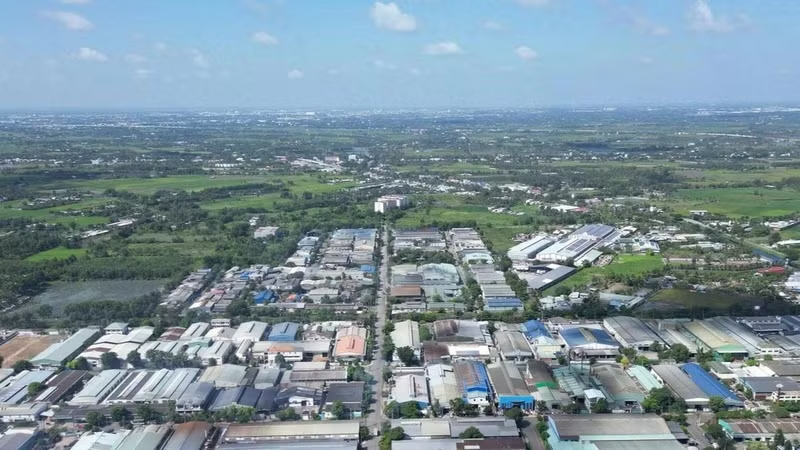
From this perspective, the Ho Chi Minh City People’s Committee’s plan to convert 109.91 hectares of the expanded Le Minh Xuan Industrial Park into social housing is a sound policy that addresses people’s pressing housing needs. Allocating land for this purpose will give low-income earners more opportunities to secure suitable accommodation where they work and contribute to the local economy. The initiative also highlights the need to closely integrate production planning, urban development and social welfare.
This need stems directly from everyday life. Factory workers, service employees, wage earners and young families all hope that their hard work will enable them to gradually build a better life. However, when housing costs consume a large share of income, their ability to save and invest in the future is constrained. Easing this burden would give people greater means to pursue education, improve their skills, maintain their health and raise their children. Social housing development is therefore also about creating opportunities for families to improve their lives through their own efforts and abilities.
These benefits also extend to production and business operations. Skilled workers represent the result of training, practice and accumulated experience. A stable workforce helps businesses maintain product quality, meet delivery schedules and fulfil orders. When workers have to change jobs because their homes are too far away or they cannot arrange childcare, businesses are affected as well. Recruitment and retraining costs, together with the time new employees need to adapt, all affect operational efficiency.
Workers’ living conditions must therefore be factored into industrial development planning from the outset. Every project that attracts additional labour creates demand for housing, schools, healthcare, transport and community facilities. If industrial land is prepared without timely provision of social infrastructure, workers are left to cope with shortages that could have been anticipated. Over the long term, such imbalances can also undermine the attractiveness of the investment environment.
This provides a basis for considering priorities in land use and resource allocation. The city still needs new industrial projects that align with its development strategy. However, before approving each expansion proposal, it must fully assess opportunities to upgrade existing industrial parks and make more effective use of them. When capital is limited, addressing existing bottlenecks can deliver direct benefits to a large number of businesses. Investment decisions should therefore be based on economic efficiency, social impact and infrastructure capacity.
For those directly involved in production management, these bottlenecks are tangible. Deteriorating roads delay the transport of raw materials and deliveries, while inadequate drainage affects factory operations and workers’ ability to arrive for their shifts.
Industrial park upgrades must therefore go hand in hand with improvements to roads, connections with warehouses and ports, and the modernisation of logistics services. Investment efficiency should be reflected in lower costs, shorter transport times and more reliable production. Addressing these obstacles will help businesses make better use of the resources they have already invested.
Building on this foundation, the green and digital transitions offer further scope to improve productivity. Upgrading equipment, saving energy, reusing resources and applying data in management can generate greater value from existing industrial land. To enable businesses, particularly small and medium-sized enterprises, to participate, support policies should address specific constraints involving capital, technology choices and workforce skills. Innovation must also be accompanied by training so that workers can adapt and have opportunities to increase their incomes.
However, higher incomes will bring people closer to homeownership only if suitable housing is available. Following the plan to convert land in the expanded Le Minh Xuan Industrial Park, the next step is to translate the policy into practical options that match the financial means of intended beneficiaries. Sale and rental prices, as well as payment schedules, must reflect actual incomes, leaving families enough to cover living expenses and cope with unexpected difficulties. Monthly repayments that push household finances to the limit can make life precarious if income falls or a family member falls ill.
Social housing development should therefore place equal emphasis on homes for sale, rental housing and rent-to-own schemes. Those with savings can opt for ownership, while people who cannot yet afford to buy can secure stable rental accommodation as they gradually establish their lives. Such diversity allows families to choose according to their circumstances and avoid financial commitments beyond their means. Above all, having a secure home means being able to maintain safe, suitable and long-term accommodation.
This also depends on the location and surrounding living conditions. Even affordable housing can impose significant additional costs if it is too far from workplaces and lacks schools or public transport, increasing commuting expenses, childcare costs and travel time. Technical and social infrastructure must therefore be developed in step with housing construction. Upon moving in, residents should be able to organise their daily lives and access essential services, rather than having to wait for basic amenities to be provided.
Alongside housing quality, access must be transparent and fair. Information on eligibility, applications, progress and selection results should be clear and easy to access. Application and guidance procedures should take into account shift workers and those who find it difficult to take time off to complete paperwork. At the same time, effective inspections and management are needed to prevent abuse and ensure that housing reaches the intended beneficiaries. Accessible procedures and strict enforcement are both essential to ensuring that social welfare resources serve their intended purpose.
The plan for the expanded Le Minh Xuan Industrial Park highlights the need to assess development quality by its impact on people’s lives. The success of social housing policy should be measured by the stability it brings to families after they receive their homes. Those who contribute to building the city must have the opportunity to establish their future on the very land they help develop. When the fruits of labour can be turned into a home, development gains the solid social foundation needed to be sustainable.