A “green lane” to speed up projects
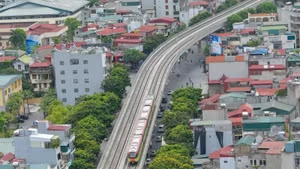
To speed up the supply of social housing, Ha Noi is working to remove bottlenecks in planning, site clearance and administrative procedures.
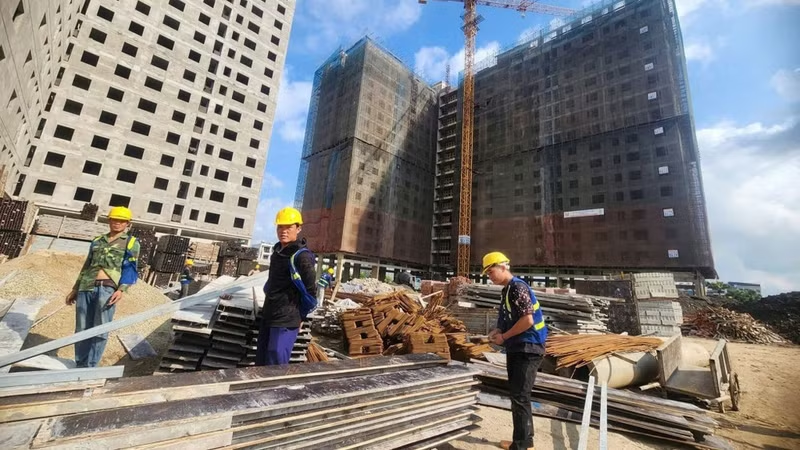
To meet the central government’s target of 18,700 completed apartments in 2026, the city has instructed relevant agencies to apply a “green lane” mechanism that cuts processing times for all social housing procedures by at least 50%. Projects with cleared sites are being prioritised so that construction can begin sooner.
A city directive on promoting social housing empowers commune authorities to appraise and approve detailed plans for social housing projects. These plans may be approved in advance and incorporated into urban zoning plans afterwards.
The city has also called for site clearance to be speeded up as soon as a project receives in-principle investment approval. Land recovery, allocation and changes of land-use purpose must be completed within 30 days of site clearance being completed within the project area.
Thanks to this approach, Ha Noi has so far granted in-principle investment approval for 131 social housing projects, with a combined total of about 114,200 apartments. In the first six months of 2026, construction began on 30 projects with about 24,000 apartments.
Notably, Ha Noi is developing social housing complexes with full social infrastructure, including schools, parks, sports facilities, commercial and service amenities, and convenient transport links.
Hai Phong was assigned a target of completing 6,700 social housing apartments in 2026 and has set itself a higher target of more than 7,000. In the first six months of the year, it completed 1,383 apartments, nearly 400 apartments ahead of schedule.
To achieve the target, the city has instructed relevant agencies to review each project and task, complete investment, land and construction procedures without delay for projects that already have investors, and apply “green lane” and “priority lane” mechanisms to resolve obstacles promptly.
According to Nguyen Thuong Hai, Sales Director of Van Phu Real Estate Development Joint Stock Company, the investor of a social housing project in Thuy Nguyen Ward, the city’s efforts to review procedures, provide guidance and remove administrative obstacles have helped businesses move faster on social housing projects. This has enabled investors to mobilise resources earlier and keep projects on schedule.
Social housing and rental housing projects in the port city are being built in convenient locations, with essential amenities, green spaces and quality close to that of commercial housing.
Le Dinh An, a worker at an industrial park in Hai Phong and one of the first residents to receive a social housing apartment in the Trang Due area, said that although he was still making monthly instalment payments on his home, he was delighted that his dream of a stable home had come true.
Housing for workers in industrial parks
Like other localities, Bac Ninh is working to increase the supply of social housing and accommodation for workers in industrial parks and clusters.
As of September 2026, Bac Ninh had 132 projects with a total of about 144,200 apartments, made up of 122 social housing projects and 10 workers’ accommodation projects.
Of these, 33 projects, with around 25,900 apartments, had been completed, while 99 projects, with about 118,300 apartments, were under construction. In addition, investment approval had been granted for 18 urban development projects with around 32,000 apartments.
Under the central government’s targets, Bac Ninh has been tasked with building 119,073 social housing apartments in 2026-2030, including 19,900 in 2026. To ensure progress, the city has set the number of apartments each investor must complete and regularly reviews individual projects to identify delays and determine which agencies are responsible.
Nguyen Quoc An, Deputy Director of the Bac Ninh Department of Construction, said: “As industrial development advances, housing, transport and services for workers must be prepared accordingly.”
The city is planning and preparing suitable land in line with population distribution, employment patterns and the locations of industrial parks.
It is building housing complexes alongside integrated transport networks, schools, healthcare facilities, commercial services, cultural and sports facilities, green spaces and public spaces.
Housing options are also being broadened to include homes for sale, rental housing and workers’ accommodation.
Bac Ninh aims to complete about 135,000 social housing apartments by 2030, while also expanding rental housing and workers’ accommodation.
Many social housing projects are under way or have been completed in Bac Ninh. Once in use, they not only improve living conditions but also give workers’ morale a significant boost.
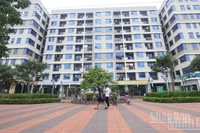
Than Quang Thanh, a worker in Bac Ninh, said his family of four had previously lived in a rented room of just 15 square metres. In 2024, they bought an apartment of more than 54 square metres in a social housing complex for workers in Nenh Ward.
Thanh said the new home has given his children better living conditions and allowed him to work with peace of mind and stay with his employer. The complex also has a playground, exercise facilities and convenience stores meeting residents’ daily needs.
These developments show that localities are delivering social housing projects more effectively, with integrated infrastructure, affordable prices and convenient access to workplaces.
When land is prepared early, administrative procedures are streamlined and construction progress is closely monitored, social housing not only helps workers settle into stable lives but can also grow into attractive neighbourhoods that change the urban landscape of localities in the years ahead.